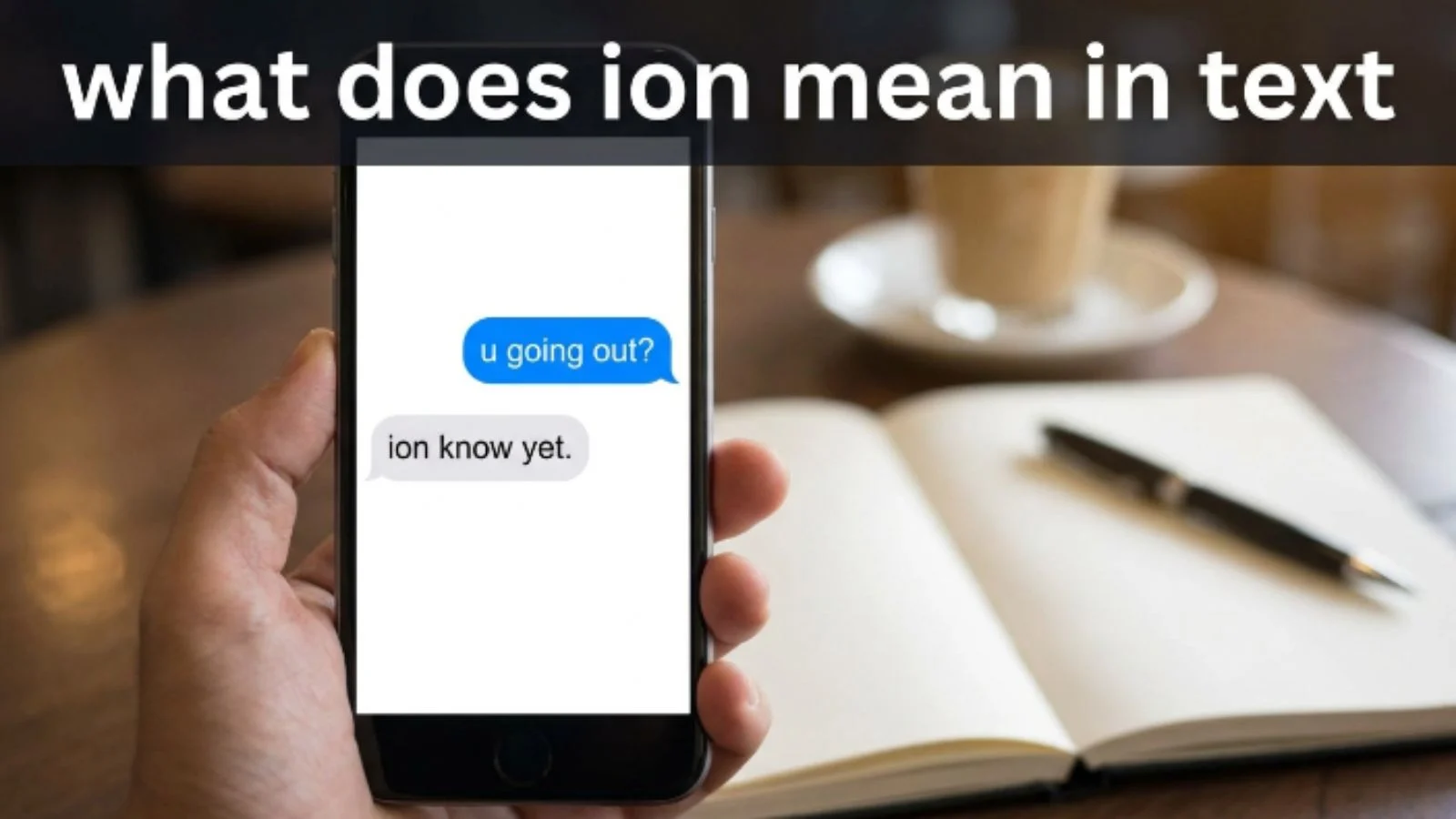
Have you ever received a message that says something like:
“ion know”
or
“ion wanna go”
and wondered what ION actually means?
You’re not alone. This popular texting slang has become common on social media, in text messages, and online conversations. At first glance, it might look confusing because many people know “ion” as a science term. However, in texting, it has a completely different meaning.
In this guide, you’ll learn exactly what does ion mean in text, how people use it, where it came from, and when you should use it yourself.
What Does ION Mean in Text?
Quick Definition
ION means “I don’t” in text messages and internet slang.
It is a shortened way of writing phrases such as:
- I don’t know
- I don’t want to
- I don’t care
- I don’t think so
For example:
Text: “Ion know what happened.”
Meaning: “I don’t know what happened.”
This slang is commonly used in casual online conversations and is not typically used in formal writing.
Simple Meaning of ION
In the simplest words, ION is a faster way of typing “I don’t.”
People often remove spaces and apostrophes when texting quickly. Over time, “I don’t” began to look and sound like ion when written in casual online conversations.
Think of it like this:
| Standard English | Text Slang |
|---|---|
| I don’t know | Ion know |
| I don’t care | Ion care |
| I don’t want to | Ion wanna |
| I don’t think so | Ion think so |
The meaning stays exactly the same.
Where Is ION Used?
You’ll usually see ION on social media and messaging apps where people communicate informally.
Common places include:
- Text messages
- Snapchat
- TikTok comments
- Instagram messages
- X (Twitter)
- Facebook Messenger
- Discord
- Online gaming chats
- Group chats
Because it’s casual slang, it’s most common among younger internet users and people who regularly communicate online.
Why Do People Use ION?
There are several reasons why ION became popular.
1. It’s Faster to Type
Typing:
“Ion know”
takes less effort than:
“I don’t know.”
Many texting abbreviations exist for this reason.
2. It Sounds Natural
In some spoken dialects and casual speech patterns, “I don’t” can sound similar to “ion.”
People often type words the way they sound when speaking casually.
3. It Fits Internet Culture
Online communication values speed, simplicity, and personality.
Using slang like ION helps messages feel:
- Relaxed
- Friendly
- Conversational
- Informal
4. It Creates a Casual Tone
Compare these examples:
Formal:
“I don’t believe that’s correct.”
Casual:
“Ion think that’s right.”
The second version feels more relaxed and conversational.
Examples of ION in Text Messages
Here are some real-world examples to help you understand how it’s used.
Example 1
Message:
“Ion know where he went.”
Meaning:
“I don’t know where he went.”
Example 2
Message:
“Ion wanna go today.”
Meaning:
“I don’t want to go today.”
Example 3
Message:
“Ion care what they say.”
Meaning:
“I don’t care what they say.”
Example 4
Message:
“Ion think that’s a good idea.”
Meaning:
“I don’t think that’s a good idea.”
Example 5
Message:
“Ion got time for that.”
Meaning:
“I don’t have time for that.”
Different Ways People Use ION
Although the basic meaning is “I don’t,” you’ll often see it combined with other common internet slang.
ION Know
Meaning: I don’t know
Example:
“Ion know what happened last night.”
ION Care
Meaning: I don’t care
Example:
“Ion care about the drama.”
ION Want To
Meaning: I don’t want to
Example:
“Ion wanna wake up early tomorrow.”
ION Think
Meaning: I don’t think
Example:
“Ion think that’s true.”
ION Have
Meaning: I don’t have
Example:
“Ion have any cash right now.”
ION vs Similar Text Slang
Many slang terms express similar ideas. Here’s how ION compares.
| Slang | Meaning | Example |
|---|---|---|
| ION | I don’t | Ion know |
| IDC | I don’t care | IDC what happens |
| IDK | I don’t know | IDK the answer |
| IMO | In my opinion | IMO it’s better |
| NVM | Never mind | NVM, I figured it out |
| FR | For real | That’s crazy FR |
The key difference is that ION replaces the phrase “I don’t,” while most other abbreviations represent entire expressions.
Can ION Mean Something Else?
Yes, but context matters.
Outside texting slang, ion is also a scientific term.
In science, an ion is:
An atom or molecule that carries an electrical charge.
For example:
- Positive ions
- Negative ions
However, if you’re chatting with friends online, the meaning is almost always “I don’t.”
Example
Science Class:
“An ion carries an electric charge.”
Text Message:
“Ion know what you’re talking about.”
Two completely different meanings.
When Should You Use ION?
ION works best in informal conversations.
Good situations include:
- Texting friends
- Casual group chats
- Social media comments
- Online gaming
- Personal messages
Example:
“Ion think we’re gonna win this game.”
This sounds natural in a casual setting.
When Should You Avoid Using ION?
Avoid it in professional or formal communication.
Examples include:
- Work emails
- School assignments
- Business reports
- Job applications
- Academic writing
Instead of:
“Ion know the answer.”
Use:
“I don’t know the answer.”
Formal writing should always use proper grammar and punctuation.
Common Misunderstandings About ION
Many people misunderstand this slang when they first see it.
Misunderstanding #1: It Means the Science Word
Not necessarily.
In texting, ION usually means “I don’t.”
The surrounding words will reveal the intended meaning.
Misunderstanding #2: It’s an Acronym
Unlike abbreviations such as IDK or LOL, ION is generally not considered a traditional acronym.
It’s more of a shortened spelling of how “I don’t” sounds in casual speech.
Misunderstanding #3: It’s Always Correct to Use
ION is acceptable in informal texting.
It is not appropriate for professional communication.
Misunderstanding #4: Everyone Understands It
Many people do, but not everyone.
Older users or people unfamiliar with internet slang may not recognize it immediately.
Consider your audience before using it.
Pro Tips for Using ION Correctly
Here are some practical tips.
Use It Only Casually
Keep it for friends, family, and social media conversations.
Know Your Audience
If the person might not understand internet slang, use the full phrase instead.
Don’t Overuse It
Too much slang can make messages harder to read.
Mix slang with normal writing naturally.
Avoid It in Professional Settings
Employers, teachers, and clients usually expect proper grammar.
Use Context Carefully
Make sure the sentence clearly shows that ION means “I don’t.”
For example:
“Ion know what happened.”
is immediately understandable.
Why Has ION Become So Popular?
Several trends helped ION spread online:
- Faster texting habits
- Social media culture
- Viral memes
- Casual online communication
- Influence from spoken language patterns
As more users adopted it, the slang became part of everyday internet language.
Today, millions of people recognize ION instantly in texts and social posts.
Final Thoughts
If you’ve been wondering what does ION mean in text, the answer is simple:
ION means “I don’t.”
People use it as a casual shorthand in text messages, social media posts, and online chats. It’s a quick, informal way to express phrases like “I don’t know,” “I don’t care,” or “I don’t want to.”
Just remember that it works best in friendly conversations and should generally be avoided in formal writing or professional settings.
Once you know the meaning, you’ll start spotting ION everywhere online.
Frequently Asked Questions
What does ION mean in texting?
In texting, ION means “I don’t.” It is commonly used in casual conversations and social media messages.
What does “Ion know” mean?
“Ion know” simply means “I don’t know.”
Is ION an acronym?
Not usually. Most people use it as a shortened spelling of “I don’t” rather than a traditional acronym.
Can I use ION in professional emails?
No. It’s best to avoid ION in professional, academic, or business communication. Use “I don’t” instead.
Is ION the same as IDK?
No.
- ION = I don’t
- IDK = I don’t know
ION can be used in many different phrases, while IDK specifically means “I don’t know.”
Discover More Post
