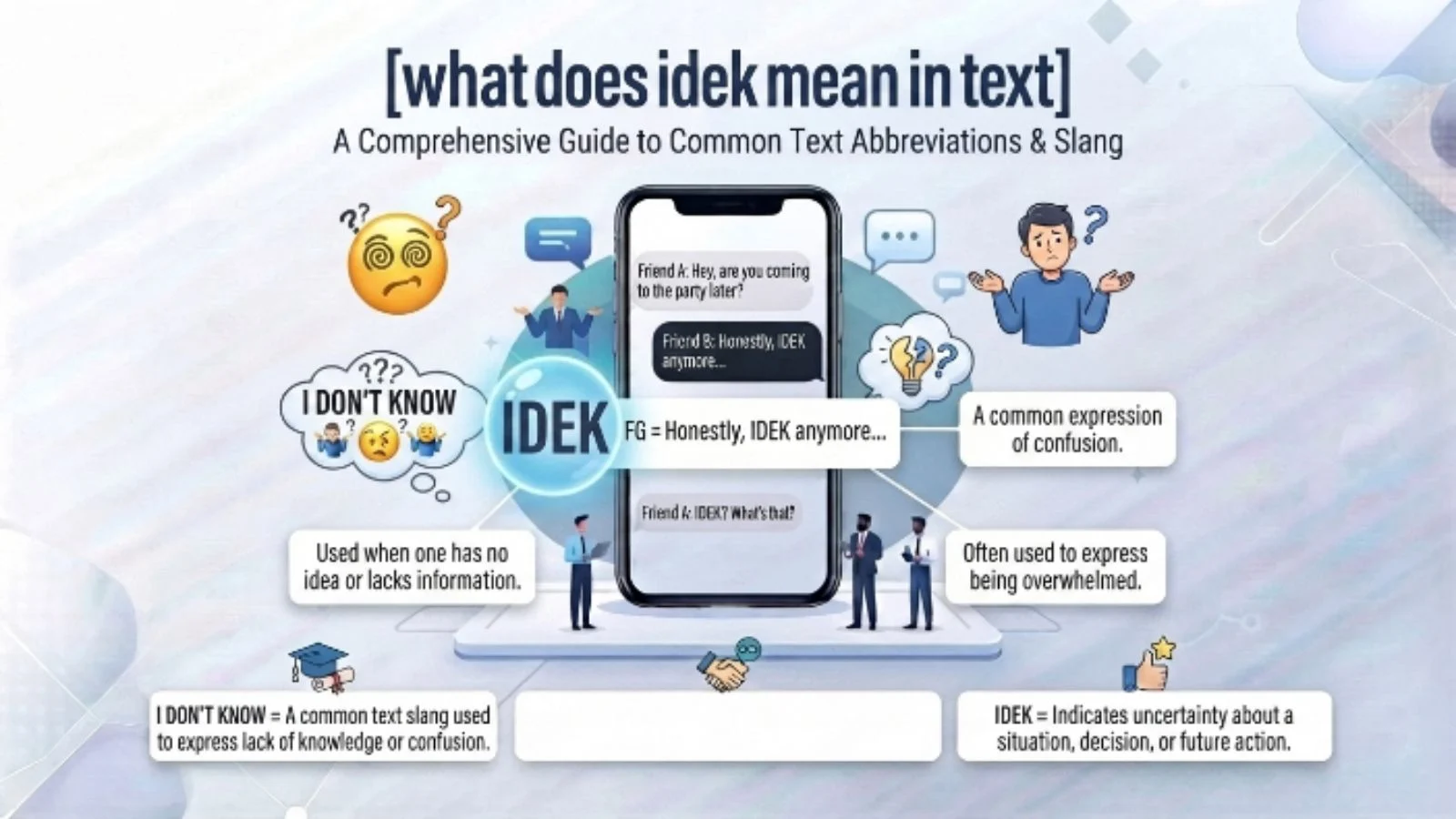
Have you ever received a message that simply says “IDEK” and wondered what it meant? You’re not alone.
Texting slang changes quickly, and new abbreviations appear on social media almost every day. Whether you’re chatting with friends, scrolling through TikTok comments, or reading posts on Instagram or Snapchat, you’ve probably seen IDEK more than once.
The good news is that IDEK is easy to understand once you know what it stands for. In this guide, you’ll learn exactly what IDEK means in text, when people use it, how to reply to it, and how it compares with similar internet slang.
What Does IDEK Mean in Text?
IDEK stands for “I Don’t Even Know.”
It is a popular internet abbreviation people use when they:
- Don’t know the answer
- Feel confused
- Are surprised
- Are frustrated
- Cannot explain something
Quick Definition
IDEK means “I Don’t Even Know.” It expresses confusion, uncertainty, disbelief, or the feeling that someone has no explanation for a situation.
It is commonly used in:
- Text messages
- Snapchat
- TikTok
- Facebook Messenger
- Discord
- X (formerly Twitter)
Simple Meaning of IDEK
In simple words, IDEK means:
“I honestly have no idea.”
or
“I can’t even explain it.”
Unlike simply saying “I don’t know,” IDEK often adds more emotion.
It can show that someone is:
- Completely confused
- Tired of explaining
- Shocked
- Frustrated
- Speechless
That extra word “even” makes the sentence feel stronger.
For example:
Friend: Why is everyone talking about that video?
You: IDEK.
This means:
“I honestly don’t know.”
Where Is IDEK Used?
You’ll mostly see IDEK in casual online conversations.
Text Messages
Friends often use it when they don’t know something.
Example:
Emma: What time is the movie?
Jake: IDEK.
Jake simply doesn’t know.
Snapchat
People use IDEK in chats or story replies.
Example:
“IDEK why I stayed awake until 3 AM.”
This means they don’t even know why they did it.
You might see captions like:
“IDEK what I was thinking.”
This usually means someone is laughing at their own decision.
TikTok
TikTok comments are full of abbreviations.
Example:
“IDEK how this ended up on my For You Page.”
This expresses surprise.
Gaming Chats
Gamers often type IDEK during matches.
Example:
“IDEK what just happened.”
They are confused about the game.
Group Chats
Friends use it constantly.
Example:
“IDEK who’s bringing snacks.”
Meaning:
“No one has told me.”
Why Do People Use IDEK?
There are many reasons people prefer IDEK instead of typing the full sentence.
It Saves Time
Typing four letters is much faster than writing:
“I don’t even know.”
It Sounds Natural
Young people often speak the same way they text.
Instead of saying:
“I don’t even know.”
They simply type:
“IDEK.”
It Shows More Emotion
Compare these two replies:
“I don’t know.”
“I don’t even know.”
The second one sounds much more emotional.
It can show:
- Surprise
- Confusion
- Exhaustion
- Frustration
It Fits Fast Conversations
Social media moves quickly.
People use short abbreviations to reply faster.
Real-Life Examples of IDEK
Here are some common examples you’ll see every day.
Example 1
Alex: Why is Sarah upset?
Mia: IDEK.
Explanation
Mia genuinely doesn’t know why Sarah is upset.
Example 2
Dad: Why is your room so messy?
Teen: IDEK.
Explanation
The teen has no explanation.
Example 3
“IDEK how I passed that exam.”
Explanation
The person is surprised by their own success.
Example 4
“IDEK why I’m laughing.”
Explanation
They cannot explain why something is funny.
Example 5
“IDEK what happened last night.”
Explanation
The speaker feels confused or cannot remember clearly.
Example 6
“IDEK where my phone is.”
Explanation
The person has no idea where the phone went.
Example 7
“IDEK why this keeps happening.”
Explanation
This usually expresses frustration.
Example 8
“IDEK what to wear.”
Explanation
The person cannot decide.
Different Feelings Behind IDEK
Depending on the conversation, IDEK can express different emotions.
Confusion
“IDEK what this assignment means.”
Surprise
“IDEK how that happened.”
Frustration
“IDEK why my Wi-Fi keeps disconnecting.”
Disbelief
“IDEK how he won.”
Being Speechless
“IDEK what to say.”
IDEK vs Similar Text Slang
| Slang | Meaning | When It’s Used |
|---|---|---|
| IDEK | I Don’t Even Know | Strong confusion or disbelief |
| IDK | I Don’t Know | Simple lack of knowledge |
| IDC | I Don’t Care | Shows little interest |
| IMO | In My Opinion | Sharing an opinion |
| TBH | To Be Honest | Giving an honest statement |
| SMH | Shaking My Head | Disappointment or disbelief |
| FR | For Real | Agreeing or emphasizing truth |
IDEK vs IDK
Many people confuse these two abbreviations.
Here’s the difference.
IDK
Means:
“I don’t know.”
It is neutral.
Example:
Where’s Mike?
IDK.
IDEK
Means:
“I don’t even know.”
It is stronger and more emotional.
Example:
Why is everyone screaming?
IDEK.
This sounds more dramatic.
When Should You Use IDEK?
Use IDEK when talking casually with:
- Friends
- Classmates
- Family
- Gaming friends
- Online communities
- Social media followers
It works well in:
- Text messages
- Social media comments
- Casual chats
- Memes
- Group conversations
When Should You Avoid IDEK?
Avoid using IDEK in professional settings.
For example:
- Job applications
- Business emails
- School essays
- Reports
- Formal presentations
- Official documents
Instead, write:
- “I’m not sure.”
- “I don’t know.”
- “I don’t have that information.”
- “I’m unable to confirm.”
These sound much more professional.
Common Misunderstandings About IDEK
It Doesn’t Mean Someone Is Unintelligent
People use IDEK because they’re being honest.
It simply means they don’t know something.
It Isn’t Always Negative
Sometimes IDEK is funny.
Example:
“IDEK why that cat video made me laugh so much.”
It Isn’t Rude
By itself, IDEK is not rude.
However, if someone keeps replying with only “IDEK,” it may seem like they aren’t interested in the conversation.
It Doesn’t Always Mean Ignorance
Sometimes people know the answer but use IDEK for dramatic effect.
Example:
“IDEK how she always looks so stylish.”
They aren’t literally asking a question.
They’re expressing amazement.
Common Replies to IDEK
If someone sends you “IDEK,” you could reply:
- “Let’s figure it out.”
- “That’s okay.”
- “Same here.”
- “We’ll find out.”
- “I’ll check.”
- “No worries.”
- “Maybe someone else knows.”
Your response depends on the conversation.
Is IDEK Popular?
Yes.
IDEK has become one of the most common texting abbreviations among teenagers and young adults.
You’ll frequently see it on:
- Instagram comments
- TikTok videos
- Snapchat chats
- Discord servers
- WhatsApp messages
- Facebook Messenger
- Online forums
Even adults now use it because it’s short, expressive, and easy to type.
Pro Tips for Using IDEK
Keep these tips in mind before using IDEK.
- Use it only in casual conversations.
- Remember that it means “I Don’t Even Know.”
- Use it when you’re confused, surprised, or frustrated.
- Avoid using it in professional communication.
- Don’t overuse abbreviations if you’re talking to someone unfamiliar with internet slang.
- If you’re unsure whether the other person understands texting slang, write the full sentence instead.
Final Thoughts
If you’ve ever wondered, “What does IDEK mean in text?”, the answer is simple: IDEK stands for “I Don’t Even Know.” It is a casual internet abbreviation used to express confusion, uncertainty, surprise, or frustration.
Because it’s short and expressive, IDEK has become a regular part of conversations across texting apps and social media platforms. Understanding its meaning helps you follow online discussions more easily and communicate in a natural way with friends and family.
Like many texting abbreviations, the key is knowing when to use it. IDEK is perfect for informal chats but should be avoided in professional or formal communication. Once you understand the context, you’ll recognize it instantly whenever it appears in a message.
Frequently Asked Questions
What does IDEK stand for in text?
IDEK stands for “I Don’t Even Know.” It is used when someone is confused, uncertain, surprised, or has no explanation for something.
Is IDEK the same as IDK?
No. IDK simply means “I Don’t Know,” while IDEK means “I Don’t Even Know,” adding stronger emotion or emphasis.
Is IDEK rude?
No. IDEK is generally considered a casual and harmless abbreviation. However, repeatedly replying with only “IDEK” may seem dismissive depending on the conversation.
Can I use IDEK in work emails?
No. IDEK is informal internet slang. In professional communication, it’s better to use phrases such as “I’m not sure,” “I don’t know,” or “I’ll look into it.”
Discover More Post
