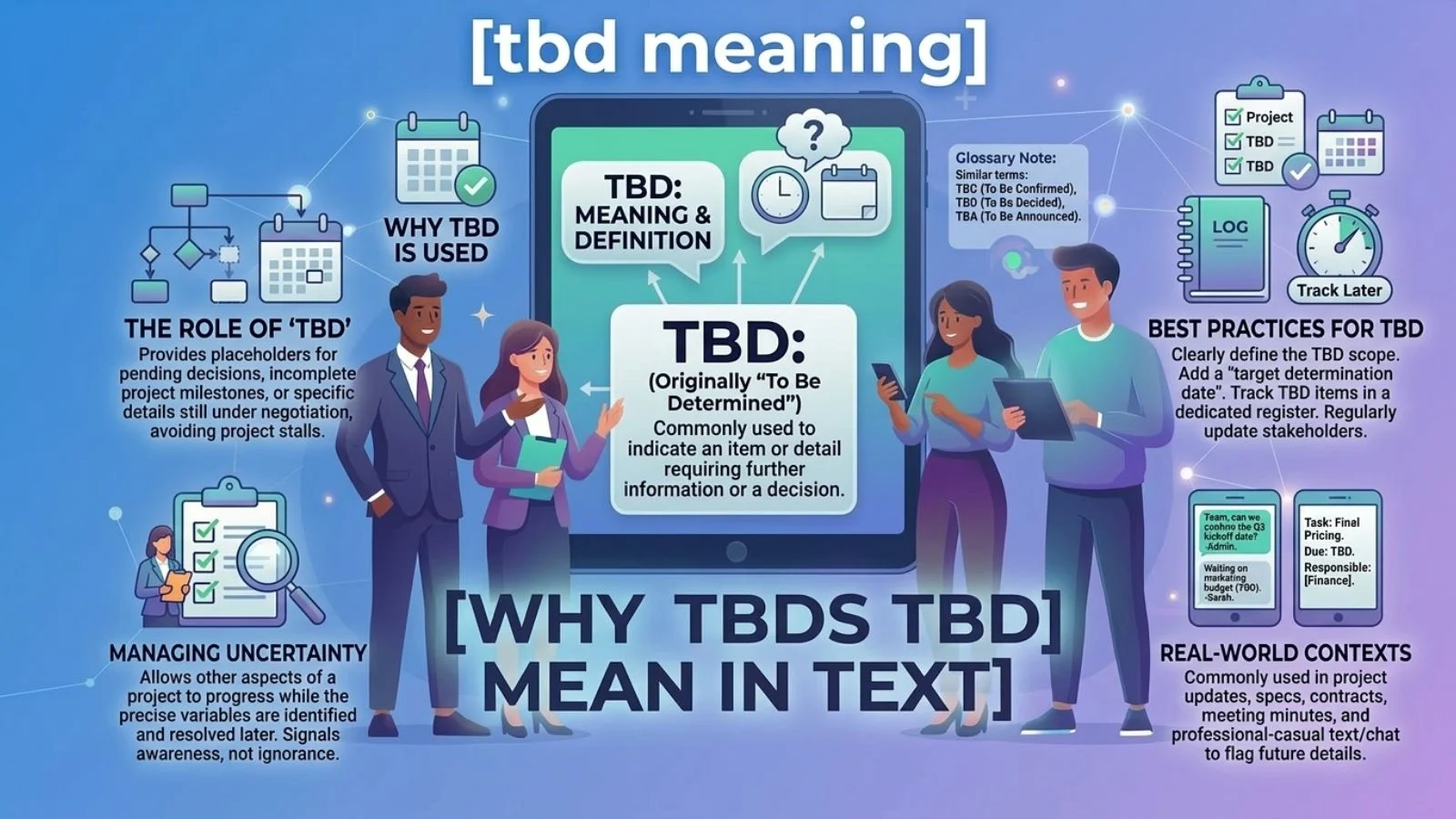
Have you ever received a message that says “The date is TBD” or “We’ll decide that TBD” and wondered what TBD actually means? You are not alone. This short abbreviation appears often in texts, social media posts, emails, work chats, and online conversations.
TBD usually means “To Be Determined.” It is used when something has not been decided yet and a final answer will be given later.
Depending on the situation, TBD can also be understood as “To Be Decided.” Both expressions communicate a similar idea: the information is not final yet.
What Does TBD Mean?
TBD means “To Be Determined.” In simple words, it means something has not been decided, confirmed, or finalized yet.
For example:
“Meeting time: TBD”
This means the meeting time has not been decided yet.
Another example is:
“Location: TBD”
This tells you that the location will be announced or confirmed later.
TBD is especially common when people know that information is still missing but expect to have the answer in the future.
Simple Meaning of TBD
The easiest way to understand TBD is:
TBD = To Be Determined = We will decide or confirm it later.
It does not usually mean that something has been canceled. It simply means the details are still being worked out.
For example, imagine your friend asks:
“Where are we going for dinner?”
You might reply:
“Restaurant is TBD.”
You are saying that you have not chosen the restaurant yet.
Similarly, someone might say:
“The event date is TBD.”
This means the exact date has not been finalized.
What Does TBD Mean in a Text Message?
In texting, TBD is often used as a quick way to say that a decision has not been made yet.
People may use it when discussing:
- Plans
- Dates
- Meeting times
- Locations
- Events
- Travel arrangements
- Work projects
- School activities
- Prices
- Deadlines
- Future decisions
For example:
“Are you coming to the party?”
“Yes, but my arrival time is TBD.”
Here, the person has not decided or confirmed exactly when they will arrive.
Because TBD is short and easy to understand, it can save time when people are chatting.
Where Is TBD Used?
TBD is not limited to texting. You can see it in many different types of communication.
1. Text Messages
Friends may use TBD when making plans.
“Movie night is Saturday. Time is TBD.”
The date is known, but the exact time has not been decided.
2. Social Media
You may see TBD in posts about upcoming events.
“New collection coming soon. Release date: TBD.”
This means the creator has not confirmed the release date.
3. Work Chats
TBD is very common in professional communication.
“Project launch date: TBD.”
The team has not finalized the launch date.
4. Emails
People may use TBD when discussing information that is still being arranged.
“The venue is TBD, but we will update everyone once it is confirmed.”
5. Event Announcements
Event organizers often use TBD when some details are not ready.
“Guest speaker: TBD.”
This means the speaker has not been confirmed yet.
6. School or College Communication
Students and teachers may use TBD for schedules, assignments, or activities.
“Exam room: TBD.”
The room has not been announced yet.
Why Do People Use TBD?
There are several reasons people use TBD instead of writing a full sentence.
It Is Short
TBD communicates a complete idea using only three letters.
Instead of writing:
“The exact date has not been decided yet.”
Someone can simply write:
“Date: TBD.”
It Shows That Information Is Pending
TBD clearly tells readers that something is not final.
This can prevent people from assuming that an unconfirmed detail is official.
It Is Convenient
In schedules, spreadsheets, calendars, event pages, and work documents, there may not be enough space for a long explanation.
TBD fits easily into these formats.
It Keeps Plans Flexible
Sometimes people know an event or project is happening but have not worked out every detail.
Using TBD lets everyone know that the information may change.
TBD Examples in Texting
Here are some realistic examples of how people might use TBD in everyday conversations.
Example 1: Making Plans
Person A: “What time are we meeting tomorrow?”
Person B: “Probably in the afternoon. Exact time is TBD.”
Meaning: The exact meeting time has not been decided.
Example 2: Going Out
Person A: “Where are we eating tonight?”
Person B: “TBD. Let’s decide after work.”
Meaning: The restaurant has not been chosen yet.
Example 3: Travel
Person A: “Have you booked the hotel?”
Person B: “Not yet. Hotel is TBD.”
Meaning: The hotel has not been selected or confirmed.
Example 4: Work
Manager: “The project deadline is TBD.”
Meaning: The final deadline has not been established.
Example 5: Event
“Wedding venue: TBD”
Meaning: The venue has not been finalized.
Example 6: Social Media
“Big announcement coming soon. Date TBD.”
Meaning: The announcement date has not been confirmed.
TBD vs TBA
TBD and TBA can look similar, but they are not exactly the same.
| Term | Meaning | Common Use |
|---|---|---|
| TBD | To Be Determined | Something has not been decided yet |
| TBA | To Be Announced | Something has been decided or is expected to be announced later |
| TBC | To Be Confirmed | Something is planned but still needs confirmation |
For example:
Date: TBD means the date has not been decided.
Date: TBA usually means the date may already be known internally but has not been announced publicly.
Date: TBC means a date may have been selected, but it still needs confirmation.
These abbreviations can overlap in casual communication, so the exact meaning can depend on context.
TBD vs TBC
TBD means a decision still needs to be made.
TBC means something needs to be confirmed.
Consider these examples:
“Dinner location: TBD.”
The restaurant has not been chosen.
“Dinner location: TBC.”
A restaurant may have been suggested or arranged, but it still needs confirmation.
The distinction can be small, especially in casual texting.
TBD vs TBA
This is another common source of confusion.
If someone writes:
“Concert date: TBD”
the date has not been determined yet.
If they write:
“Concert date: TBA”
they are telling you that the date will be announced later.
In everyday conversations, however, people sometimes use these terms loosely.
When Should You Use TBD?
You can use TBD when something is genuinely undecided.
It works well when:
- A date has not been finalized.
- A location has not been selected.
- A time has not been decided.
- A price is still being worked out.
- A person has not been assigned to a role.
- A project deadline is still under discussion.
- Event details are incomplete.
For example:
“Meeting room: TBD.”
“Final price: TBD.”
“Travel dates: TBD.”
“Guest list: TBD.”
These are all natural uses of the abbreviation.
When Should You Avoid TBD?
Although TBD is useful, it is not always the best choice.
If you are speaking with someone who may not understand abbreviations, it is better to write the full phrase.
For example, instead of:
“The date is TBD.”
you could write:
“We haven’t decided on the date yet.”
This is especially useful in formal documents, public announcements, or communication with a new audience.
You should also avoid using TBD when the information is already known.
If a meeting is definitely scheduled for Friday, writing “Friday: TBD” would be confusing.
Common Misunderstandings About TBD
1. TBD Does Not Usually Mean Cancelled
One common misunderstanding is thinking that TBD means an event or plan may not happen.
Usually, that is not what it means.
If someone writes:
“Event date: TBD”
they are saying the date is undecided, not necessarily that the event is canceled.
2. TBD Does Not Always Mean “Unknown”
There is a small difference between something being unknown and something being undecided.
For example, a person might know that a meeting will happen but have no idea which day works best.
That detail is TBD because it still needs to be determined.
3. TBD Is Not Always the Same as TBA
Although people sometimes use the terms interchangeably, TBD focuses on something being undecided, while TBA generally focuses on information that has not yet been announced.
4. Context Matters
The meaning of an abbreviation can change depending on the conversation.
If you see TBD in a message and the meaning is unclear, look at the words around it. In most everyday planning contexts, however, TBD means “To Be Determined.”
Pro Tips for Using TBD
If you want to use TBD correctly, keep these simple tips in mind.
Use it for unfinished decisions.
TBD works best when a detail still needs to be determined.
Use it when the audience understands abbreviations.
In casual chats and familiar work environments, TBD is usually easy to understand.
Give more information when necessary.
Instead of only writing “TBD,” you can explain when an update is expected.
For example:
“Meeting time: TBD. I’ll confirm it tomorrow.”
This is much clearer than simply saying:
“TBD.”
Do not treat TBD as a final answer.
It means the information is still subject to change.
How to Reply When Someone Says TBD
If someone sends you a message containing TBD, your response depends on what you need to know.
For example:
Them: “The meeting time is TBD.”
You could reply:
“Okay, just let me know once it’s confirmed.”
Or:
“No problem. Please update me when you know the time.”
If you need a decision soon, you can ask:
“Do you have an idea of when the time will be finalized?”
This keeps the conversation clear and polite.
Is TBD Formal or Informal?
TBD can be both formal and informal.
You may see it in:
- Text messages
- Social media
- Emails
- Business documents
- Project schedules
- Event pages
- Calendars
- School announcements
However, the full phrase “To Be Determined” may be better when communicating with people who are unfamiliar with abbreviations.
In a professional setting, context is important. If your audience regularly uses terms such as TBD, TBA, and TBC, the abbreviation is usually perfectly understandable.
Does TBD Have Other Meanings?
In most texting and planning situations, TBD means “To Be Determined.”
However, abbreviations can have different meanings in specialized industries, organizations, games, or communities.
That is why context matters.
If you see TBD in an unusual situation and it does not seem to fit the conversation, check the surrounding information before assuming what it means.
For everyday texting, scheduling, and online communication, “To Be Determined” is the standard meaning.
Frequently Asked Questions
What does TBD stand for in texting?
TBD usually stands for “To Be Determined.” It means that something has not been decided or finalized yet and will be confirmed later.
What does TBD mean in a message?
In a message, TBD tells you that a particular detail is still undecided. For example, “Time TBD” means the exact time has not been decided.
Is TBD the same as TBA?
Not exactly. TBD means “To Be Determined,” while TBA means “To Be Announced.” TBD generally indicates that a decision has not been made, while TBA often means information will be announced later.
What is the difference between TBD and TBC?
TBD means something still needs to be determined, while TBC means something needs to be confirmed. The terms can sometimes overlap in casual communication.
Final Thoughts
If you see TBD in a text, email, schedule, or social media post, it usually means “To Be Determined.” In simple terms, the information is not final yet and will be decided or confirmed later.
Whether someone is talking about a meeting time, event date, travel plans, a location, or a project deadline, TBD is a quick way to show that the details are still being worked out.
Once you understand this abbreviation, messages such as “Date TBD” or “Location TBD” become much easier to understand.
Discover More post
