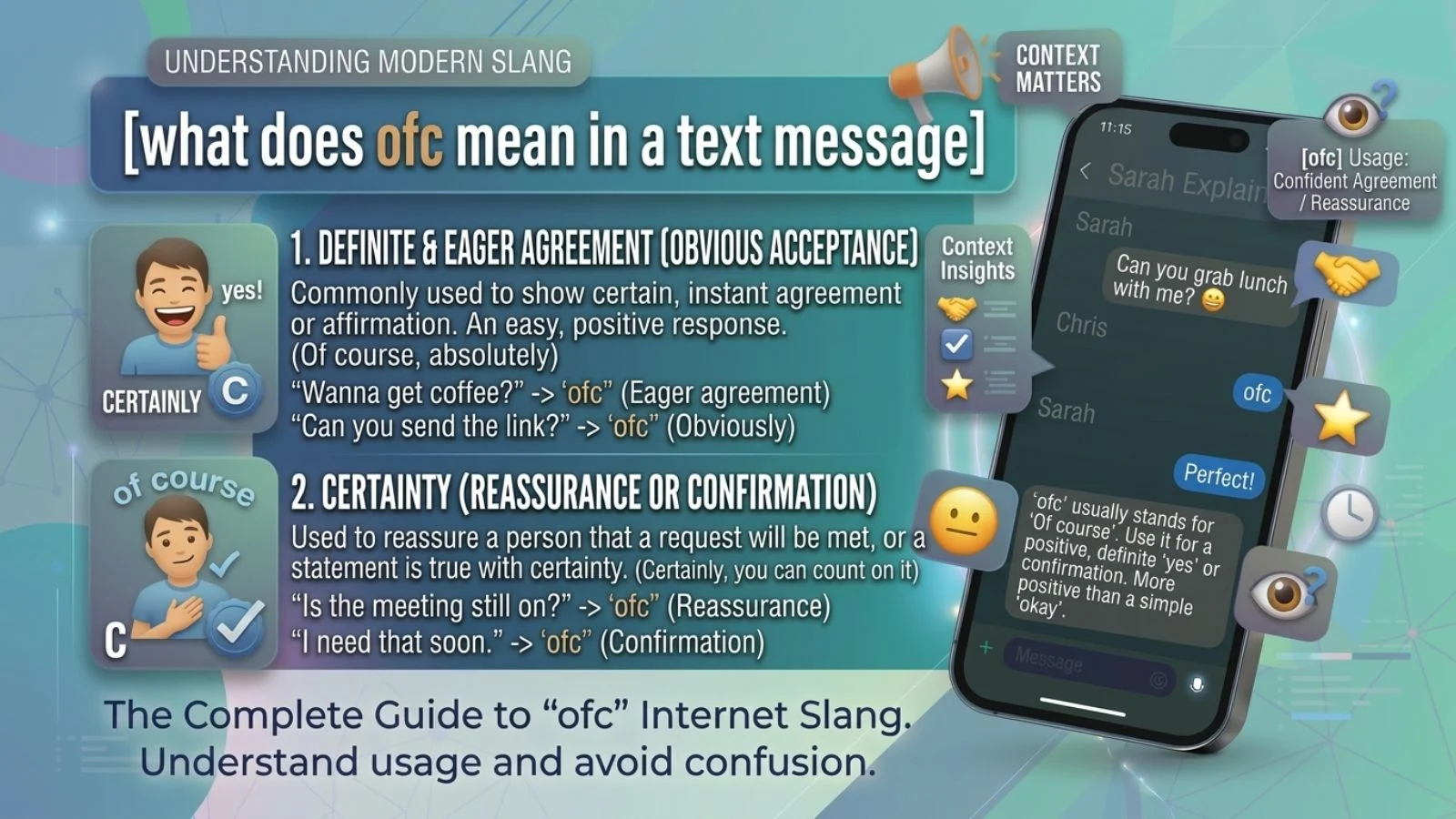
If someone texts you “ofc”, they are usually saying “of course.” It is a short and casual way to agree, confirm something, or show that an answer is obvious. You may see ofc in texts, social media comments, DMs, gaming chats, and everyday online conversations.
But depending on the situation, ofc can sound friendly, excited, sarcastic, or even slightly annoyed. The meaning is simple, but the tone depends on the conversation around it.
What Does OFC Mean in a Text Message?
OFC means “of course” in a text message.
It is an abbreviation people use to type faster when chatting online. Instead of writing the full phrase “of course,” they simply write “ofc.”
For example:
“Can you help me with this?”
“Ofc!”
Here, ofc means “Of course!” or “Sure, I can help.”
It is one of those internet abbreviations that has become common in casual digital communication.
Simple Meaning of OFC
In simple English, ofc = of course.
The phrase “of course” can have several meanings depending on the context. It can mean:
- Yes
- Sure
- Definitely
- Obviously
- Certainly
- No problem
For example:
“Are you coming tonight?”
“Ofc.”
This means:
“Of course, I’m coming.”
Another example:
“Can I call you later?”
“Ofc.”
This means:
“Sure, you can call me later.”
So when you see ofc, don’t overthink it. In most casual conversations, it is simply a quick way of saying “of course.”
What Does OFC Mean in Texting and Social Media?
On social media and messaging apps, ofc is commonly used as a quick response.
You might see it on:
- TikTok
- Snapchat
- Facebook Messenger
- Discord
- X
- iMessage
- Online gaming chats
Because people often want to respond quickly, abbreviations such as ofc, idk, tbh, btw, and rn are popular in casual digital conversations.
For example:
“You watched the new episode?”
“Ofc.”
Or:
“Can I join you guys?”
“Ofc!”
The first example sounds like a simple confirmation. The second sounds more welcoming and enthusiastic.
Why Do People Use OFC?
There are several reasons people use ofc instead of typing “of course.”
1. It Saves Time
The biggest reason is convenience.
Typing “ofc” takes only three letters, while “of course” takes nine characters including the space.
When you’re having a fast conversation, shorter words are easier.
2. It Makes Conversations Casual
OFC usually feels informal and relaxed.
Compare these:
“Of course, I can help you.”
and
“Ofc, I can help.”
The first sounds more complete and formal. The second feels more like a quick text between friends.
3. It Shows Agreement
People often use ofc when they strongly agree with something.
For example:
“Do you want pizza?”
“Ofc.”
The person is basically saying “Absolutely.”
4. It Can Show Something Is Obvious
Sometimes ofc means that the answer should already be obvious.
For example:
“Are you going to support your best friend?”
“Ofc.”
Here, the person may be saying:
“Obviously. Why wouldn’t I?”
The tone can depend heavily on the conversation.
Real-Life Examples of OFC in Text Messages
Understanding examples is one of the easiest ways to understand internet slang.
Example 1: Asking for Help
Person A: Can you help me with my homework?
Person B: Ofc.
Here, ofc means “Of course, I can help.”
It is a friendly and simple response.
Example 2: Making Plans
Person A: Are you coming to the party tonight?
Person B: Ofc!
The person is confirming that they are coming.
The exclamation mark makes the response sound more excited.
Example 3: Asking for Permission
Person A: Can I borrow your charger?
Person B: Ofc.
Here, ofc means “Sure, you can.”
There is no negative meaning.
Example 4: Showing Support
Person A: Will you support me during the competition?
Person B: Ofc. I got you.
Here, ofc means “Of course I will.”
The second sentence adds a supportive and friendly tone.
Example 5: Something Obvious
Person A: You like chocolate, right?
Person B: Ofc.
In this situation, ofc can mean:
“Obviously! You already know I love chocolate.”
Example 6: Casual Online Conversation
Person A: Did you see my message?
Person B: Ofc lol.
Here, ofc means “Of course I saw it.”
The word lol makes the response feel even more casual.
What Does “OFC” Mean From a Girl?
If a girl sends you “ofc,” it normally still means “of course.”
There is no special female meaning for the abbreviation.
The actual meaning depends on the conversation.
For example:
“Can I talk to you later?”
“Ofc.”
This is simply a friendly confirmation.
However, if the conversation is emotional or romantic, the same word can feel warmer depending on the rest of the message.
For example:
“Will you always be there for me?”
“Ofc.”
Here, ofc can communicate reassurance and support.
Do not assume that ofc automatically means someone is flirting. Look at the full conversation instead.
What Does “OFC” Mean From a Guy?
If a guy texts “ofc,” it generally means exactly the same thing: “of course.”
For example:
“Are you still coming?”
“Ofc.”
He is simply confirming that he is coming.
Likewise:
“Can you send me the notes?”
“Ofc.”
This means:
“Sure, I’ll send them.”
The abbreviation itself does not tell you whether someone is interested romantically. The surrounding conversation gives you more information about their tone.
OFC vs Similar Texting Terms
Several abbreviations can have meanings that are close to ofc, but they are not always interchangeable.
| Text Slang | Meaning | Common Use |
|---|---|---|
| OFC | Of course | Agreement or confirmation |
| Sure | Yes / okay | Accepting a request |
| Yup | Yes | Casual confirmation |
| Definitely | Certainly | Strong agreement |
| Obvi | Obviously | Something seen as obvious |
| FR | For real | Agreement or emphasis |
| Absolutely | Certainly / yes | Strong positive response |
For example, ofc is more directly connected to the phrase “of course,” while fr usually means “for real.”
OFC vs Sure
“Sure” can mean yes, but it may sometimes sound less enthusiastic.
“Can you help me?”
“Sure.”
Compared with:
“Can you help me?”
“Ofc!”
The second response may feel warmer or more confident.
OFC vs Definitely
Definitely is stronger and more formal than ofc.
“Are you coming?”
“Definitely.”
This sounds clear and confident.
“Are you coming?”
“Ofc.”
This sounds more casual.
OFC vs Obvi
Obvi is short for “obviously.”
For example:
“You like music, right?”
“Obvi.”
This can sound playful or teasing.
OFC, on the other hand, means “of course.”
When Should You Use OFC?
You can use ofc when you’re having a casual conversation and want to say “of course.”
It works well when:
- Talking with friends
- Messaging family members
- Chatting with classmates
- Replying to social media messages
- Talking in gaming communities
- Sending casual DMs
- Answering simple questions
- Confirming plans
For example:
“Can you send me the address?”
“Ofc.”
Or:
“Are you free tomorrow?”
“Ofc, what’s up?”
These are natural uses of the abbreviation.
When Should You Avoid OFC?
Although ofc is common online, it is not appropriate for every situation.
Avoid using it in formal communication unless the situation is clearly casual.
For example, you probably should not write:
“Ofc, I will attend the meeting.”
in a formal business email.
A better version would be:
“Of course, I will attend the meeting.”
You should also avoid texting ofc in formal school or professional documents unless casual language is specifically expected.
The basic rule is simple:
Use OFC with people and platforms where casual texting is appropriate.
Can OFC Sound Rude?
Usually, ofc is not rude.
However, the tone can change depending on the conversation.
Consider this:
“Do you even know how to do this?”
“Ofc.”
That response could sound defensive or annoyed.
Now compare:
“Can you help me with this?”
“Ofc!”
That sounds friendly and helpful.
The difference is not really the abbreviation itself. It is the context, punctuation, previous messages, and relationship between the people.
What Does “Ofc!” Mean?
Adding an exclamation mark can make ofc sound more enthusiastic.
“Ofc!”
usually feels warmer than:
“ofc”
For example:
“Can you come with me?”
“Ofc!”
This can sound excited and friendly.
Meanwhile:
“Can you come with me?”
“ofc.”
may feel more neutral.
Of course, people have different texting styles, so punctuation should not be treated as a strict rule.
What Does “Ofc Lol” Mean?
“Ofc lol” usually means “Of course, haha” or “Obviously, haha.”
The word lol makes the conversation feel more playful.
Example:
“You knew I was going to ask that, right?”
“Ofc lol.”
The person is likely joking or responding in a relaxed way.
What Does “OFC” Mean in Gaming?
In gaming chats, ofc has the same basic meaning: “of course.”
Gamers often use short abbreviations because messages need to be quick.
For example:
“You joining the next match?”
“Ofc.”
Or:
“Can I use your extra gear?”
“Ofc.”
It is simply a fast way to respond without typing the full phrase.
Common Misunderstandings About OFC
1. OFC Does Not Have One Special Hidden Meaning
The standard texting meaning of ofc is “of course.”
You do not need to assume it has a secret meaning just because someone uses it in a short message.
2. OFC Does Not Automatically Mean Flirting
Someone saying “ofc” does not necessarily mean they like you romantically.
For example:
“Can you send me the homework?”
“Ofc.”
That’s simply a helpful response.
Look at the broader conversation before trying to interpret romantic intentions.
3. OFC Is Not Always Enthusiastic
Sometimes ofc is enthusiastic:
“Ofc! I would love to!”
Sometimes it is neutral:
“Ofc.”
And sometimes it can sound slightly sarcastic depending on the context:
“Did you actually read the instructions?”
“Ofc.”
The surrounding messages matter.
4. Capital Letters Do Not Usually Change the Meaning
OFC, ofc, and Ofc generally mean the same thing.
People choose different capitalization styles based on their personal texting habits.
Pro Tips for Understanding OFC
If you receive a message containing ofc, use these tips to understand the tone correctly.
Look at the Full Sentence
Do not interpret the abbreviation by itself.
Read the messages before and after it.
Pay Attention to Punctuation
An “Ofc!” may feel more energetic than a simple “ofc.”
But punctuation alone does not prove someone’s emotions.
Consider Your Relationship
A close friend may use ofc very casually.
A new acquaintance may use it simply as a quick confirmation.
Do Not Overanalyze It
If someone says:
“Ofc I can help.”
they probably just mean:
“Of course I can help.”
Sometimes a simple message really is that simple.
How to Reply to OFC
Your response depends on the conversation.
If someone says:
“Ofc!”
you can respond naturally with:
- “Thanks!”
- “Awesome.”
- “Perfect.”
- “Appreciate it.”
- “Great, see you then.”
- “Haha, thanks.”
- “You’re the best.”
For example:
You: Can you send me the photo?
Friend: Ofc!
You: Thanks!
There is no special response required.
Is OFC Proper English?
OFC is not standard formal English.
It is an internet abbreviation used in informal communication.
The full phrase, “of course,” is standard English.
So you can think of it this way:
Formal: “Of course, I would be happy to help.”
Casual: “Ofc, I can help.”
Both communicate a similar idea, but the first is more appropriate for formal situations.
Frequently Asked Questions
What does OFC mean in texting?
OFC means “of course” in texting. It is a casual abbreviation used to agree, confirm something, or show that an answer seems obvious.
What does OFC mean from a girl?
If a girl texts “ofc,” it normally means “of course.” It does not automatically indicate flirting or romantic interest. The meaning depends on the conversation and context.
What does OFC mean from a guy?
From a guy, ofc generally means “of course.” It can be used to say yes, definitely, sure, or obviously in a casual conversation.
Is OFC rude?
No, OFC is usually not rude. However, depending on the context, punctuation, and previous messages, it can sometimes sound sarcastic, annoyed, or overly obvious.
Final Thoughts
So, what does ofc mean in a text message? It simply means “of course.” People use it as a quick, casual way to agree, confirm something, or show that an answer is obvious.
You will commonly see ofc in texts, social media, DMs, gaming chats, and other informal conversations.
The most important thing is to understand the context. “Ofc!” can sound excited and friendly, while “ofc.” may feel more neutral. The abbreviation itself is simple; the surrounding conversation gives it its tone.
Discover More Post
