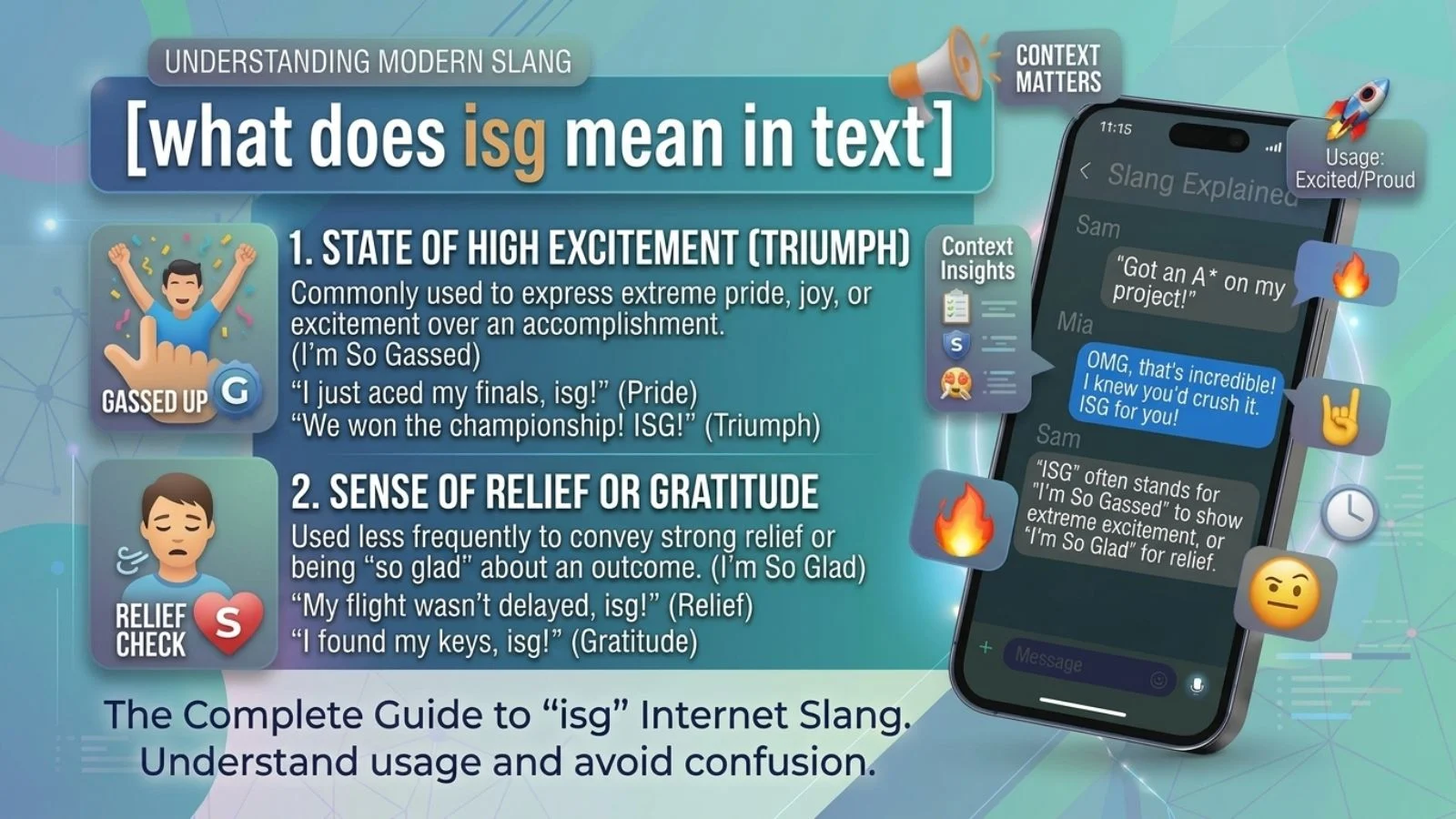
Have you received a message containing “ISG” and wondered what those three letters actually mean? In casual texting, ISG most commonly means “I Swear to God.” People use it to emphasize that they are being honest, serious, frustrated, surprised, or very emotional.
However, there is an important detail: ISG is less standardized than ISTG, the more widely recognized abbreviation for “I Swear to God.” Context matters when deciding what the sender means. Grammar Ora
What Does ISG Mean in Text?
ISG usually means “I Swear to God” in casual texting and online conversations.
It is used to add extra emphasis to a statement. In simple words, the sender is saying something like:
- “I’m serious.”
- “I promise.”
- “Believe me.”
- “I’m telling the truth.”
- “I really mean this.”
For example:
“ISG, I didn’t take your charger.”
Here, the person is strongly insisting that they are telling the truth.
You may see ISG in text messages, group chats, DMs, comments, and other casual online conversations. Daily Trekly
Simple Meaning of ISG
The easiest way to understand ISG is to think of it as an emotional emphasis phrase.
When someone writes:
“ISG this movie was amazing.”
They are not necessarily making a literal religious statement. They are emphasizing how strongly they feel about the movie.
Similarly:
“ISG I didn’t know about the party.”
This means:
“I swear to God, I genuinely didn’t know about the party.”
The exact emotion can change depending on the conversation.
ISG can express honesty, frustration, excitement, disbelief, annoyance, or strong agreement.
Why Do People Use ISG?
People use short slang terms because texting is fast and informal. Instead of typing the entire phrase “I swear to God,” someone may shorten it to ISG.
Common reasons include:
1. To Show Honesty
Someone may use ISG when they want you to believe them.
“ISG, I never told anyone your secret.”
The sender is strongly emphasizing that they are telling the truth.
2. To Add Emotion
ISG can make an ordinary statement sound much stronger.
“ISG that was the funniest video ever.”
The person is emphasizing just how funny they found the video.
3. To Show Frustration
It can also appear when someone is annoyed.
“ISG, I’ve explained this three times already.”
Here, ISG adds frustration and seriousness.
4. To Emphasize Surprise
People sometimes use it after something unexpected happens.
“ISG, he actually showed up!”
The abbreviation makes the reaction feel more dramatic.
Where Is ISG Used?
You can encounter ISG in many forms of casual digital communication.
Text Messages
Friends may use ISG when talking about everyday events.
“ISG I thought today was Friday.”
The person is emphasizing their surprise or mistake.
Group Chats
ISG can make reactions in group conversations more expressive.
“ISG you guys missed everything.”
The sender is stressing that something important or interesting happened.
Instagram and TikTok
You may see ISG in comments, captions, or direct messages when someone wants to emphasize a reaction.
“ISG this is literally me.”
Here, the person strongly relates to the content.
Snapchat
Casual Snapchat conversations can also contain abbreviations such as ISG, especially between friends.
Gaming and Online Communities
Players sometimes use short slang expressions when reacting quickly during conversations.
“ISG that was the worst match.”
The phrase adds emotional emphasis to the comment.
Real-Life Examples of ISG in Text
Understanding examples is one of the easiest ways to learn slang.
Example 1: Defending Yourself
Friend: Did you eat my last slice of pizza?
You: ISG, I didn’t touch it.
Meaning: You are strongly saying that you are telling the truth.
Example 2: Showing Excitement
“ISG, that concert was incredible.”
Meaning: The person is emphasizing how much they enjoyed the concert.
Example 3: Showing Frustration
“ISG, this homework is driving me crazy.”
Meaning: The sender is extremely frustrated with the homework.
Example 4: Reacting to Something Unexpected
“ISG, she actually said yes.”
Meaning: The person is surprised and wants to emphasize what happened.
Example 5: Emphasizing an Opinion
“ISG, this is the best burger I’ve ever had.”
Meaning: The person feels very strongly about the burger.
Example 6: Proving a Point
“ISG, I saw him at the store yesterday.”
Meaning: The sender is emphasizing that they are certain about what they saw.
ISG vs ISTG
One of the biggest sources of confusion is the difference between ISG and ISTG.
Both can be used to express the idea of “I Swear to God,” but ISTG is the more established and widely recognized texting abbreviation.
| Slang | Meaning | Typical Use |
|---|---|---|
| ISG | I Swear to God | Emphasis or strong emotion |
| ISTG | I Swear to God | Strong emphasis, frustration, honesty |
| STG | Swear to God | Informal promise or emphasis |
| ONG | On God | Strong agreement or assurance |
| FR | For Real | Agreement or sincerity |
For example:
“ISTG I’m not lying.”
and
“ISG I’m not lying.”
can communicate essentially the same idea in casual conversation.
However, if you are trying to use the more commonly recognized internet abbreviation, ISTG is generally the safer choice.
ISG vs ONG
ISG and ONG can sometimes feel similar because both can emphasize sincerity.
ISG means “I Swear to God.”
ONG means “On God.”
Compare:
“ISG, I didn’t do it.”
This strongly emphasizes that the person is telling the truth.
“ONG, that’s the best song.”
This strongly emphasizes the person’s opinion or agreement.
The two expressions can overlap in casual conversation, but they are not exactly the same phrase.
ISG vs FR
FR means “For Real.”
It is usually simpler and more casual than ISG.
For example:
“That test was so hard.”
“FR.”
Here, the second person is simply agreeing.
Compare that with:
“ISG that test was impossible.”
The second sentence carries stronger emotional emphasis.
Can ISG Have Other Meanings?
Yes. This is where context becomes important.
Although “I Swear to God” is a common interpretation in English-language casual texting, ISG does not have one universal meaning everywhere.
For example, isg is documented in Dutch internet slang as an abbreviation of “is goed,” meaning roughly “okay,” “sure,” or “all right.” Wiktionary
There are also non-slang meanings of ISG used in specific professional or technical contexts.
So don’t automatically assume that every occurrence of ISG means “I Swear to God.”
Look at the surrounding words.
Compare These Two Situations
“ISG I didn’t do that.”
This strongly suggests the slang meaning “I Swear to God.”
But if you see:
“isg”
as a standalone response in a Dutch-language conversation, the intended meaning may be completely different.
Context is the key.
When Should You Use ISG?
ISG is best suited to casual conversations.
You might use it when talking with:
- Close friends
- Siblings
- People you regularly message
- Online friends
- Casual social-media contacts
- Group-chat members
For example:
“ISG, you have to watch this show.”
That sounds natural in a casual conversation.
When You Should Avoid ISG
Avoid ISG in formal or professional communication.
For example, don’t normally write:
“ISG I completed the project.”
in a professional email.
Instead, say:
“I can confirm that I completed the project.”
or:
“I assure you that the project is complete.”
Slang can make a professional message seem too casual.
Is ISG Rude?
ISG is not automatically rude, but the phrase behind it can be sensitive for some people because it contains a reference to God.
In casual online conversations, people may use it simply as an emotional expression rather than as a literal religious oath. Still, different people have different comfort levels with this type of language.
If you know someone prefers respectful or religiously sensitive language, it may be better to use alternatives such as:
- “Honestly”
- “I promise”
- “Seriously”
- “For real”
- “I really mean it”
This lets you emphasize your point without using the phrase “I Swear to God.”
Common Misunderstandings About ISG
1. ISG Always Means “I Swear to God”
Not necessarily.
That is a common interpretation in casual English texting, but abbreviations can have different meanings in different communities and languages.
Always consider the context.
2. ISG and ISTG Are Completely Different
Not usually.
When both are being used as slang for “I Swear to God,” they communicate essentially the same basic idea.
The major difference is that ISTG is more established as the abbreviation for the phrase, while ISG can be more ambiguous. Grammar Ora
3. ISG Is Always Serious
Not necessarily.
Someone may use it seriously:
“ISG, I didn’t know.”
But they can also use it dramatically or humorously:
“ISG this cat thinks he owns the house.”
The surrounding conversation tells you whether the person is genuinely serious or simply being dramatic.
4. ISG Is Only Used by Teenagers
No.
Internet slang is especially common among younger users, but people of different ages can use or understand abbreviations through texting and social media.
How to Reply When Someone Says ISG
Your response depends on what the person is saying.
If they are reassuring you:
Them: “ISG, I didn’t tell anyone.”
You could reply:
“Okay, I believe you.”
If they are expressing excitement:
Them: “ISG that movie was amazing.”
You could say:
“Seriously? I need to watch it.”
If they are complaining:
Them: “ISG this homework is endless.”
You could reply:
“I know. I’m still working on mine.”
You don’t have to use slang just because the other person does.
Pro Tips for Understanding ISG
Here are a few simple tips that can help you understand the abbreviation correctly.
Look at What Comes After ISG
If you see:
“ISG I didn’t do it.”
the phrase is probably being used to emphasize honesty.
Check the Language
If the conversation is in another language, ISG may have a different meaning.
Consider the Relationship
A friend may use ISG playfully, while someone you barely know may use it more seriously.
Pay Attention to Punctuation
Compare:
“isg that’s crazy”
with:
“ISG! That’s crazy!”
The second version may feel more intense because capitalization and punctuation can increase the emotional tone.
Don’t Assume Every Abbreviation Is Universal
Online slang changes quickly. A term that is common in one group may be unfamiliar to another.
When in doubt, simply ask:
“What do you mean by ISG?”
That is often better than guessing incorrectly.
Is ISG Capitalized?
You can see ISG written in several ways:
- ISG
- isg
- Isg
In casual texting, lowercase is common because people often type quickly.
Capital letters can make the expression look stronger:
“ISG, I’m serious.”
Lowercase can feel more relaxed:
“isg i’m serious.”
The capitalization usually does not change the basic meaning.
Is ISG Appropriate for Formal Writing?
Generally, no.
ISG is informal internet slang. It works naturally in casual messages, but it is not a good choice for:
- Business emails
- School assignments
- Job applications
- Formal reports
- Professional documents
- Official communication
For formal writing, use clearer expressions such as “I assure you,” “I promise,” “honestly,” or “I can confirm.”
Frequently Asked Questions
What does ISG mean in text?
ISG most commonly means “I Swear to God” in casual texting. It is used to emphasize honesty, seriousness, frustration, surprise, or a strong emotional reaction.
Is ISG the same as ISTG?
They can mean the same thing when both are being used for “I Swear to God.” However, ISTG is the more established texting abbreviation, while ISG can be more ambiguous.
Is ISG rude?
ISG is not automatically rude, but some people may consider “I Swear to God” inappropriate or uncomfortable because of its religious wording. Use it carefully depending on your audience.
Can ISG mean something else?
Yes. Meaning depends on context. For example, Dutch internet slang uses isg as an abbreviation of “is goed,” meaning “okay,” “sure,” or “all right.” Wiktionary
Final Thoughts
So, what does ISG mean in text? In most casual English conversations, it can mean “I Swear to God.” People use it to make a statement feel more serious, honest, emotional, or convincing.
However, remember that ISG is less standardized than ISTG, and it can have other meanings depending on the language or community. The best way to understand it is to look at the words around it and consider the context.
If a friend writes “ISG, I’m telling the truth,” they are most likely saying, “I swear to God, I’m telling the truth.”
Discover More Post
