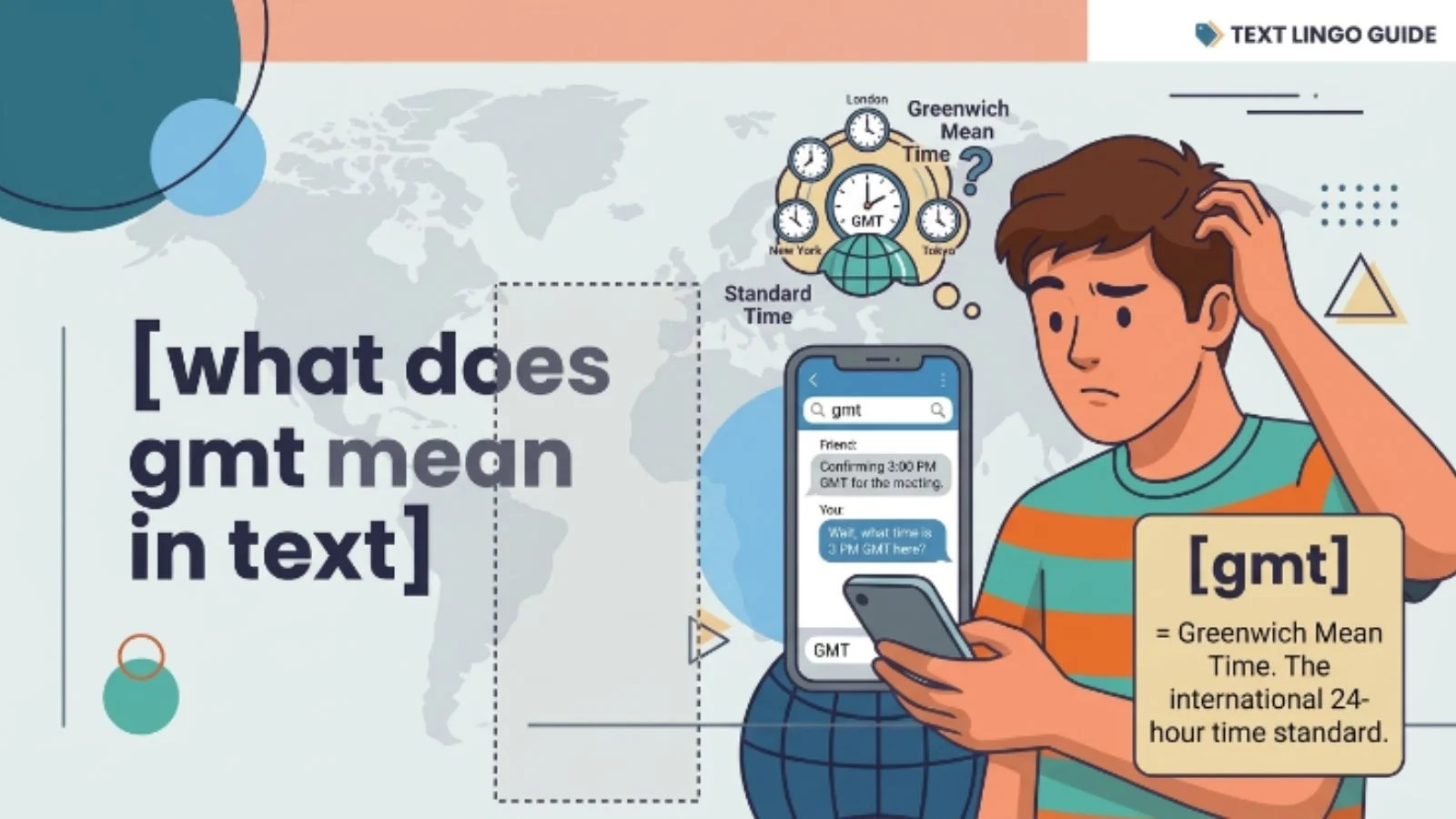
Have you ever received a message that says, “I’ll be online at 8 GMT,” and wondered what the person actually meant? If you have seen GMT in a text, chat, social media post, or online event notice, the meaning can seem confusing at first.
The good news is that GMT usually refers to Greenwich Mean Time, a time standard used to describe a specific time zone. People often use it when talking about meeting times, international events, online games, work schedules, flights, or live streams.
But there is a little more to know. Depending on the conversation, GMT can also appear alongside other time-zone abbreviations, which can make things confusing.
So, what does GMT mean in text? Let’s break it down in simple words.
What Does GMT Mean in Text?
GMT means “Greenwich Mean Time.” In texts and online conversations, people usually use it to tell you the time according to the time standard historically based on the Prime Meridian at Greenwich, London.
For example:
“The meeting starts at 5 GMT.”
This means the meeting starts at 5:00 according to GMT. You may need to convert that time to your own local time zone.
GMT is especially common when people from different countries need to agree on one time.
For example, someone in the United Kingdom might say:
“The game starts at 7 GMT.”
A person in another country can then convert 7 GMT into their local time.
Quick Definition
GMT in text means “Greenwich Mean Time,” a time standard used to communicate a specific time without relying on a person’s local clock.
Simple Meaning of GMT
In very simple terms, GMT is a reference time.
Imagine that you are talking to someone who lives in another country. If you simply say, “Let’s talk at 8,” they may not know whether you mean 8 AM in your country or 8 AM in theirs.
Adding GMT makes the message clearer:
“Let’s talk at 8 GMT.”
Now both people have a common time reference.
This is why GMT often appears in international chats, online communities, gaming groups, business messages, and event announcements.
It helps people avoid confusion when they live in different time zones.
What Does GMT Stand For?
GMT stands for:
Greenwich Mean Time
The name comes from Greenwich, an area of London associated with the Prime Meridian, traditionally defined as 0 degrees longitude.
The word “mean” refers to the historical calculation of average solar time.
Today, GMT is still widely recognized and used in everyday communication, although modern timekeeping also uses more precise standards and systems such as UTC.
For casual texting, however, you will most often see GMT used simply as a time-zone reference.
Where Is GMT Used in Text?
You may see GMT in many different types of online conversations.
1. International Chats
People living in different countries may use GMT to agree on a time.
For example:
“Can you call me at 3 GMT?”
This tells the other person which time reference to use.
2. Online Meetings
International teams sometimes mention GMT when scheduling meetings.
“Our weekly meeting is at 10 GMT.”
This can be easier than listing several different local times.
3. Gaming
Online gaming communities often use GMT when announcing tournaments, updates, or events.
“The tournament begins at 18 GMT.”
Players from different countries can convert the time to their own locations.
4. Live Streams and Online Events
You may see GMT in announcements for livestreams, webinars, launches, or online conferences.
For example:
“The livestream starts at 20:00 GMT.”
The audience can then determine when that event starts locally.
5. Work and Business Messages
Companies with international employees may use GMT to coordinate schedules.
“Please send the report by 12 GMT.”
This gives everyone the same reference point.
6. Travel and Flight Information
GMT may also appear when discussing international travel, although airports and airlines often use other standardized time information as well.
You might see someone say:
“My flight leaves at 9 GMT.”
The person may be using GMT to explain the departure time to an international audience.
Why Do People Use GMT in Text?
The main reason is clarity.
When people live in different time zones, saying only “8 PM” can create confusion.
Consider this message:
“The event starts at 8 PM.”
Which country’s 8 PM?
Now compare it with:
“The event starts at 8 PM GMT.”
The second message gives readers a clear reference.
People use GMT because it can make international communication easier.
Common reasons include:
- Scheduling international meetings
- Planning online events
- Coordinating gaming sessions
- Discussing livestream times
- Sharing work deadlines
- Organizing global communities
- Avoiding time-zone confusion
Real-Life Examples of GMT in Text
Understanding GMT becomes easier when you see how people actually use it.
Example 1: Meeting
Person A: “Are you free at 6 GMT?”
Person B: “Yes, that works for me.”
Here, GMT tells both people which time reference Person A is using.
Example 2: Online Game
Friend: “The tournament starts at 19 GMT. Don’t be late.”
The person is telling everyone the official starting time according to GMT.
Example 3: Livestream
Post: “Our new video goes live at 16 GMT.”
People in different countries can convert 16 GMT to their own local time.
Example 4: Work Schedule
Manager: “The meeting is scheduled for 14 GMT.”
An international team can use that time to determine when they should join.
Example 5: International Friend
Friend: “I usually get online around 21 GMT.”
They are giving you a time reference that can be converted to your own local time.
GMT vs UTC: What Is the Difference?
One of the biggest sources of confusion is the difference between GMT and UTC.
They are closely related, but they are not exactly the same concept.
| Term | Meaning | Common Use |
|---|---|---|
| GMT | Greenwich Mean Time | Everyday time-zone reference |
| UTC | Coordinated Universal Time | Modern international time standard |
| BST | British Summer Time | UK summer time |
| EST | Eastern Standard Time | U.S. and Canadian time-zone reference |
| CET | Central European Time | European time-zone reference |
For casual conversations, people may use GMT and UTC almost interchangeably because they generally show the same clock time when UTC is at +00:00.
However, technically, UTC is the modern international time standard, while GMT has a historical basis connected to mean solar time at Greenwich.
If you are simply trying to understand a text message, you usually do not need to worry about the technical distinction.
GMT vs Local Time
GMT and your local time may not be the same.
For example, if someone sends:
“Let’s meet at 12 GMT.”
You should not automatically assume they mean 12 PM on your clock.
You need to know your local time-zone offset.
This is particularly important when arranging:
- International calls
- Online interviews
- Virtual classes
- Gaming events
- Webinars
- Deadlines
- Live broadcasts
A small time-zone mistake can make you arrive hours early or late.
Is GMT Used on Social Media?
Yes. GMT can appear on social media, especially when people share information with an international audience.
For example:
“New episode drops at 17 GMT.”
Or:
“Join us tonight at 20 GMT.”
You may also see GMT in posts about online events, cryptocurrency discussions, gaming tournaments, sports broadcasts, livestreams, and international communities.
However, GMT is not usually internet slang in the same way as abbreviations such as “LOL,” “BRB,” or “IDK.”
It is primarily a time abbreviation.
Is GMT a Slang Word?
No, GMT is generally not slang.
When someone types GMT in a message, they are usually referring to Greenwich Mean Time.
For example:
“What time is the event in GMT?”
This is a question about time, not slang.
That said, abbreviations can have different meanings in different communities. If GMT appears in a conversation where time is not being discussed, you should look at the surrounding context before deciding what it means.
Common Misunderstandings About GMT
GMT is simple once you understand the basic idea, but there are a few common mistakes.
1. Thinking GMT Means Your Local Time
GMT is not automatically your local time.
If someone says 10 GMT, you may need to convert it to your own time zone.
2. Assuming GMT and Every Time Zone Are the Same
They are not.
Countries and regions can be several hours ahead of or behind GMT.
3. Confusing GMT With a Slang Abbreviation
GMT is usually a time-related abbreviation.
It is not normally used as casual slang like “OMG” or “TBH.”
4. Forgetting Seasonal Time Changes
Some locations change their clocks during part of the year because of daylight saving time.
This means you should check the relevant local time-zone rules when scheduling an important event.
5. Assuming GMT Always Means the Same Thing as UTC Technically
For everyday purposes, GMT and UTC+00:00 often display the same clock time.
Technically, though, they come from different timekeeping concepts.
When Should You Use GMT?
You can use GMT when you need to communicate a time to people who may live in different parts of the world.
For example, GMT can be useful when saying:
“The webinar begins at 15 GMT.”
Or:
“Message me at 18 GMT if you’re available.”
It is especially helpful when your audience is international.
GMT Is Useful For:
- International work teams
- Online communities
- Gaming groups
- Virtual meetings
- Online classes
- Global events
- Livestreams
- International scheduling
If everyone in the conversation lives in the same area, using GMT may not be necessary. A normal local time can be simpler.
How to Reply When Someone Uses GMT
If someone sends you a message containing GMT and you are unsure about the time, you can simply ask:
“What time is that for me?”
Or:
“Can you tell me the time in my time zone?”
You can also ask:
“Do you mean 8 GMT?”
This is better than guessing, especially when the event is important.
Pro Tips for Understanding GMT in Messages
Here are a few practical tips to avoid confusion.
Check the Number
Look carefully at the time mentioned before GMT.
For example:
“11 GMT”
means 11:00 according to GMT.
Check AM or PM When Provided
Some people use the 24-hour clock instead.
For example:
“18 GMT”
means 18:00, or 6:00 PM.
Check Your Own Time Zone
If you are in another country, convert the GMT time to your local time.
Ask When You Are Unsure
There is nothing wrong with asking someone to confirm the time.
A simple question can prevent a major scheduling mistake.
Be Careful With Important Events
For interviews, meetings, deadlines, flights, or live events, always double-check the conversion rather than relying on memory.
What Does GMT Mean in Text Messages?
In a text message, GMT usually means Greenwich Mean Time.
It is used to communicate a specific time using a common international reference.
For example:
“I’ll call you at 9 GMT.”
The sender is saying that they will call at 9:00 according to GMT, not necessarily at 9:00 according to your local clock.
This makes GMT especially useful when people from different countries are chatting.
What Does 5 GMT Mean?
5 GMT means 5:00 according to Greenwich Mean Time.
If someone sends:
“The meeting starts at 5 GMT.”
you should convert 5 GMT to your local time before deciding when to join.
The exact local time will depend on your location and whether your region observes seasonal clock changes.
What Does 12 GMT Mean?
12 GMT means 12:00 noon according to GMT.
For an international audience, this can be a useful way to announce an event without assuming everyone lives in the same time zone.
For example:
“The live class starts at 12 GMT.”
Anyone attending can convert that time to their local clock.
Final Thoughts
So, what does GMT mean in text?
GMT usually means Greenwich Mean Time. It is mainly used as a time reference when people need to communicate or schedule something across different time zones.
You may see it in messages about meetings, gaming, livestreams, work, online events, travel, and international conversations.
The most important thing to remember is simple: GMT is a reference time, not automatically your local time.
When someone gives you a GMT time, check your local time zone before making plans. If you are unsure, ask the sender to confirm the time in your location.
Once you understand that basic idea, seeing “GMT” in a text becomes much less confusing.
FAQ: What Does GMT Mean in Text?
1. What does GMT stand for?
GMT stands for Greenwich Mean Time. It is a time standard historically based on mean solar time at Greenwich in London and is commonly used as a reference when discussing time zones.
2. What does GMT mean in a text message?
In a text message, GMT usually refers to Greenwich Mean Time. Someone may use it to give a meeting, event, gaming, or call time to people living in different time zones.
3. Is GMT the same as UTC?
GMT and UTC are closely related and often show the same clock time at UTC+00:00. However, they are technically different timekeeping concepts, with UTC serving as the modern international standard.
4. Is GMT internet slang?
No. GMT is generally not internet slang. It is normally a time abbreviation. If you see it in a message, the conversation is most likely related to scheduling, time zones, or an international event.
Discover More Post
