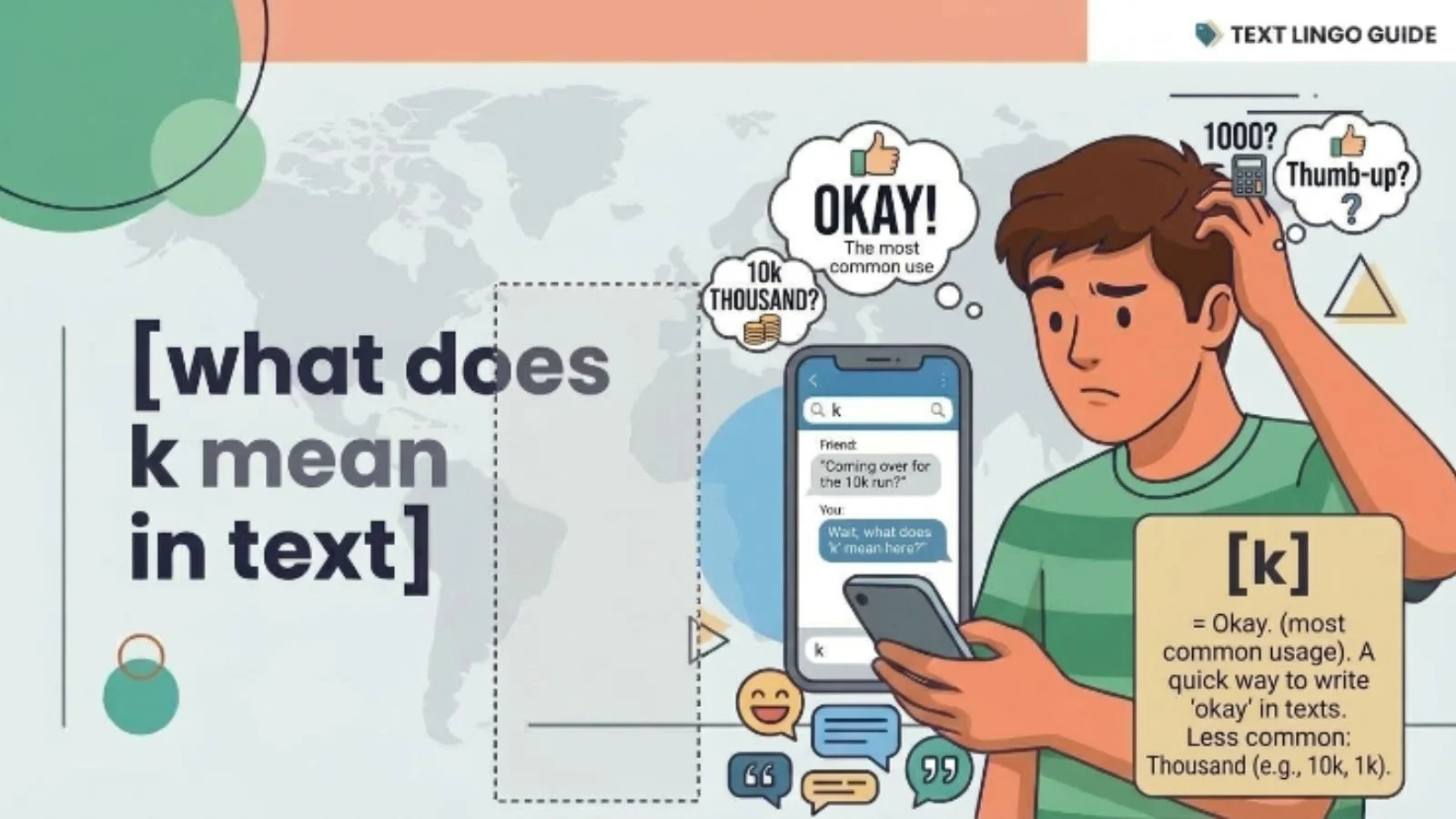
Have you ever sent a long message and received just one letter back: “K”?
It looks simple, but that tiny reply can sometimes leave you wondering what the other person really means. Are they okay? Are they annoyed? Are they busy? Or are they trying to end the conversation?
So, what does K mean in text? In most cases, K means “okay” or “OK.” It is a quick way to acknowledge something, agree with it, or show that the person has received your message.
However, the tone can change depending on the situation. A friendly “k” may simply mean “okay,” while a sudden “K” after an argument may sound cold, annoyed, or dismissive.
Let’s look at what this short texting reply really means and how you can understand it correctly.
What Does K Mean in Text?
K means “okay” or “OK” in text messages. People use it as a short response to show that they understand, agree, or have received what someone said.
For example:
“I’ll call you after work.”
“K.”
Here, K probably means “Okay, I understand.”
But texting is not only about words. Tone and context matter a lot. The same letter can feel friendly in one conversation and rude in another.
For example:
“Can you send me the address?”
“K.”
This may simply mean “Okay.”
But if someone says:
“I’m sorry I upset you.”
“K.”
That response may feel much colder. The person might be upset, disappointed, or simply not interested in continuing the conversation.
Simple Meaning of K in Text
In simple English, K = Okay.
It can communicate several basic ideas:
- Okay
- Alright
- I understand
- Got it
- Sure
- I received your message
- I agree
The exact meaning depends on what was said before it.
The letter K is especially common when someone wants to respond quickly without typing the complete word “okay.”
Why Do People Text K Instead of Okay?
There are several reasons people use K.
1. It Is Quick
Typing one letter is faster than typing “okay.” When someone is busy or having a short conversation, they may simply reply with K.
For example:
“The meeting starts at 5.”
“K.”
There may be no hidden meaning at all.
2. They Want to Acknowledge Your Message
Sometimes a person does not have anything else to say. They use K to show that they saw your message.
For example:
“I left the documents on your desk.”
“K.”
The reply may simply mean, “I got it.”
3. They Agree
In some conversations, K means the person agrees with what you said.
“Let’s meet at 7.”
“K.”
This can mean, “Okay, 7 works for me.”
4. They Want to End the Conversation
A short K can sometimes signal that the person does not want to continue talking.
For example:
“I think we should talk about this later.”
“K.”
Depending on the previous conversation, this can feel like a conversation-ending response.
5. They May Be Annoyed
This is where things become more complicated.
A person who normally sends complete messages may suddenly start replying with “K” after an argument. In that situation, the short reply may sound irritated or emotionally distant.
However, you should not automatically assume they are angry. Context matters.
Where Is K Used in Texting?
K can appear on almost any messaging platform.
You may see it in:
- Text messages
- Facebook Messenger
- Instagram DMs
- Snapchat
- iMessage
- Discord
- Group chats
- Online conversations
- Casual work chats
It is most common in informal communication.
In a formal email or professional message, writing “K” may appear too casual. A complete response such as “Okay, thank you” or “Understood” is usually more appropriate.
What Does K Mean From a Girl?
If a girl sends you K, the meaning depends on your conversation and her usual texting style.
It could simply mean:
“Okay, I understand.”
But if she normally sends longer messages and suddenly replies with only K, she might be annoyed, busy, disappointed, or trying to end the conversation.
For example:
You: “Sorry, I forgot to call you.”
Her: “K.”
That could feel different from:
You: “I’ll send the pictures tonight.”
Her: “K.”
The first conversation has emotional context, while the second is simply informational.
Do not judge the meaning from the letter alone.
What Does K Mean From a Guy?
The same idea applies when a guy sends K.
He may simply be saying:
- “Okay.”
- “Got it.”
- “Sure.”
- “I understand.”
If the conversation was emotional or tense, however, K may sound dismissive or distant.
A person’s normal texting habits are important. If they always use short replies, K may mean nothing negative.
K vs OK vs Okay vs Kk
These responses can look similar, but they may feel slightly different in casual texting.
| Text | Common Meaning | Possible Tone |
|---|---|---|
| K | Okay | Very short; can sound neutral or cold |
| OK | Okay | Neutral and direct |
| Okay | Agreement or understanding | Usually more natural and friendly |
| Kk | Okay, got it | Often casual and friendly |
| Okey | Okay | Informal spelling |
| Alright | Okay / agreed | Neutral and conversational |
| Got it | I understand | Clear and friendly |
These tone differences are not strict rules. People have different texting habits, so the surrounding conversation is always more important.
Why Can “K” Sound Rude?
One major reason is brevity.
When someone sends only one letter, there is no extra information showing emotion. You cannot hear their voice or see their facial expression.
Compare these:
“Okay!”
“Okay, sounds good.”
“K.”
All three can technically communicate agreement, but the last one may feel much colder.
This is especially true when someone expects an emotional response.
For example:
“I worked really hard on this project.”
“K.”
That reply could feel dismissive because the response does not match the emotional weight of the message.
Examples of K in Text
Example 1: Simple Agreement
Person 1: “I’ll meet you at 6.”
Person 2: “K.”
Meaning: “Okay, I’ll see you then.”
This is a basic acknowledgment.
Example 2: Receiving Information
Person 1: “Your appointment is tomorrow at 10 AM.”
Person 2: “K.”
Meaning: “Got it.”
There is not necessarily any negative emotion.
Example 3: Ending a Conversation
Person 1: “I’m going to sleep now.”
Person 2: “K.”
Meaning: “Okay.”
The person may simply have nothing else to add.
Example 4: Possible Annoyance
Person 1: “I forgot again. I’m sorry.”
Person 2: “K.”
Possible meaning: “Okay, but I’m still upset.”
Here, the previous message gives K a more emotional tone.
Example 5: Casual Planning
Person 1: “Can you bring some snacks?”
Person 2: “K.”
Meaning: “Sure.”
This is likely a normal, practical response.
When Should You Use K?
You can use K when the conversation is casual and the other person is likely to understand your tone.
It works well when:
- You are acknowledging simple information.
- You are agreeing to a plan.
- You are replying quickly.
- You are chatting casually with friends.
- The conversation does not require an emotional response.
For example:
“I’ll send it tonight.”
“K.”
That is perfectly normal in many casual conversations.
However, think twice before using K when someone is sharing something emotional or serious.
Instead of:
“K.”
You might say:
“Okay, I understand.”
or:
“Okay, no problem.”
A few extra words can make your message sound much warmer.
When Should You Avoid Using K?
Although K is common, it is not always the best response.
Avoid using only K when:
- Someone is apologizing to you.
- Someone is sharing sad news.
- Someone asks an important question.
- You are having a serious conversation.
- You are talking to a customer or professional contact.
- The other person may already feel ignored or upset.
In these situations, a fuller response can prevent misunderstandings.
For example, instead of:
“K.”
Try:
“Okay, I understand.”
This small difference can make your message sound more respectful.
Common Misunderstandings About K
“K Always Means the Person Is Angry”
Not necessarily.
Many people use K simply because it is quick. If someone regularly texts this way, there may be no hidden emotion.
“K Means They Do Not Care”
Again, not always.
A short response can mean the person is busy, distracted, or simply has nothing else to say.
“K and Okay Always Have the Same Tone”
Not exactly.
Although they have the same basic meaning, the shorter version can sometimes feel more distant.
“You Can Know Someone’s Feelings From K Alone”
You should not.
Look at the entire conversation, the person’s usual texting style, and what happened before the message.
Pro Tips for Understanding K in Text
1. Look at the Context
The message before K is often the biggest clue.
A simple question followed by “K” is probably harmless. An emotional conversation followed by “K” may have a different tone.
2. Know Their Normal Texting Style
If someone always writes short replies, their K probably does not mean anything negative.
If they normally write long messages and suddenly start sending one-word replies, pay more attention.
3. Do Not Overthink One Letter
It is easy to read too much into a short message.
Instead of immediately assuming someone is angry, consider other possibilities. They could be working, driving, tired, or simply busy.
4. Match the Situation
Use short replies for simple conversations and fuller replies for serious conversations.
This makes your communication clearer.
5. Ask If You Are Unsure
If the conversation feels tense, you can simply ask:
“Everything okay?”
A direct question is usually better than guessing someone’s feelings from one letter.
K in Text: Is It Positive or Negative?
K can be either positive, neutral, or negative depending on context.
Here is a simple guide:
Positive or neutral:
“Can you bring the charger?”
“K.”
Meaning: “Sure.”
Neutral:
“The class starts at 9.”
“K.”
Meaning: “Got it.”
Possibly negative:
“I know you’re upset. I’m sorry.”
“K.”
Meaning: “Okay, but I may still be upset.”
The key point is that K does not have one fixed emotional meaning.
Final Thoughts
So, what does K mean in text? Most commonly, it means “okay,” “OK,” “sure,” or “I understand.” It is a fast and casual way to acknowledge a message.
However, the tone can change depending on the conversation. A simple K may be completely normal between friends, while the same reply during an argument can feel cold or dismissive.
The best way to understand K in texting is to look at the context, the person’s usual communication style, and the messages that came before it.
When in doubt, do not judge an entire conversation based on one letter.
Frequently Asked Questions
What does K mean in text messages?
K usually means “okay” or “OK.” It can show agreement, understanding, or that someone has received your message.
Does K mean someone is angry?
Not necessarily. K can sometimes sound cold or annoyed, especially during an argument, but it may also be a completely normal short reply.
Is K rude in texting?
It can sound rude or dismissive in some situations because it is extremely short. However, the meaning depends on the person’s texting habits and the conversation.
What is the difference between K and Okay?
Both usually mean the same basic thing, but “K” can sound shorter and more direct, while “Okay” often feels slightly warmer or more complete.
Discover More Post
