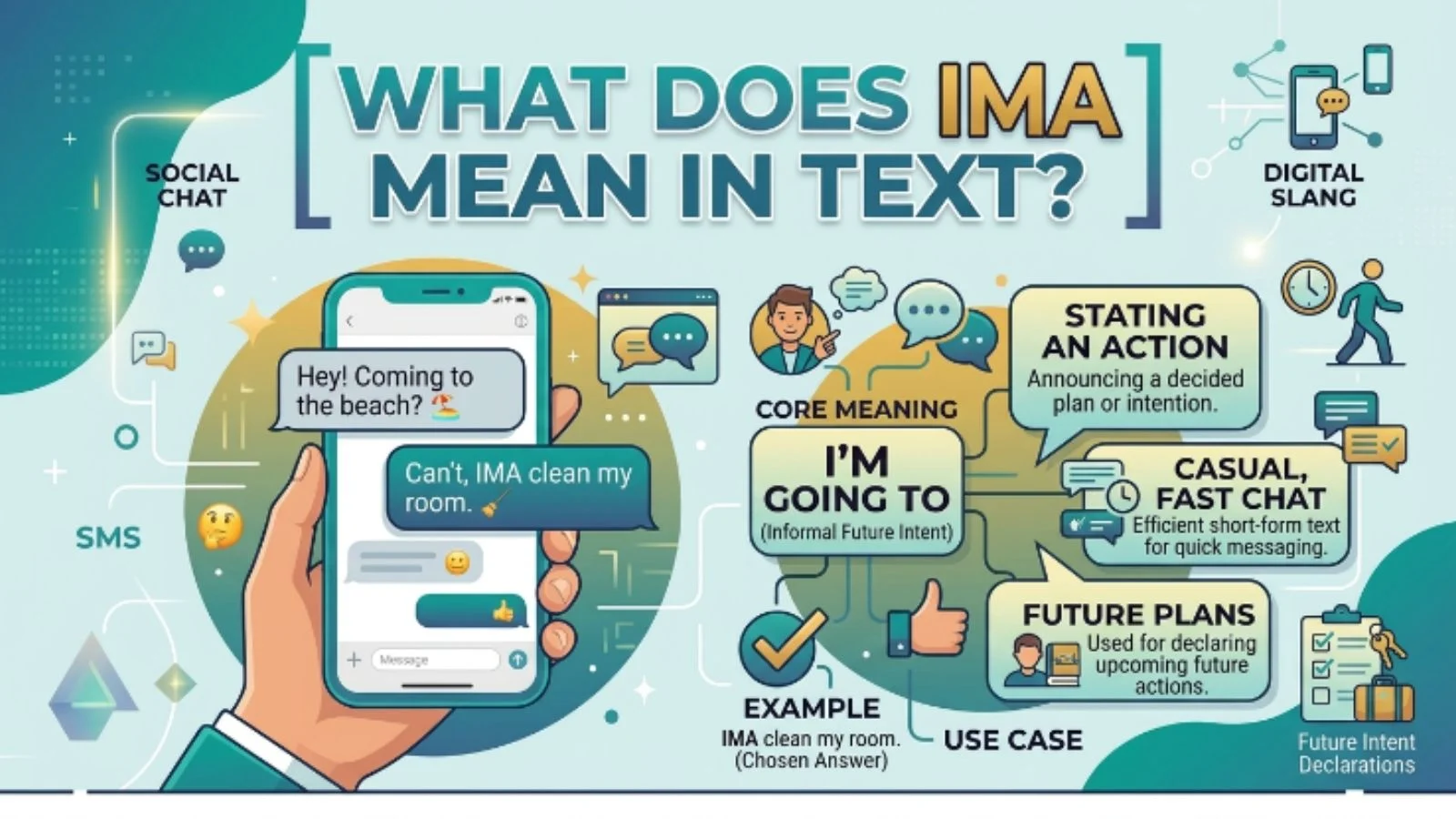
If someone suddenly texts you “ima call you later” or “ima be there soon,” you might wonder what “ima” actually means. It looks like a short word, but its meaning is pretty simple once you know where it comes from.
In texting and online conversations, “ima” usually means “I’m going to” or “I am going to.” It is an informal way to show that someone plans or intends to do something.
For example, “ima go home” means “I’m going to go home.”
This abbreviation is common in casual texts, social media comments, chats, gaming conversations, and other informal digital communication.
What Does IMA Mean in Text?
IMA means “I’m going to” or “I am going to” in text messages and online slang.
It is commonly used before a verb to tell someone what you plan to do.
Examples:
- “ima call you” = I’m going to call you.
- “ima sleep” = I’m going to sleep.
- “ima text her” = I’m going to text her.
- “ima be late” = I’m going to be late.
- “ima check” = I’m going to check.
The spelling “ima” is a casual texting form of “I’m gonna” or “I’m going to.”
It is not normally used in formal writing. You will mostly see it when people are typing quickly or trying to sound relaxed and conversational.
IMA Meaning in Simple Words
In simple words, “ima” means “I’m going to.”
It usually tells you that the person is about to do something or intends to do something.
For example:
“ima eat first.”
This means:
“I’m going to eat first.”
Another example is:
“ima send it tonight.”
That means:
“I’m going to send it tonight.”
So, whenever you see “ima” before an action, you can usually read it as “I’m going to.”
What Does IMA Stand For?
In internet slang, IMA is generally a shortened form of “I’m going to.”
It is related to the casual spoken phrase “I’m gonna.” When people type quickly, they may remove spaces and letters and write:
I’m going to → I’m gonna → ima
This is why “ima” can look unusual if you have never seen it in a text conversation before.
Where Is IMA Used?
You can see “ima” in many casual online spaces.
It is especially common in:
- Text messages
- Instagram comments and DMs
- TikTok comments
- Snapchat chats
- WhatsApp messages
- Facebook Messenger
- Discord
- Gaming chats
- Online forums
- Casual social media posts
The main thing to remember is that “ima” is informal.
You would usually use it when talking to friends, family members, classmates, or people you already communicate with casually.
For example:
Friend: “Are you coming tonight?”
You: “Yeah, ima be there around 8.”
That sounds natural in a casual conversation.
However, writing “ima be there” in a formal business email would not be appropriate. In that situation, you would write “I’m going to be there” or “I will be there.”
Why Do People Use IMA?
People use “ima” mainly because it is quick, casual, and sounds like everyday speech.
1. It Saves Time
Typing “I’m going to” takes more effort than typing “ima.”
For example:
“I’m going to call you after work.”
becomes:
“ima call you after work.”
The second version is shorter and more relaxed.
2. It Sounds Casual
Texting is usually less formal than writing an email or an essay.
Using “ima” can make a message sound like natural conversation between friends.
3. It Matches Internet Slang
Online conversations are full of shortened words and phrases.
Words such as gonna, wanna, gotta, idk, btw, lol, rn, and ima are often used because they match the fast and informal style of online communication.
4. It Shows Immediate Intention
When someone says:
“ima call you.”
they are usually telling you what they intend to do next.
It can have a stronger sense of immediate action than simply saying:
“I might call you.”
However, context still matters. Saying “ima do it tomorrow” describes a future intention, not necessarily something happening immediately.
Real-Life Examples of IMA in Text
Understanding examples is one of the easiest ways to recognize “ima” in a conversation.
Example 1: Making Plans
Friend: “Are you coming to the party?”
You: “Yeah, ima come after dinner.”
Meaning: You are saying that you are going to come after dinner.
Example 2: Ending a Conversation
Person A: “You still awake?”
Person B: “Not for long. ima sleep.”
Meaning: “I’m going to sleep.”
Here, “ima” tells the other person what the speaker plans to do.
Example 3: Making a Phone Call
Friend: “Did you talk to Sarah?”
You: “Not yet. ima call her later.”
Meaning: “I’m going to call her later.”
Example 4: Going Somewhere
Person A: “Where are you?”
Person B: “At home. ima go to the store soon.”
Meaning: “I’m going to go to the store soon.”
Example 5: Starting a Task
Friend: “Did you finish the assignment?”
You: “No, ima do it tonight.”
Meaning: “No, I’m going to do it tonight.”
Example 6: Giving a Quick Update
Person A: “What are you doing?”
Person B: “ima make some food.”
Meaning: “I’m going to make some food.”
IMA vs Similar Texting Terms
Although “ima” is easy to understand once you know it, it can be confused with other informal expressions.
| Term | Meaning | Example |
|---|---|---|
| IMA | I’m going to | “ima call you” |
| Gonna | Going to | “I’m gonna call you” |
| Wanna | Want to | “I wanna go” |
| Gotta | Have got to / have to | “I gotta leave” |
| I’ll | I will | “I’ll call you” |
| IDK | I don’t know | “idk what happened” |
| IMMA | I’m going to / I’m about to | “imma do it” |
IMA vs IMMA
This is one of the most common points of confusion.
IMA and IMMA are often used in very similar ways.
For example:
- “ima go now.”
- “imma go now.”
Both can mean:
“I’m going to go now.”
The exact spelling depends on the person’s texting style.
IMA vs Gonna
“Gonna” is another casual way of saying “going to.”
For example:
“I’m gonna call you.”
and
“ima call you.”
can communicate essentially the same idea.
The difference is mostly in style and spelling.
When Should You Use IMA?
You can use “ima” when the conversation is relaxed and informal.
It works well when texting:
- Close friends
- Siblings
- Classmates
- Online friends
- Gaming friends
- People you regularly chat with
For example:
“ima be there in 10.”
is perfectly natural in a casual text.
You can also use it jokingly in social media posts or comments when you want your message to sound conversational.
When You Should Avoid IMA
Avoid “ima” in formal or professional writing.
For example, don’t write:
“ima send the report tomorrow.”
in a professional email.
Instead, use:
“I’m going to send the report tomorrow.”
Or, depending on the context:
“I will send the report tomorrow.”
The same rule applies to school assignments, official applications, business documents, and other situations where standard English is expected.
Common Misunderstandings About IMA
There are a few things worth knowing before interpreting “ima.”
IMA Does Not Usually Mean “I Am”
Some people may assume that “ima” simply means “I am.”
Usually, that’s not the intended meaning in texting slang.
For example:
“ima call you.”
does not mean:
“I am call you.”
It means:
“I’m going to call you.”
The word generally carries the idea of a future action or intention.
IMA Is Not Always an Acronym
In casual internet language, “ima” is better understood as a phonetic or shortened texting form rather than a formal acronym.
People often type it based on how a phrase sounds when spoken.
That is why spelling can vary between:
- ima
- imma
- IMA
- Imma
The lowercase version “ima” is especially common in casual texting.
Context Still Matters
Not every use of “IMA” online has to mean “I’m going to.”
IMA can have other meanings in specific fields, organizations, or professional contexts.
For example, an abbreviation can mean something completely different in medicine, business, education, or other specialized areas.
So, if you see “IMA” in a professional document rather than a text message, check the surrounding context before assuming it means internet slang.
Pro Tips for Understanding IMA
If you’re trying to understand a message containing “ima,” these simple tips can help.
1. Look at the Word After IMA
If a verb follows it, “ima” probably means “I’m going to.”
For example:
“ima eat.”
“ima leave.”
“ima call.”
“ima check.”
All of these describe future actions.
2. Consider the Conversation
Look at what the person was talking about before using the abbreviation.
If they were discussing plans, “ima” probably introduces something they intend to do.
3. Notice the Tone
“IMA” is generally casual.
It can make a message feel relaxed, spontaneous, or conversational.
4. Don’t Overthink the Spelling
If someone writes “imma” instead of “ima,” the meaning is usually very similar.
Online slang does not always follow standard spelling rules.
How to Reply to IMA in Text
Your response depends on what the person says.
If someone writes:
“ima call you later.”
you could reply:
- “Okay, sounds good.”
- “Sure, call me when you’re free.”
- “Alright.”
- “No problem.”
If they say:
“ima go to the store.”
you might say:
- “Okay.”
- “Need anything?”
- “Alright, see you later.”
You don’t need to use slang just because the other person does. A normal response is perfectly fine.
Is IMA Rude?
No. “Ima” is not inherently rude.
It is simply informal.
However, tone depends on the complete message.
For example:
“ima help you.”
sounds casual and friendly.
But:
“ima do whatever I want.”
could sound dismissive depending on the conversation.
So, don’t judge the tone from “ima” alone. Look at the entire message and the relationship between the people talking.
Is IMA Correct English?
“Ima” is not standard formal English.
It is internet slang and a casual spelling used in digital communication.
That does not mean it is “wrong” in a text message. Informal communication naturally develops shortened spellings and expressions.
In formal writing, however, use standard forms such as:
“I’m going to”
or
“I will.”
Final Thoughts
So, what does “ima” mean in text?
In most casual conversations, “ima” means “I’m going to” or “I am going to.” It is a shortened, informal way to talk about an intended or upcoming action.
You might see someone write “ima call you,” “ima go,” “ima eat,” or “ima check.” In each case, the person is describing something they plan to do.
The key is to pay attention to the context. While “ima” is common in texting and social media, it is not suitable for formal writing.
Once you know the meaning, this small piece of internet slang becomes very easy to understand.
FAQ: What Does IMA Mean in Text?
What does IMA mean in texting?
IMA usually means “I’m going to” or “I am going to” in casual texting. It is commonly placed before a verb to describe an intended future action.
What does “ima” mean in a text from a girl?
If a girl texts “ima call you,” “ima go,” or something similar, “ima” generally means “I’m going to.” The abbreviation itself does not indicate a specific romantic meaning.
Is IMA the same as IMMA?
Usually, yes. “Ima” and “imma” are informal spellings that can both be used to mean “I’m going to.” Individual texting styles may vary.
Can I use IMA in formal writing?
It is better to avoid it in formal writing. Use “I’m going to” or “I will” in professional emails, school assignments, applications, and other formal situations.
Discover More Post
