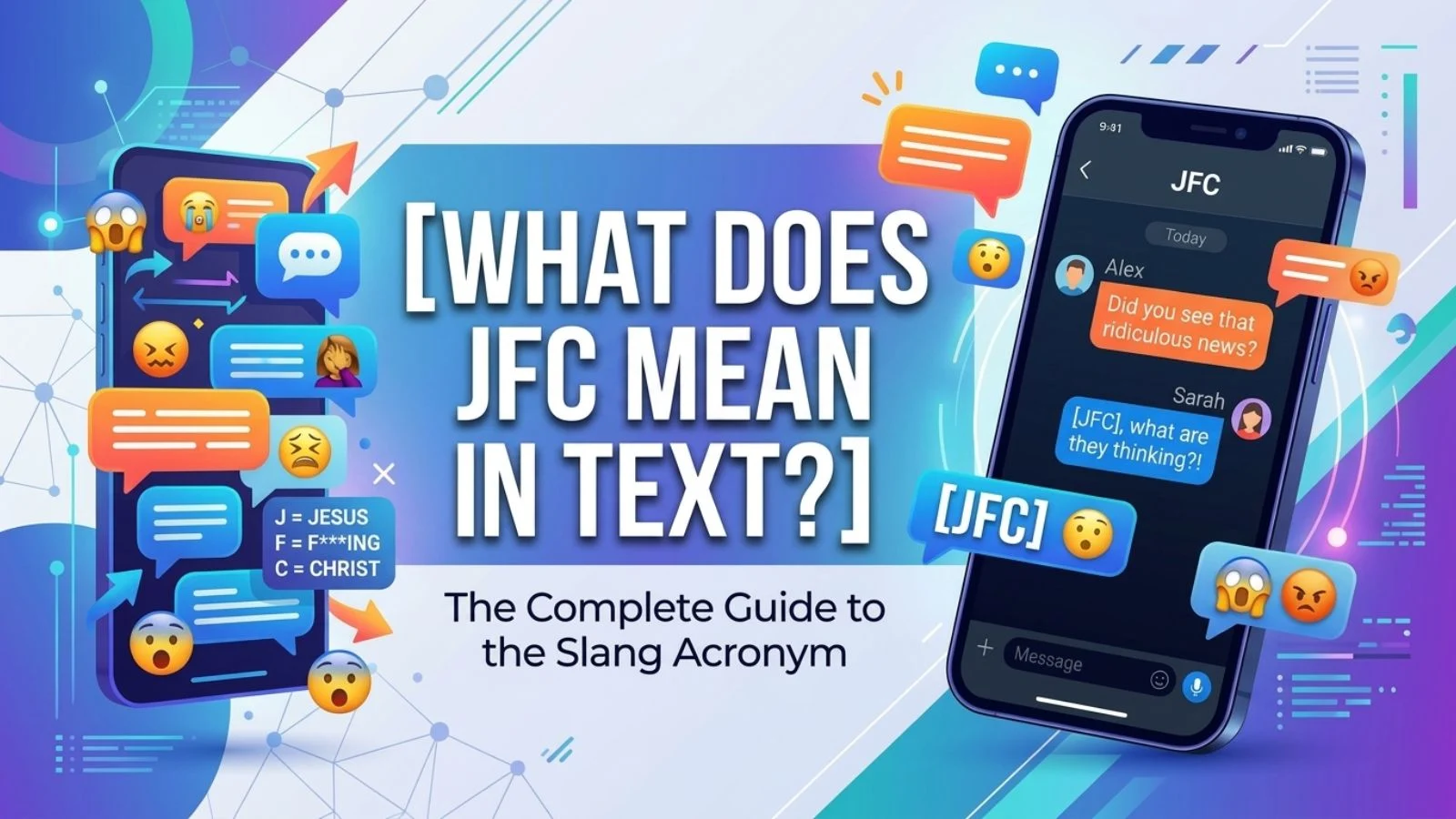
Have you ever received a text like “JFC, what happened?” and wondered what those three letters actually mean? You are not alone. JFC is a common internet abbreviation used to show a strong emotional reaction, especially surprise, frustration, shock, or disbelief.
But there is something important to know before using it. JFC contains profanity, so it is not suitable for every conversation.
In this guide, you will learn exactly what JFC means in text, where people use it, what emotions it can express, and how to use it naturally without sounding rude or inappropriate.
What Does JFC Mean in Text?
JFC usually means “Jesus F*ing Christ.”**
It is an informal expression used to show a strong emotional reaction. Depending on the situation, it can express shock, anger, frustration, disbelief, excitement, or surprise.
For example:
“JFC, that was expensive!”
Here, the person is showing strong shock about the price.
Another example is:
“JFC, I can’t believe you actually did that.”
In this case, JFC expresses surprise and disbelief.
Because the phrase contains profanity and uses a religious name as an exclamation, it can sound strong or offensive to some people.
JFC Meaning in Simple Words
In simple terms, JFC is a strong way of saying “Wow,” “Oh my God,” “Seriously?” or “I can’t believe this.”
The exact meaning depends on the context and the person’s tone.
For example:
- JFC, that’s crazy! = That’s extremely surprising.
- JFC, I’m so tired. = I’m extremely tired or frustrated.
- JFC, you scared me! = You really scared me.
- JFC, look at that view! = I’m extremely impressed or amazed.
So, JFC does not have only one emotional meaning. It works as an intensifier that makes the speaker’s reaction sound much stronger.
What Does JFC Stand For?
JFC stands for “Jesus F*ing Christ.”**
The middle word is a profanity that adds strong emphasis to the expression.
You may also see it written in different forms, including:
- JFC
- jfc
- J.F.C.
- Jesus F***ing Christ
- Jesus fucking Christ
People usually type JFC because it is shorter and easier to use in texting and online conversations.
Some people use the abbreviation specifically because they do not want to type the full phrase.
Where Is JFC Used?
JFC is mainly used in casual digital communication.
You may see it on:
- Text messages
- Group chats
- TikTok
- X
- Discord
- Online gaming chats
- Private messages
- Casual conversations
It is especially common when someone wants to react quickly to something surprising or frustrating.
For example, a friend might send you a picture of a huge restaurant bill and say:
“JFC, look at this bill.”
The abbreviation communicates the person’s immediate reaction without needing a long explanation.
Is JFC Common in Texting?
Yes. JFC is widely understood in informal online communication, especially among people who are comfortable with profanity and internet slang.
However, being commonly understood does not mean it is appropriate everywhere.
You should avoid using JFC in professional emails, formal writing, job applications, school assignments, or conversations where strong language may be considered disrespectful.
Why Do People Use JFC?
People use JFC because it makes an emotional reaction feel stronger and more immediate.
Instead of saying:
“Wow, that’s unbelievable.”
Someone might write:
“JFC, that’s unbelievable.”
The second version sounds much more emotional.
People commonly use JFC to express:
1. Shock
Someone sees something unexpected and wants to show surprise.
“JFC, you actually won the competition.”
The person is shocked that their friend won.
2. Frustration
JFC can show that someone is annoyed or overwhelmed.
“JFC, this computer is so slow.”
The speaker is frustrated with the computer.
3. Disbelief
It can also mean that something seems difficult to believe.
“JFC, did he really say that?”
The person cannot believe what happened.
4. Amazement
JFC is not always negative. It can also show positive excitement.
“JFC, that sunset is beautiful.”
Here, the speaker is extremely impressed.
5. Anger
Sometimes JFC is used during an angry reaction.
“JFC, why did you do that?”
The person is clearly upset or irritated.
JFC Examples in Real-Life Texting
Understanding examples is one of the easiest ways to learn internet slang.
Example 1: Unexpected News
Person A: “I got the job!”
Person B: “JFC, congratulations! You actually got it!”
Here, JFC shows excitement and surprise.
Example 2: High Price
Person A: “The repair cost $900.”
Person B: “JFC, that’s expensive.”
Here, JFC expresses shock about the price.
Example 3: A Scary Situation
Person A: “Sorry I jumped out and scared you.”
Person B: “JFC, you scared me!”
In this example, JFC emphasizes how strongly the person reacted.
Example 4: Frustration
Person: “JFC, I’ve been waiting for this website to load for 20 minutes.”
The speaker is extremely frustrated.
Example 5: Amazing Experience
Person A: “Look at the view from the mountain.”
Person B: “JFC, that’s beautiful.”
Here, JFC expresses amazement rather than anger.
Example 6: Disbelief
Person A: “He spent all his savings on that car.”
Person B: “JFC, seriously?”
The speaker is surprised and finds the situation difficult to believe.
JFC vs Similar Expressions
JFC can be confused with several other internet expressions. However, each one has a slightly different tone.
| Expression | Meaning | Typical Emotion | Strength |
|---|---|---|---|
| JFC | Jesus F***ing Christ | Shock, frustration, disbelief | Strong |
| OMG | Oh my God | Surprise or excitement | Mild to medium |
| WTF | What the f*** | Shock, confusion, anger | Strong |
| WTH | What the heck | Confusion or surprise | Mild |
| Damn | Strong reaction | Surprise, frustration, admiration | Medium |
| Wow | Surprise or admiration | Usually positive or neutral | Mild |
| Seriously? | Disbelief or annoyance | Confusion or frustration | Mild |
JFC vs OMG
OMG is generally more acceptable in everyday conversations.
For example:
“OMG, that’s amazing!”
JFC sounds much stronger:
“JFC, that’s amazing!”
If you are unsure about the other person’s comfort with profanity, OMG is usually the safer choice.
JFC vs WTF
JFC and WTF can both express shock, anger, and disbelief.
However, WTF often focuses on confusion about what is happening.
“WTF is going on?”
JFC is more often an emotional reaction:
“JFC, this is crazy.”
The meanings can overlap depending on context.
JFC vs WTH
WTH is a softer alternative to WTF.
It generally means “What the heck?”
If you want to express surprise or confusion without using strong profanity, WTH is a better choice.
When Should You Use JFC?
JFC is best used in informal conversations with people who are comfortable with strong language.
You might use it when:
- Talking with close friends
- Reacting to surprising news
- Chatting in an informal group
- Commenting on a funny or shocking situation
- Reacting to something frustrating
- Talking casually online
Before using it, consider your relationship with the person and the situation.
If your friend regularly uses profanity, JFC may sound completely normal.
If you are speaking with a teacher, manager, client, customer, or someone you do not know well, it is better to avoid it.
When Should You Avoid JFC?
There are several situations where JFC is not a good choice.
Avoid it in:
- Job applications
- Professional emails
- Business meetings
- Academic assignments
- Formal presentations
- Customer service conversations
- Interviews
- Official documents
- Conversations with people who dislike profanity
For example, writing:
“JFC, I don’t understand this report.”
in a professional email would be inappropriate.
A better option would be:
“I’m having some difficulty understanding this report.”
The second sentence communicates the problem without unnecessary offensive language.
Common Misunderstandings About JFC
JFC Does Not Always Mean Anger
One common mistake is assuming JFC always means that someone is angry.
That is not true.
A person can use JFC when they are excited, amazed, shocked, frustrated, or confused.
The surrounding words provide important clues.
“JFC, you look amazing!”
This is probably admiration.
But:
“JFC, stop doing that!”
is clearly frustration or anger.
JFC Is Not Always Directed at Someone
JFC can be used as a general reaction rather than an insult toward another person.
For example:
“JFC, it’s freezing outside.”
The speaker is reacting to the weather.
They are not necessarily insulting anyone.
Capital Letters Do Not Change the Meaning
You may see JFC, jfc, or J.F.C.
The meaning is generally the same.
People often use lowercase letters in casual texting because typing everything in lowercase is common online.
How Do You Reply to JFC?
Your response depends on what the person is reacting to.
If someone says:
“JFC, that’s expensive.”
You could reply:
“I know, right?”
If someone says:
“JFC, you scared me!”
You might say:
“Sorry! I didn’t mean to.”
If someone says:
“JFC, that’s amazing!”
You could respond:
“I know! It looks incredible.”
You do not have to use JFC yourself just because someone else uses it.
A natural response is often better than copying their slang.
Is JFC Rude?
JFC can be considered rude or offensive because it contains profanity.
Whether it feels rude depends on the people involved, the context, and their personal beliefs.
Some people use JFC casually and do not intend to offend anyone. Others may find the expression disrespectful, especially because it includes a religious reference.
The safest rule is simple: use JFC only when you know the conversation is informal and the other person is comfortable with strong language.
Pro Tips for Using JFC Naturally
Here are a few useful tips if you see or want to use this abbreviation online.
1. Check the Context
Do not assume JFC always expresses anger.
Look at the words around it and consider what happened before the message.
2. Consider Your Audience
JFC is casual and contains profanity.
Use it with people who understand and accept that type of language.
3. Avoid It in Professional Communication
Even if you use JFC with friends every day, that does not make it suitable for work or formal communication.
4. Pay Attention to Tone
Text messages do not include facial expressions or voice tone.
A short message such as:
“JFC.”
can sound much harsher than the sender intended.
5. Use Softer Alternatives When Needed
If you want the same general reaction without profanity, try:
- Wow
- OMG
- Oh my gosh
- Seriously?
- That’s crazy
- No way
- What the heck?
These alternatives are usually safer in mixed or unfamiliar groups.
Is JFC Appropriate for Social Media?
It depends on the platform, audience, and type of post.
In a casual comment between friends, JFC may be perfectly understandable.
However, if you are posting for a business, professional brand, school, or workplace audience, it is better to choose a cleaner expression.
Remember that social media posts can also be seen by people outside your intended audience.
What Does JFC Mean From a Girl or Guy?
JFC does not have a special meaning based on whether a girl or guy uses it.
A person of any gender can use JFC to express:
- Surprise
- Frustration
- Shock
- Excitement
- Disbelief
- Amazement
The context and tone matter more than the gender of the person sending it.
For example:
“JFC, you’re actually here!”
could simply mean the person is surprised to see you.
It does not automatically have a romantic or negative meaning.
Final Thoughts
So, what does JFC mean in text? JFC usually stands for “Jesus F*ing Christ”** and is used as a strong reaction to surprise, frustration, disbelief, shock, excitement, or amazement.
It is common in texting, social media, gaming chats, and other informal online conversations.
However, JFC contains profanity and may also be considered offensive because of its religious reference. For that reason, it is best saved for casual conversations where you know the audience is comfortable with strong language.
If you want a softer option, expressions such as OMG, wow, seriously, or what the heck can communicate a similar reaction without sounding as strong.
Frequently Asked Questions
What does JFC stand for in texting?
JFC usually stands for “Jesus F*ing Christ.”** It is an informal expression used to show strong emotions such as shock, frustration, surprise, disbelief, or amazement.
Is JFC a bad word?
JFC contains profanity, so it can be considered inappropriate or offensive in some situations. It is generally better to use it only in casual conversations with people who are comfortable with strong language.
What does JFC mean from a girl?
There is no special meaning when a girl uses JFC. She may be expressing surprise, frustration, excitement, disbelief, or another strong emotion. The surrounding conversation determines the intended meaning.
What is a softer alternative to JFC?
Common softer alternatives include OMG, wow, seriously, oh my gosh, no way, and what the heck. These expressions can communicate surprise or disbelief without using strong profanity.
Discover More Post
