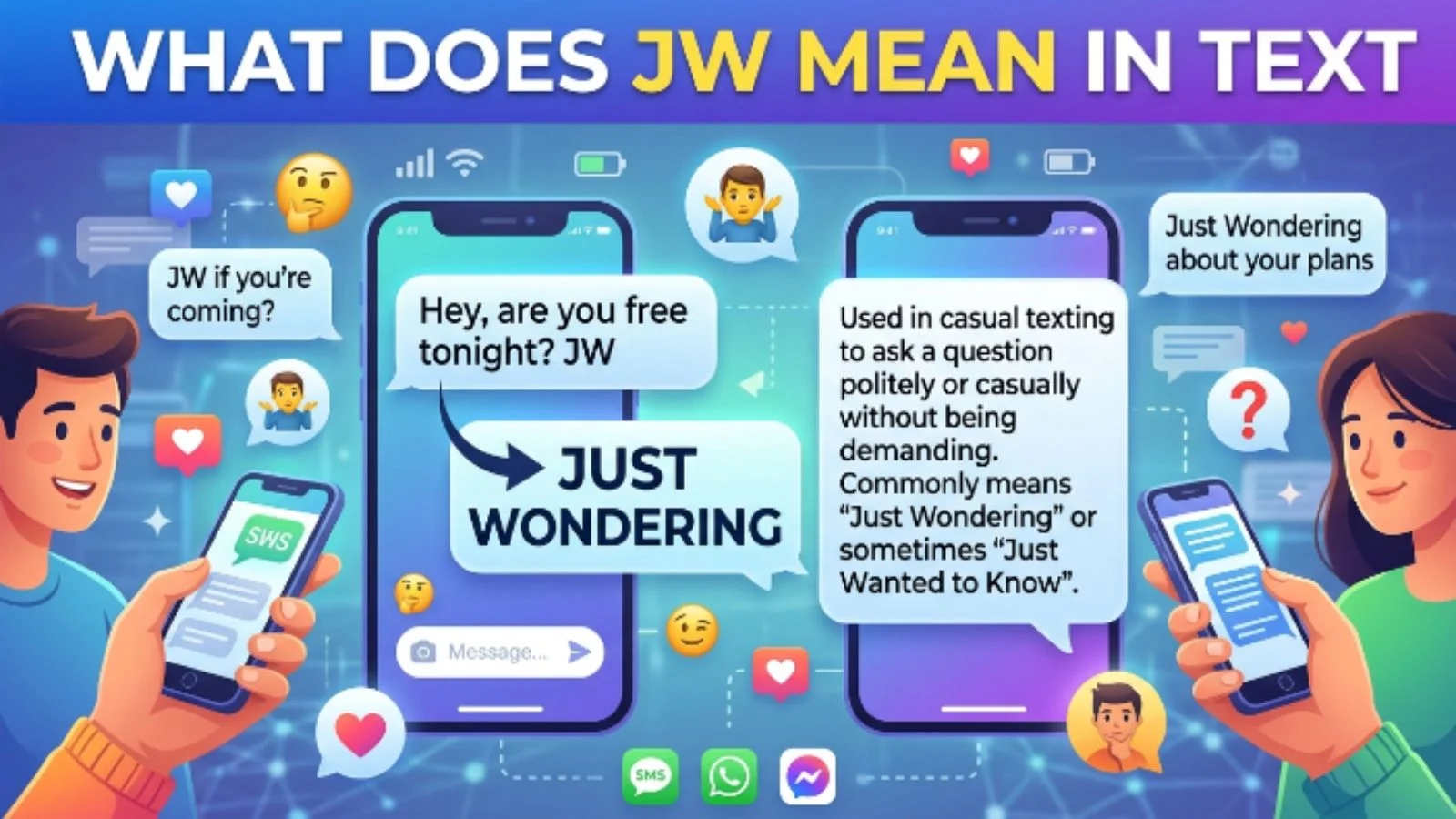
If you have received a message containing “JW” and wondered what it means, you are not alone. Text abbreviations are everywhere today. People use short forms to save time while texting, chatting online, or posting on social media.
In most cases, JW means “Just Wondering.”
People use it when they are curious about something and want to ask a question in a casual and friendly way. It often makes a question sound less direct or less demanding.
For example:
“Are you coming to the party tonight? JW.”
Here, the sender is simply asking because they are curious. They are not trying to pressure the other person.
In this guide, you’ll learn everything about the meaning of JW, where it came from, how people use it, examples, common mistakes, and modern usage in 2026.
Quick Answer: What Does JW Mean?
JW = Just Wondering
It is a casual internet abbreviation used in:
- Text messages
- Snapchat
- Facebook Messenger
- Discord
- Online forums
- Gaming chats
People use it when they want to ask a question politely or show curiosity.
Example
Text: “JW, did you finish the project?”
Meaning: “Just wondering, did you finish the project?”
The abbreviation softens the question and makes it sound more relaxed.
What Does JW Mean in Simple Words?
In simple words, JW means someone is curious about something.
When a person says “just wondering,” they are usually:
- Asking a question
- Looking for information
- Being friendly
- Avoiding sounding demanding
- Showing interest
Example
Message: “JW, what time are you arriving?”
Meaning: The person simply wants to know your arrival time.
Explanation: They are asking casually and not putting pressure on you.
The Main Meaning of JW in Texting
The most common meaning of JW is:
Just Wondering
This phrase helps make a question feel softer and more polite.
Instead of writing:
“Why haven’t you replied?”
Someone might write:
“JW, are you busy today?”
This sounds friendlier and less confrontational.
Why People Use It
People use JW because:
- It saves typing time.
- It sounds casual.
- It reduces tension.
- It makes questions feel polite.
- It fits modern texting culture.
Origin and History of JW
Like many internet abbreviations, JW became popular during the rise of:
- SMS texting
- Chat rooms
- Instant messaging
- Early social media
In the late 1990s and early 2000s, text messages often had character limits. People started shortening common phrases to save space.
Examples included:
- LOL = Laughing Out Loud
- BRB = Be Right Back
- IMO = In My Opinion
- JW = Just Wondering
Over time, JW spread across:
- MSN Messenger
- AOL Instant Messenger
- Yahoo Messenger
- Snapchat
Today, it remains a common abbreviation in digital communication.
How JW Is Used in Conversations
People usually place JW:
- At the beginning of a message
- At the end of a message
- In the middle of a sentence
Beginning Example
JW, are you free tomorrow?
Explanation: The sender is politely asking about your availability.
End Example
Have you watched the new movie yet? JW.
Explanation: The sender is simply curious about whether you’ve seen it.
Middle Example
I was JW if you wanted to join us later.
Explanation: The sender is casually inviting you.
Examples of JW in Text Messages
Here are some common examples.
Example 1
Text: “JW, how was your interview?”
Meaning: Just wondering how your interview went.
Explanation: The sender is showing interest and concern.
Example 2
Text: “Are you still awake? JW.”
Meaning: The sender wants to know if you’re awake.
Explanation: It sounds casual instead of demanding.
Example 3
Text: “JW if you got my email.”
Meaning: Just wondering if you received the email.
Explanation: The sender is politely checking.
Example 4
Text: “JW, when does your vacation start?”
Meaning: The sender is curious about your travel plans.
Explanation: A friendly question without pressure.
Example 5
Text: “JW why the store closed early.”
Meaning: The person is curious about the reason.
Explanation: They are seeking information.
Real-Life Dialogue Examples
Dialogue 1: Friends
Sarah: “JW, are you coming tonight?”
Emma: “Yes, I’ll be there around 8.”
Explanation: Sarah wants to know Emma’s plans.
Dialogue 2: Workplace
Tom: “JW if the meeting has been moved.”
Rachel: “Yes, it’s now at 3 PM.”
Explanation: Tom is checking for updated information.
Dialogue 3: Family
Dad: “JW, did you get home safely?”
Son: “Yes, I’m home now.”
Explanation: Dad is expressing concern and care.
Dialogue 4: School
Student: “JW, when is the exam schedule coming out?”
Teacher: “It will be posted tomorrow.”
Explanation: The student is asking politely.
Dialogue 5: Dating
Alex: “JW if you’re free this weekend.”
Taylor: “I am. What do you have planned?”
Explanation: Alex is showing interest without sounding pushy.
Personality Traits Associated With Using JW
People who use JW are often seen as:
Curious
They genuinely want information.
Friendly
The phrase sounds warm and conversational.
Polite
It softens questions and avoids sounding demanding.
Relaxed
JW creates a casual tone.
Considerate
The sender acknowledges that the other person may be busy.
Of course, using JW does not automatically define someone’s personality, but it often creates these impressions.
When Should You Use JW?
JW works best in casual situations.
Good Situations
- Talking with friends
- Family conversations
- Casual work chats
- Social media messages
- Group chats
- Online communities
Examples
- “JW if you’re joining us.”
- “JW what happened.”
- “JW when the event starts.”
These sound natural and friendly.
When You Should Avoid JW
JW is not always appropriate.
Formal Business Emails
Avoid:
“JW if my application was reviewed.”
Better:
“I would like to follow up regarding my application.”
Academic Writing
Avoid using internet abbreviations in essays or research papers.
Professional Reports
Use complete sentences instead.
Different Meanings of JW
Although Just Wondering is the most common meaning, JW can sometimes mean other things depending on context.
| Meaning | Context |
|---|---|
| Just Wondering | Texting and social media |
| Jehovah’s Witness | Religious discussions |
| Initials of a person’s name | Personal references |
| Brand or company initials | Business context |
Example
Text: “JW, are you free?”
Meaning: Just Wondering.
Sentence: “My neighbor is a JW.”
Meaning: Jehovah’s Witness.
Always look at the conversation context.
JW on Snapchat
On Snapchat, JW almost always means Just Wondering.
Example
“JW why you left me on read.”
Meaning: The sender is curious about why their message was not answered.
Explanation: They are asking casually.
JW on Instagram
Instagram users often use JW in:
- Direct messages
- Story replies
- Comments
Example
“JW where you took this photo.”
Meaning: The person wants to know the location.
Explanation: They are expressing interest.
JW on TikTok
TikTok users sometimes include JW in comments.
Example
“JW what camera you use.”
Meaning: The commenter wants information about the camera.
Explanation: A simple and friendly question.
JW in Gaming
Gamers often use abbreviations for speed.
Example
“JW if the update is live.”
Meaning: Just wondering whether the update is available.
Explanation: The player wants information quickly.
JW in Online Dating
JW appears frequently in dating conversations.
Example
“JW if you’d like to meet sometime.”
Meaning: The person is showing interest.
Explanation: The question feels gentle and non-aggressive.
Common Mistakes About JW
Many people misunderstand JW.
Mistake 1: Thinking It Means a Joke
Some users confuse JW with other abbreviations.
Reality: It usually means “Just Wondering.”
Mistake 2: Assuming It’s Always Religious
JW can mean Jehovah’s Witness, but not in most texting situations.
Reality: Context matters.
Mistake 3: Using It in Formal Communication
JW is casual internet slang.
Reality: Use full sentences in professional settings.
Mistake 4: Overusing It
Adding JW to every question can sound repetitive.
Reality: Use it only when it fits naturally.
Modern Examples of JW in 2026
Texting habits continue to evolve, but JW remains common.
Example 1
“JW if the concert tickets sold out.”
Explanation: The sender wants an update.
Example 2
“JW why everyone’s talking about that trend.”
Explanation: The person is curious about a popular topic.
Example 3
“JW if the app is working for you.”
Explanation: The sender is checking whether others have the same experience.
Example 4
“JW what AI tool you use most.”
Explanation: The sender wants recommendations.
Example 5
“JW if anyone else noticed the update.”
Explanation: The person is seeking opinions.
Similar Slang Terms to JW
Several abbreviations have similar purposes.
| Abbreviation | Meaning |
|---|---|
| IMO | In My Opinion |
| TBH | To Be Honest |
| FYI | For Your Information |
| IDK | I Don’t Know |
| BTW | By The Way |
| LMK | Let Me Know |
| IMO | In My Opinion |
These abbreviations help make digital communication faster.
Why JW Remains Popular
Even in 2026, JW continues to be used because it is:
- Short
- Easy to understand
- Friendly
- Flexible
- Widely recognized
People appreciate communication that feels natural and relaxed.
JW helps achieve that goal.
How to Reply When Someone Says JW
You can simply answer the question.
Example 1
Message: “JW if you’re coming.”
Reply: “Yes, I’ll be there.”
Explanation: Directly answers the question.
Example 2
Message: “JW what time the movie starts.”
Reply: “It starts at 7 PM.”
Explanation: Provides the requested information.
Example 3
Message: “JW if you’re busy.”
Reply: “Not right now.”
Explanation: Responds to the person’s curiosity.
Frequently Asked Questions
Is JW rude in a text?
No. JW is generally considered polite and friendly. It softens a question and makes it sound less demanding.
What does JW stand for in texting?
In texting, JW usually stands for Just Wondering.
Does JW mean Jehovah’s Witness?
Sometimes, yes. In religious discussions, JW can mean Jehovah’s Witness. In casual texting, it usually means Just Wondering.
Can I use JW at work?
You can use it in casual workplace chats, but avoid it in formal emails and professional documents.
Is JW still used in 2026?
Yes. JW remains a common abbreviation across texting apps, social media platforms, and online communities.
Where do people use JW the most?
People commonly use JW on Snapchat, Instagram, WhatsApp, Discord, Facebook Messenger, TikTok, and standard text messages.
Is JW used by younger people only?
No. While younger users often use it, people of many age groups use JW because it is simple and widely understood.
Conclusion
So, what does JW mean in text? In most conversations, JW stands for “Just Wondering.” It is a casual and friendly abbreviation used when someone is curious or wants to ask a question without sounding demanding. The phrase has been popular since the early days of texting and continues to be widely used across social media, messaging apps, gaming communities, and everyday conversations in 2026. Understanding JW can help you communicate more naturally online and avoid confusion when chatting with friends, family, coworkers, or new acquaintances. The next time you see JW in a message, you’ll know exactly what it means and how to respond confidently.
Discover More Post
