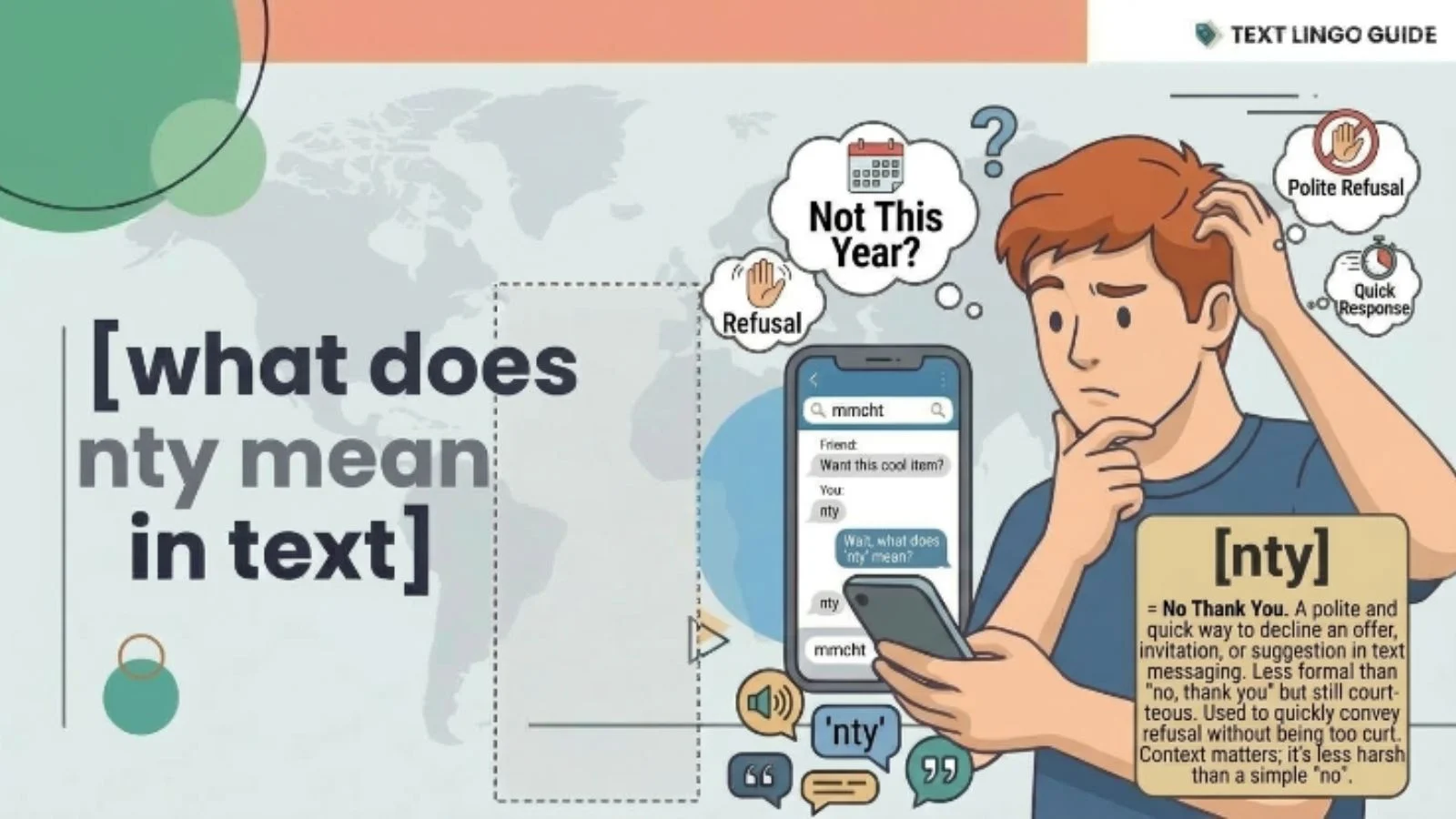
Have you ever received a text that simply says “NTY” and wondered what the person actually meant? It may look like a random group of letters, but in texting and online conversations, NTY usually has a very simple meaning.
The tone behind NTY can change depending on the conversation. Sometimes it is a quick and polite way to say no. In other cases, it can sound short, cold, or even a little dismissive.
So, what does NTY mean in text, and how should you respond when someone sends it to you? Let’s break it down with simple explanations and real-life examples.
What Does NTY Mean in Text?
NTY usually means “No Thank You” in text messages and online conversations.
People use NTY as a short way to politely reject an offer, invitation, suggestion, or request. It is commonly used in texting, social media messages, gaming chats, and other casual digital conversations.
For example:
“Want to come to the party tonight?”
“NTY, I have plans.”
Here, NTY means “No thank you.” The person is saying no while still trying to keep the response polite.
NTY Meaning in One Line
NTY = No Thank You
It is mainly used when someone wants to decline something without typing the full phrase.
Simple Meaning of NTY
In simple English, NTY means “No, thank you.”
Imagine someone offers you something and you politely refuse:
“Would you like some coffee?”
“No, thank you.”
When people are texting, they may shorten that response to:
“NTY.”
The meaning is usually clear from the context.
NTY can be used for many things, including:
- Invitations
- Offers
- Suggestions
- Requests
- Sales messages
- Food or drinks
- Online gaming invitations
- Social media conversations
- Plans with friends
The abbreviation saves time and keeps the conversation short.
Where Is NTY Used?
NTY is mostly found in informal digital communication. You may see it in different types of online conversations.
Text Messages
Friends and family may use NTY in everyday texting.
Example:
“Do you want me to pick you up?”
“NTY, I can get there myself.”
The person is politely declining the offer.
Snapchat
NTY can appear in Snapchat chats when someone quickly responds to an invitation or suggestion.
Example:
“Want to hang out later?”
“NTY, maybe tomorrow.”
Instagram and TikTok
People may also use NTY in direct messages or comments, especially when responding to an offer or suggestion.
Example:
“You should try this challenge.”
“NTY lol.”
The exact tone depends on the rest of the conversation.
Online Gaming
Gamers often use short abbreviations because they want to respond quickly.
Example:
“Want to join our team?”
“NTY, I’m already playing with friends.”
Group Chats
In a busy group conversation, NTY can be an easy way to decline something without writing a long response.
Why Do People Use NTY?
There are several reasons someone might choose NTY instead of typing “No thank you.”
1. It Is Faster
Typing three letters is much quicker than writing the entire phrase.
When someone is having a fast conversation, abbreviations make communication easier.
2. It Is Usually Polite
Unlike simply saying “No”, NTY includes the idea of gratitude.
“No” can sometimes sound blunt.
“NTY” generally communicates:
“I appreciate the offer, but I don’t want it.”
3. It Keeps the Message Short
Not every situation needs a long explanation.
If a friend asks:
“Want some pizza?”
You might simply reply:
“NTY.”
There is no need to explain yourself if the situation is casual.
4. It Fits Casual Online Language
Texting has created many short forms that help people communicate quickly. NTY belongs to this group of common digital abbreviations.
Real-Life Examples of NTY
Understanding examples is one of the easiest ways to learn how NTY works.
Example 1: Declining an Invitation
Person A: “Do you want to come shopping with us?”
Person B: “NTY, I’m staying home today.”
Here, NTY politely declines the invitation.
Example 2: Rejecting an Offer
Person A: “Want me to send you the notes?”
Person B: “NTY, I already have them.”
The person appreciates the offer but does not need the notes.
Example 3: Turning Down Food
Person A: “Do you want some cake?”
Person B: “NTY, I’m full.”
This is a simple and friendly use of the abbreviation.
Example 4: Declining a Suggestion
Person A: “You should watch that new movie.”
Person B: “NTY, it doesn’t really look like my type of movie.”
Here, NTY means the person is not interested in following the suggestion.
Example 5: Online Gaming
Player A: “Want to join our squad?”
Player B: “NTY, I’m logging off.”
The player is declining the invitation.
Example 6: A Short Reply
Person A: “Want another drink?”
Person B: “NTY.”
This is probably one of the simplest examples of NTY.
NTY vs Similar Texting Terms
NTY can look similar to other ways of saying no, but the tone may be different.
| Text Term | Meaning | Typical Tone |
|---|---|---|
| NTY | No thank you | Polite and brief |
| No | No | Direct |
| Nah | No / not really | Casual |
| Nty | No thank you | Casual and brief |
| TY | Thank you | Friendly |
| NP | No problem | Reassuring |
| IDC | I don’t care | Can sound dismissive |
| NVM | Never mind | Used to withdraw or dismiss a topic |
The context matters more than the abbreviation itself.
For example, “NTY” is generally softer than simply saying “No.”
However, a one-word or three-letter response can still feel cold if the conversation is serious.
Is NTY Rude?
NTY is not normally considered rude. It usually means “No thank you,” which is a polite way to decline something.
However, the tone can depend on the situation.
Compare these:
“NTY.”
and
“NTY, but thanks for asking!”
The second message sounds warmer because it adds extra appreciation.
If someone sends only “NTY” after you make a personal offer, you might feel that the response is a little cold. That does not necessarily mean the person is angry or upset.
Text messages do not always show facial expressions, voice tone, or body language. A short response can therefore be interpreted in different ways.
Does NTY Always Mean “No Thank You”?
In most texting situations, NTY means “No thank you.”
However, abbreviations can sometimes have different meanings in different communities or contexts. That is why you should look at the surrounding conversation before assuming what someone means.
For example, if NTY appears in a conversation about an offer or invitation, “No thank you” is the natural interpretation.
If the message appears in a specialized workplace, gaming, technical, or personal context, the meaning could potentially be different.
When in doubt, look at what was said immediately before NTY.
When Should You Use NTY?
You can use NTY when you want to politely decline something in a casual conversation.
It works especially well when:
- A friend invites you somewhere.
- Someone offers you food.
- Someone offers to help.
- Someone makes a suggestion.
- Someone asks whether you want something.
- You want to decline a casual request.
- You are chatting online and want a short response.
For example:
“Want to play another round?”
“NTY, I need to sleep.”
That sounds natural in a casual conversation.
When You Should Avoid NTY
NTY may not be the best choice in formal or sensitive situations.
For example, if you are replying to a teacher, employer, customer, or professional contact, writing only “NTY” may sound too casual.
Instead, use a complete sentence such as:
“No, thank you. I appreciate the offer.”
The right response depends on your relationship with the other person.
How to Reply When Someone Says NTY
If someone sends you NTY, you usually do not need to take it personally.
You can simply move on.
Friendly Reply
“No worries!”
Casual Reply
“All good.”
Understanding Reply
“Okay, no problem.”
If You Want to Keep the Conversation Going
“No worries. Maybe another time?”
A simple response is usually enough.
If the person clearly does not want to continue with the topic, respect their answer instead of repeatedly asking.
Common Misunderstandings About NTY
There are a few mistakes people make when interpreting this abbreviation.
Mistake 1: Thinking NTY Means Anger
NTY does not automatically mean that someone is angry.
It usually just means the person is declining something.
Mistake 2: Assuming It Is Always Very Formal
Although “thank you” is polite, NTY itself is an informal texting abbreviation.
You would normally use it with friends or in casual online conversations rather than in a formal business email.
Mistake 3: Thinking a Short Reply Is Always Negative
Someone may send “NTY” simply because they are busy, distracted, or prefer short messages.
Do not assume there is a hidden problem unless the rest of the conversation suggests one.
Mistake 4: Ignoring Context
The safest way to understand slang is to consider the entire conversation.
The message before NTY often tells you exactly what the person is declining.
NTY in Different Tones
Although NTY has the same basic meaning, it can feel different depending on how it is written.
Friendly
“NTY, but thanks!”
This clearly shows appreciation.
Neutral
“NTY.”
Short and straightforward.
More Casual
“nty lol”
This can make the message feel relaxed and informal.
Softer Version
“No thank you, maybe next time.”
This sounds more considerate when you want to avoid any chance of seeming dismissive.
Pro Tips for Using NTY Correctly
If you want to use NTY naturally, keep these points in mind.
Use it with people who understand texting slang. Friends, classmates, gaming friends, and online contacts are more likely to understand it immediately.
Consider the situation. A casual invitation is a good place for NTY. A formal business conversation usually calls for complete words.
Add context when necessary. If simply saying “NTY” might sound cold, add a short reason or thank-you.
Do not overthink it. NTY generally has a straightforward meaning: No thank you.
Pay attention to tone. Adding words such as “thanks,” “sorry,” or “maybe next time” can make a refusal sound warmer.
Final Thoughts
So, what does NTY mean in text? In most online conversations, NTY stands for “No Thank You.” It is a short and casual way to decline an offer, invitation, suggestion, or request.
The abbreviation is common because it saves time while still expressing basic politeness. You may see it in text messages, social media chats, gaming conversations, and group chats.
Remember that tone depends on context. A simple “NTY” can be completely friendly, but adding a few words can make your response warmer when the situation calls for it.
Once you know that NTY means “No thank you,” this common texting abbreviation becomes much easier to understand.
Frequently Asked Questions About NTY
What does NTY mean in texting?
NTY means “No Thank You” in texting. It is a casual abbreviation used to politely decline an offer, invitation, suggestion, or request.
Is NTY rude?
Usually, NTY is not rude. It is generally a short and polite way to say no. However, a message containing only “NTY” may sometimes feel a little cold depending on the situation and relationship.
What does NTY mean on Snapchat?
On Snapchat, NTY usually means “No Thank You.” Someone may use it to quickly decline an invitation, suggestion, or offer in a casual chat.
How do you respond to NTY?
You can respond with something simple such as “No worries,” “All good,” or “Okay, no problem.” If appropriate, you can also say, “Maybe another time?”
Discover More Post
