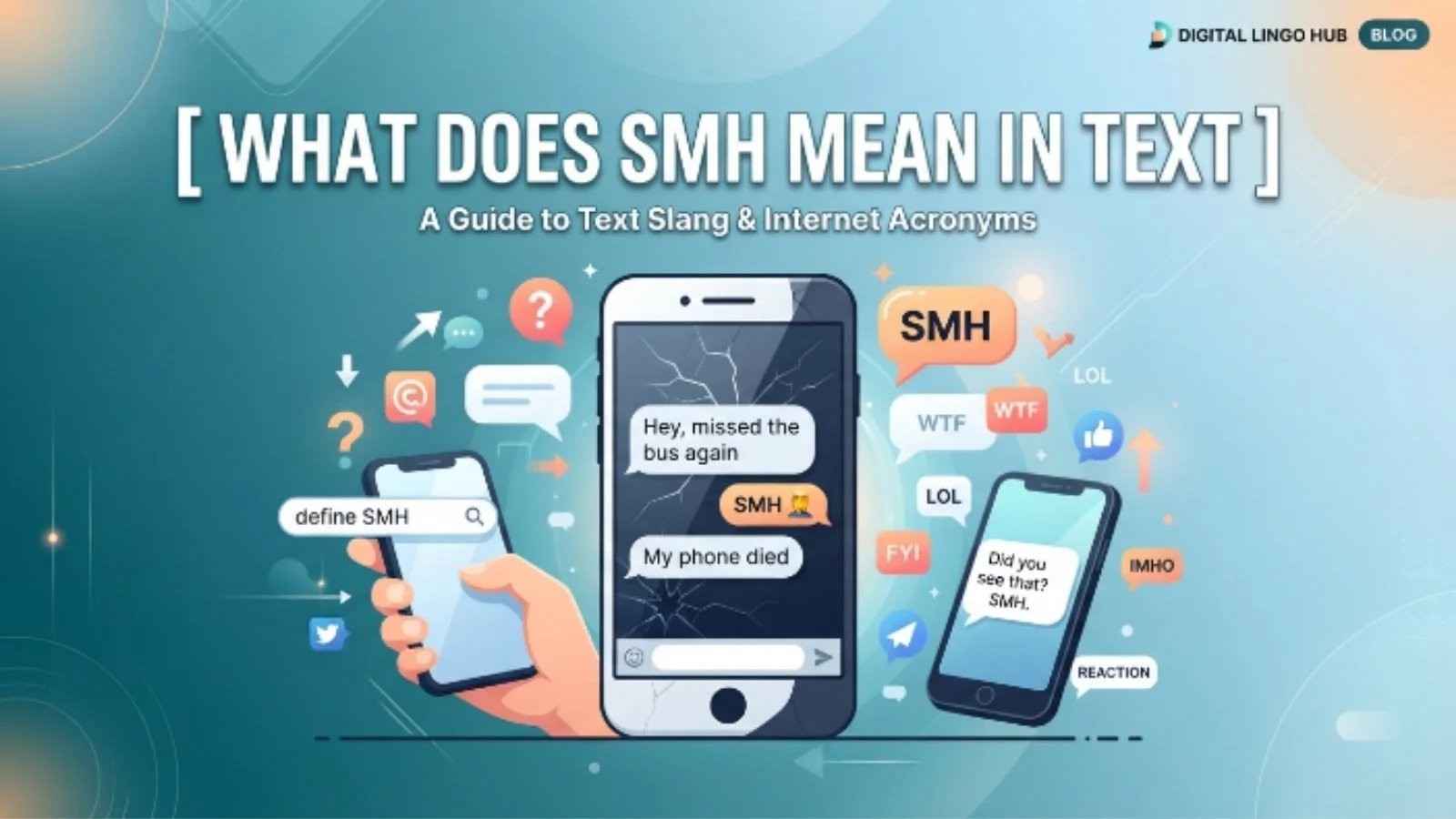
If someone sends you a message like “SMH, I can’t believe you did that”, you may wonder what those three letters mean.
So, what does SMH mean in text?
SMH usually means “shaking my head.” People use it in texts, social media posts, comments, and online chats to show disbelief, disappointment, frustration, annoyance, or mild disapproval. It is similar to the reaction of physically shaking your head when someone does something surprising, silly, careless, or disappointing.
For example:
“You forgot your keys again? SMH.”
This does not literally mean that the person is shaking their head. Instead, the sender is saying something like, “I can’t believe you did that” or “Seriously?”
SMH is one of the many short expressions that make online conversations faster and more emotional. Unlike a simple “okay” or “no,” it can communicate a whole reaction with only three letters.
In this guide, you will learn the SMH meaning in text, where it came from, how people use it, what tone it can have, examples from everyday conversations, common mistakes, and how to understand SMH in modern online communication in 2026.
What Does SMH Mean in Text?
In texting and online communication, SMH means “shaking my head.”
It is an initialism, meaning each letter represents the first letter of a word:
| Letter | Word |
|---|---|
| S | Shaking |
| M | My |
| H | Head |
The expression is based on the physical action of shaking your head from side to side. In real life, people may shake their heads when they disagree, feel disappointed, cannot believe something, or think a situation is ridiculous.
Online, SMH turns that physical reaction into a short text expression.
Simple Definition of SMH
SMH = Shaking My Head
It is commonly used to express:
- Disbelief
- Disappointment
- Frustration
- Annoyance
- Disapproval
- Mild embarrassment
- Surprise
- Exasperation
The exact feeling depends on the conversation.
For example:
“He left his phone at home again. SMH.”
The sender is probably disappointed or amused by the person’s forgetfulness.
Another example:
“SMH, people are still arguing about this?”
Here, SMH expresses frustration or disbelief.
What Does SMH Mean in a Text Message?
When you see SMH in a text message, it usually means that the sender is reacting negatively or incredulously to something.
It can often be understood as:
- “I can’t believe this.”
- “Seriously?”
- “Come on.”
- “That’s disappointing.”
- “What were you thinking?”
- “I don’t even know what to say.”
- “This is ridiculous.”
The expression does not always show serious anger. In many conversations, SMH is playful or humorous.
For example:
Friend 1: I watched the entire movie and realized I had already seen it.
Friend 2: SMH.
The second person is probably teasing the friend rather than genuinely criticizing them.
SMH Can Be Serious or Playful
Context is important.
Compare these two examples:
“SMH, you lied to me.”
This sounds serious and disappointed.
“SMH, you really ate the whole pizza?”
This could be playful teasing.
The letters are the same, but the emotional meaning changes because of the situation.
What Is the Origin and History of SMH?
Like many internet abbreviations, the exact beginning of SMH is difficult to identify. However, evidence places its emergence in online communication in the 2000s.
Dictionary.com reports that SMH became visible as internet slang during the 2000s and was used to communicate tone in text-based conversations. An Urban Dictionary entry appeared in 2004, and the abbreviation became more visible on Twitter around 2007.
The basic idea behind SMH is much older than the abbreviation itself.
People have long used shaking the head as a nonverbal way to communicate disagreement, disbelief, frustration, or disappointment. Internet users simply converted that physical reaction into three letters.
During the growth of texting, forums, social networks, and later social media platforms, abbreviations became useful because people wanted to communicate quickly.
SMH fit perfectly into this style of communication.
How SMH Became Popular
The rise of platforms such as Twitter helped short expressions spread quickly.
Users could write:
“He really said that. SMH.”
instead of:
“I can’t believe he actually said that. I’m shaking my head because I’m disappointed.”
The shorter version was faster and better suited to casual online communication.
By the 2010s, SMH had become familiar enough that media outlets and internet users frequently used it without explaining the abbreviation. Dictionary.com also notes that SMH became common in internet culture and could even be used grammatically within informal digital communication.
Is SMH an Acronym or an Initialism?
Technically, SMH is an initialism.
An acronym is normally pronounced as a word, such as “NASA.” An initialism is usually pronounced letter by letter, such as “FBI.”
SMH is generally read as “S-M-H,” although people may simply recognize it visually without saying it aloud.
In everyday conversation, however, people may casually call SMH an acronym, abbreviation, or slang term. The important point is that it is a short form of “shaking my head.”
What Feelings Can SMH Express?
One reason SMH is so popular is that it can communicate several related emotions.
1. Disbelief
Someone may use SMH when they cannot believe what happened.
“You bought another phone even though yours works perfectly? SMH.”
The sender is surprised by the decision.
2. Disappointment
SMH can show that someone’s actions were disappointing.
“I trusted him, and he still broke his promise. SMH.”
Here, the expression communicates disappointment.
3. Frustration
People also use SMH when something is annoying.
“The website crashed right before I submitted my assignment. SMH.”
The sender is frustrated by the situation.
4. Disapproval
SMH can suggest that the sender thinks someone’s behavior was wrong or foolish.
“She was rude to the waiter for no reason. SMH.”
The sender is showing disapproval.
5. Humor
SMH can also be used jokingly.
“You seriously forgot your own birthday plans? SMH.”
The speaker is probably teasing rather than expressing serious anger.
SMH Tone: What Does It Really Sound Like?
The tone of SMH depends heavily on context.
It can be:
| Tone | Example | Meaning |
|---|---|---|
| Disappointed | “You forgot again. SMH.” | I expected better. |
| Frustrated | “SMH, this app keeps crashing.” | This is annoying. |
| Surprised | “He actually won? SMH.” | I can’t believe it. |
| Playful | “You ate all the cookies? SMH.” | I’m teasing you. |
| Disapproving | “They treated him badly. SMH.” | I don’t approve. |
| Amused | “You wore two different shoes. SMH.” | That’s funny or silly. |
Because text messages do not include facial expressions or voice tone, readers often need to use the surrounding words to understand the intended emotion.
How Is SMH Used in Texting?
There are several common ways people use SMH.
SMH at the Beginning of a Sentence
“SMH, why would you do that?”
This makes the reaction clear before the main statement.
SMH at the End
“You forgot the milk again, smh.”
Here, SMH acts like a reaction to everything that came before it.
SMH by Itself
“SMH.”
This can be a complete response.
For example:
Friend: I accidentally deleted the entire folder.
Friend: SMH.
The sender does not need to explain further because the abbreviation communicates the reaction.
Lowercase “smh”
People often type smh instead of SMH.
Both mean the same thing.
“smh, I should have checked first.”
Lowercase writing is common in casual texting and social media.
Real-Life Texting Examples of SMH
Understanding examples is one of the easiest ways to learn internet slang.
Example 1: Forgetting Something
A: I left my wallet at home again.
B: SMH, you need a reminder.
Explanation: B is mildly frustrated but may also be joking.
Example 2: A Silly Mistake
A: I put my shirt on inside out and didn’t notice for three hours.
B: SMH.
Explanation: B is probably amused by the mistake.
Example 3: Disappointment
A: He promised he would help, but he never showed up.
B: SMH. That’s not okay.
Explanation: Here, SMH shows disappointment and disapproval.
Example 4: Online Discussion
“People are still spreading that rumor even after it was proven false. SMH.”
Explanation: The writer is frustrated by what they see as unreasonable behavior.
Example 5: School or Work
A: I submitted the wrong file to my teacher.
B: SMH, check the filename next time.
Explanation: B is expressing mild frustration while giving advice.
Example 6: Family Conversation
Brother: Mom told me to clean my room, so I cleaned only the doorway.
Sister: SMH.
Explanation: The response suggests that the sister finds the behavior silly.
SMH in Social Media
SMH is common in online comments, posts, group chats, and other forms of digital communication.
A person may use it after seeing something they consider:
- Ridiculous
- Confusing
- Disappointing
- Unfair
- Funny
- Careless
- Unbelievable
For example:
“He posted the same complaint three times today. SMH.”
The writer is reacting to behavior they find excessive or frustrating.
Dictionary.com describes SMH as a common expression on social media and in texting for frustration, exasperation, and disbelief.
SMH on TikTok and Other Social Platforms
SMH can also appear in captions, comments, memes, reaction posts, and videos.
For example:
“When you study the wrong chapter for the exam… smh.”
The phrase adds a humorous reaction to the situation.
It can also appear with other text:
“I really thought this would work. SMH.”
The expression tells readers that the person is disappointed with the result.
What Kind of Person Uses SMH?
There is no single type of person who uses SMH.
It is widely understood in internet culture and can appear in conversations between friends, classmates, coworkers, family members, and online communities.
However, it is most natural in casual communication.
People who use SMH may want to:
- Keep a message short
- Show emotion quickly
- Sound conversational
- Add humor
- React to something surprising
- Show mild frustration
- Make their message feel informal
It is less about someone’s personality and more about the communication style and situation.
Is SMH Rude?
SMH is not automatically rude, but it can sound rude depending on the context.
Consider:
“SMH, you’re impossible.”
This may sound insulting.
But:
“SMH, you really forgot your coffee again?”
This could simply be friendly teasing.
If someone uses SMH while discussing a serious disagreement, it may make their message sound dismissive.
Therefore, always consider who you are talking to and what happened before using it.
When Should You Use SMH?
SMH works best in casual situations.
Good Places to Use SMH
You can normally use it in:
- Text messages
- Group chats
- Social media comments
- Social media posts
- Casual DMs
- Conversations with friends
- Informal online communities
Places to Avoid SMH
Avoid using SMH in formal writing such as:
- Job applications
- Professional emails
- Academic essays
- Business reports
- Official letters
- Formal presentations
Instead of:
“SMH, this report has several errors.”
A professional message would say:
“I noticed several errors in the report that should be corrected.”
This is clearer and more appropriate for formal communication.
SMH vs. Similar Texting Expressions
SMH is often confused with other internet abbreviations.
| Expression | Meaning | Main Use |
|---|---|---|
| SMH | Shaking my head | Disbelief or disappointment |
| SMDH | Shaking my damn head | Stronger frustration |
| LOL | Laughing out loud | Humor |
| OMG | Oh my God | Surprise or shock |
| WTH | What the heck/hell | Confusion or frustration |
| IDK | I don’t know | Uncertainty |
| TBH | To be honest | Honest opinion |
| FR | For real | Agreement or emphasis |
Understanding these differences helps you read text messages more naturally.
What Does SMDH Mean?
You may also see SMDH, which is a stronger variation of SMH.
It commonly means “shaking my damn head.”
The extra word makes the reaction more intense.
For example:
“SMDH, I can’t believe he did that again.”
This expresses stronger frustration than a simple “SMH.”
Because SMDH contains stronger language, it may not be appropriate in every conversation. Dictionary.com identifies SMDH as an intensified form of SMH.
Does SMH Always Mean “Shaking My Head”?
No.
“Shaking my head” is by far the main texting meaning, but abbreviations can have different meanings in different contexts.
Dictionary.com notes that SMH can occasionally have other interpretations, including “so much hate” and “scratching my head.” It also points out that SMH can refer to unrelated names or organizations in other contexts.
This is why context matters.
For example:
“SMH, I can’t believe you did that.”
Here, “shaking my head” clearly fits.
But if SMH appears in a business, medical, financial, or organizational document, it may have nothing to do with internet slang.
Common Mistakes and Misconceptions About SMH
Mistake 1: Thinking SMH Means “So Much Hate”
This is not the usual texting meaning.
In everyday internet conversations, SMH normally means “shaking my head.”
Mistake 2: Thinking SMH Always Means Anger
Not necessarily.
It can express mild amusement, disappointment, surprise, frustration, or playful teasing.
Mistake 3: Using SMH in Formal Writing
SMH is informal internet language.
It is better to write the full thought in professional or academic communication.
Mistake 4: Assuming SMH Is Always Insulting
The tone depends on context.
A friend may write “SMH” as a joke, while someone in an argument may use it to show serious disapproval.
Mistake 5: Believing Capital Letters Change the Meaning
SMH and smh generally mean the same thing.
Capitalization usually changes the visual style, not the definition.
How to Respond When Someone Says SMH
Your response depends on why they used it.
If they are joking:
“Haha, I know. That was a bad decision.”
If they are criticizing you:
“What did I do?”
If you agree with their reaction:
“Honestly, same.”
If you want to explain yourself:
“I know it looks bad, but there was a reason.”
You do not always need to respond directly to SMH. Sometimes it functions as a reaction rather than a question.
Modern SMH Examples for 2026
In 2026, SMH continues to fit naturally into fast-moving digital conversations, especially where users react to posts, videos, messages, and everyday situations.
Social Media Example
“He made a whole video complaining about people commenting on his videos. SMH.”
Explanation: The writer finds the situation contradictory or ridiculous.
Group Chat Example
“Guys, I forgot we had a meeting today. SMH.”
Explanation: The sender is criticizing their own forgetfulness.
Gaming Example
“We were winning until someone quit. SMH.”
Explanation: The player is frustrated by what happened.
Online Shopping Example
“I waited all week for the delivery and they sent the wrong item. SMH.”
Explanation: SMH shows disappointment with the situation.
Everyday Life Example
“I searched for my glasses for ten minutes. They were on my head. SMH.”
Explanation: This is a humorous use showing embarrassment and amusement.
How to Understand SMH From Context
If you see SMH and do not know what it means, look at the words around it.
Ask yourself:
- Did something surprising happen?
- Did someone make a mistake?
- Is the sender disappointed?
- Is the situation funny or ridiculous?
- Is the sender criticizing someone’s behavior?
- Is the conversation casual?
If the answer to one or more of these questions is yes, “shaking my head” is probably the intended meaning.
Frequently Asked Questions About SMH
What does SMH mean in text?
SMH means “shaking my head.” It is used to express disbelief, frustration, disappointment, annoyance, or disapproval. It can also be playful or humorous depending on the context.
What does SMH mean from a girl?
If a girl sends SMH, it generally has the same meaning as when anyone else uses it: “shaking my head.” Her exact emotion depends on the conversation. She could be joking, disappointed, frustrated, or surprised.
What does SMH mean from a guy?
If a guy texts SMH, it usually means “shaking my head.” It does not automatically indicate anger or romantic interest. Look at the surrounding messages to understand the tone.
Is SMH positive or negative?
SMH is usually negative or disapproving, but it does not always express strong negativity. It can be playful, humorous, or teasing between friends.
Is SMH rude?
It can be rude in some situations, especially when used to dismiss or criticize another person. However, friends often use it casually without intending offense.
What does SMDH mean?
SMDH usually means “shaking my damn head.” It is a stronger version of SMH and generally communicates greater frustration or disbelief.
Can I use SMH in professional messages?
It is better to avoid SMH in formal professional communication. Use clear words such as “I’m disappointed,” “I’m surprised,” or “I’m concerned about this” instead.
Final Thoughts
SMH means “shaking my head” and is one of the most recognizable expressions in casual online communication. People use it to show disbelief, disappointment, frustration, disapproval, surprise, or playful amusement. Its meaning is usually easy to understand when you look at the surrounding conversation. While SMH is perfect for texts, chats, comments, and casual social media posts, it is best avoided in formal writing. If you see SMH in a message, think of it as a short digital version of someone shaking their head and saying, “Seriously?” Understanding expressions like this can make texting and online conversations much easier to follow. If you found this explanation useful, explore more common texting abbreviations to build your everyday English vocabulary.
Discover More Post
