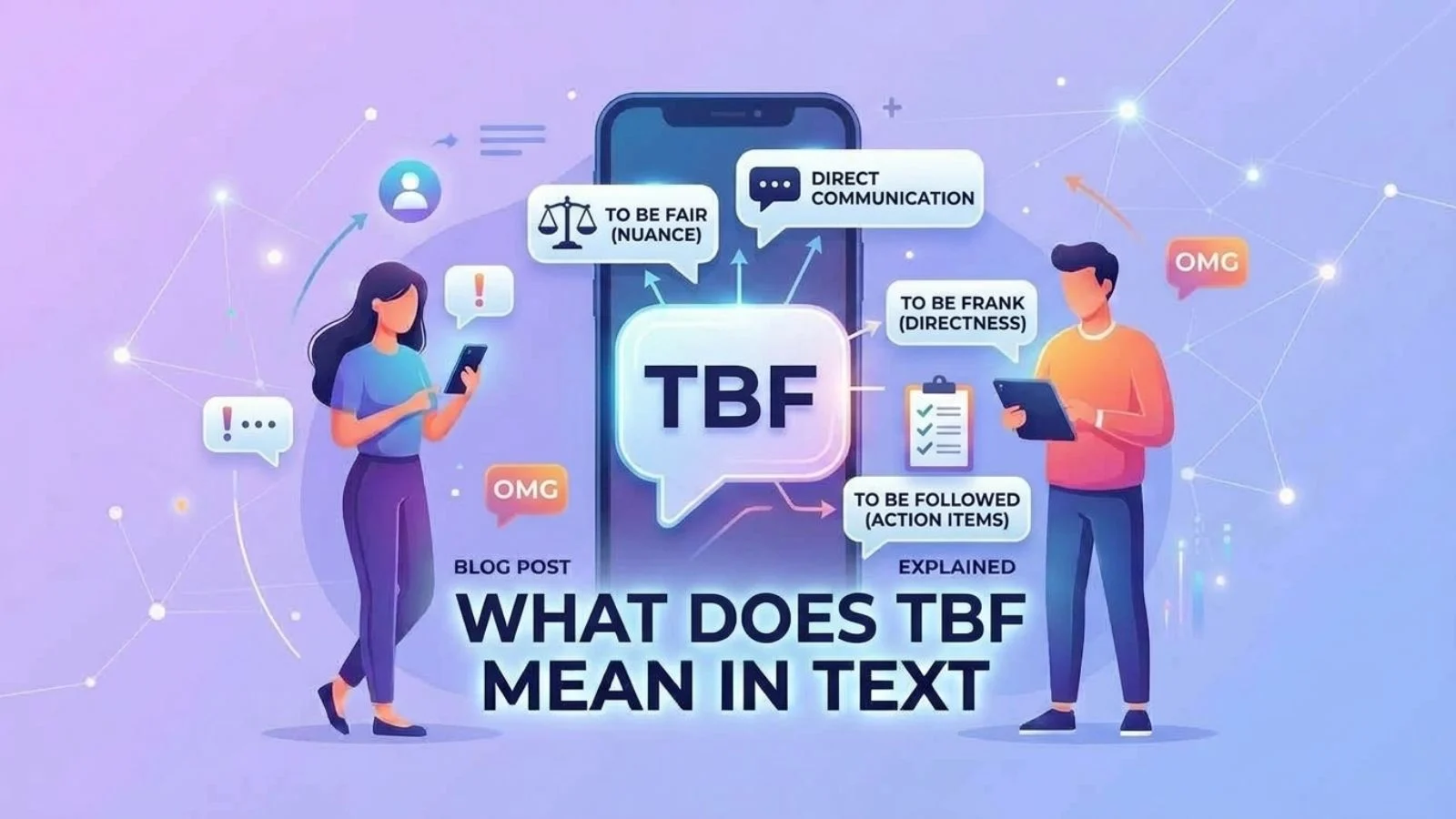
If someone sends you “tbf” in a text, they are usually saying “to be fair.” It is a common internet abbreviation used when someone wants to add balance, explain another side of a situation, or make their opinion sound more reasonable.
For example, if a friend says, “I didn’t like the movie, tbf the ending was good,” they mean, “To be fair, the ending was good.” The abbreviation is short, casual, and widely used in everyday online conversations.
What Does TBF Mean in Text?
TBF means “to be fair” in text messages and online conversations.
People use it when they want to acknowledge another point, give someone credit, or add a fair comment to what they have already said.
For example:
“I don’t really like his music, tbf his latest song is pretty good.”
Here, tbf introduces a positive point that balances the speaker’s earlier opinion.
The abbreviation is especially common in texting, social media comments, chats, gaming conversations, and other informal digital communication.
Simple Meaning of TBF
In simple English, tbf means “to be fair.”
You can think of it as a quick way to say:
- To be fair
- Honestly, when you think about it
- I have to admit
- On the other hand
- Giving credit where it is due
The exact meaning depends on the sentence.
For example:
“She was late, but tbf she had a lot going on.”
This means:
“She was late, but to be fair, she had a lot going on.”
The person is not completely defending her, but they are asking you to consider another side of the situation.
What Does TBF Mean in a Conversation?
In a conversation, tbf often signals that someone is about to make a fair or balanced observation.
Imagine two friends discussing a restaurant.
Friend 1: “The service was really slow.”
Friend 2: “Yeah, tbf the place was packed.”
Friend 2 agrees that the service was slow but points out a reason that explains the situation.
This is one of the most common ways people use tbf.
It can also be used before a positive comment:
“Tbf, you did warn me about it.”
This means:
“To be fair, you did warn me about it.”
Where Is TBF Used?
You can see tbf in many informal online spaces.
Text Messages
People often use tbf in private conversations because abbreviations make messages faster and more casual.
Example:
“I was annoyed at first, tbf I understand why you did it.”
Social Media
TBF is also common in comments, posts, and replies on social platforms.
Someone might write:
“Tbf, this is actually better than the original.”
Group Chats
Friends may use tbf when discussing plans, arguments, movies, sports, school, work, or everyday situations.
Example:
“He didn’t come with us, but tbf nobody invited him.”
Gaming Chats
Gamers may use tbf when discussing another player’s performance.
Example:
“He missed the shot, but tbf it was a difficult angle.”
Online Discussions
TBF can be especially useful when someone wants to acknowledge a point made by another person.
Example:
“I disagree with her, but tbf she has a point.”
Why Do People Use TBF?
There are several reasons people use tbf instead of writing the full phrase.
It Saves Time
Typing “tbf” is much faster than typing “to be fair.”
This is especially useful in quick conversations.
It Sounds Casual
TBF feels natural in informal texting. It does not sound as formal as phrases such as “however” or “on the other hand.”
It Adds Balance
One of the main purposes of tbf is to show that someone is considering more than one side.
For example:
“I don’t like the new design. Tbf, it is easier to use.”
The speaker still dislikes the design but recognizes something positive about it.
It Softens an Opinion
Sometimes tbf makes criticism sound less harsh.
Compare:
“You made a bad decision.”
with:
“Tbf, you didn’t have much information at the time.”
The second statement sounds more understanding because it considers the circumstances.
TBF Examples in Text Messages
Here are some realistic examples of how people use tbf in everyday texting.
Example 1
“I thought the movie was boring, tbf the acting was really good.”
Meaning: The person did not enjoy the movie but admits that the acting was good.
Example 2
“He can be annoying sometimes, tbf he’s always there when you need him.”
Meaning: The person recognizes his annoying behavior but also gives him credit for being supportive.
Example 3
“I don’t want to go out tonight. Tbf, I haven’t slept properly all week.”
Meaning: The person explains why staying home is reasonable.
Example 4
“She didn’t answer my message, but tbf I only sent it an hour ago.”
Meaning: The person realizes it may be unfair to expect an immediate response.
Example 5
“That game was difficult, tbf we were playing against a much better team.”
Meaning: The speaker explains why losing was understandable.
Example 6
“I wasn’t expecting much from the restaurant, tbf the food was amazing.”
Meaning: The food was surprisingly good despite the speaker’s low expectations.
TBF vs Similar Texting Terms
TBF can look similar to several other expressions, but they do not always have exactly the same meaning.
| Term | Meaning | Common Use |
|---|---|---|
| TBF | To be fair | Adding balance or acknowledging another point |
| TBH | To be honest | Giving an honest opinion |
| IMO | In my opinion | Sharing a personal viewpoint |
| IKR | I know, right? | Agreeing strongly with someone |
| BTW | By the way | Introducing additional information |
| NGL | Not gonna lie | Introducing an honest statement |
TBF vs TBH
TBF means “to be fair.”
TBH means “to be honest.”
For example:
“TBF, he tried his best.”
This focuses on fairness.
“TBH, I didn’t enjoy the movie.”
This focuses on honesty.
They can sometimes appear together:
“TBH, I didn’t like it. TBF, the ending was good.”
TBF vs IMO
IMO means “in my opinion.”
It is used to introduce a personal view.
Example:
“IMO, this is the best album.”
TBF has a different purpose:
“TBF, the old version was easier to use.”
The first expresses an opinion, while the second acknowledges a fair point.
When Should You Use TBF?
You can use tbf when you are having an informal conversation and want to add a balanced observation.
It works well when:
- You are acknowledging someone’s good point.
- You want to give someone credit.
- You are explaining a situation.
- You want to make criticism softer.
- You are admitting that another side has some truth.
- You are changing or balancing your initial opinion.
For example:
“I didn’t want to go, but tbf I had a great time.”
This shows that your original opinion changed after considering what actually happened.
When Should You Avoid TBF?
Although tbf is common online, it is not appropriate for every situation.
Avoid using it in very formal communication, such as:
- Formal business letters
- Academic essays
- Official applications
- Legal documents
- Professional reports
Instead of writing:
“TBF, the project was difficult.”
A formal version would be:
“To be fair, the project presented several challenges.”
The full phrase is clearer and more professional.
Common Misunderstandings About TBF
TBF Does Not Always Mean Agreement
Someone using tbf does not necessarily agree with everything you said.
For example:
“I don’t agree with you, but tbf I understand your point.”
The person still disagrees but recognizes that your argument has something reasonable about it.
TBF Is Not Always an Apology
TBF can sometimes sound apologetic, but it does not directly mean “sorry.”
For example:
“Tbf, you never told me about the meeting.”
This is not an apology. The speaker is pointing out a fact that they believe should be considered.
TBF Does Not Automatically Mean Someone Is Defending Another Person
It can be used to defend someone, but that is not its only purpose.
For example:
“Tbf, the phone is expensive but the camera is excellent.”
Here, the speaker is balancing a negative point with a positive one.
Can TBF Be Used at the Beginning of a Sentence?
Yes. This is very common.
Examples:
“Tbf, I didn’t expect you to come.”
“Tbf, that was a difficult question.”
“Tbf, she did warn us.”
Putting tbf at the beginning makes it clear that the following statement is a balancing or qualifying point.
Can TBF Be Used at the End of a Sentence?
Yes, although the placement depends on the style of the conversation.
For example:
“That was actually pretty funny tbf.”
This means:
“That was actually pretty funny, to be fair.”
Using tbf at the end can make the message sound especially casual.
Is TBF Rude?
No, tbf is not normally considered rude.
In many situations, it can actually make a message sound more reasonable because you are showing that you have considered another perspective.
However, tone matters.
For example:
“You’re wrong, tbf.”
could sound dismissive or argumentative.
Meanwhile:
“I see what you mean, tbf.”
sounds more open and understanding.
The surrounding words are often more important than the abbreviation itself.
How Do You Reply to TBF in a Text?
Your response depends on the situation.
If you agree, you can say:
“Yeah, that’s true.”
“Fair point.”
“Exactly.”
“I agree with you.”
If you disagree, you can explain your position:
“I get that, but I still think…”
“That’s fair, but…”
If you are unsure what the person means, you can simply ask:
“What do you mean?”
There is nothing strange about asking for clarification when the context is unclear.
Pro Tips for Using TBF Correctly
If you want your texting to sound natural, keep a few things in mind.
Use It in Casual Conversations
TBF works best in texts, chats, social media, and conversations with people you know.
Use It When You Are Adding Balance
Don’t add tbf randomly. It works best when you are acknowledging another side of a situation.
Pay Attention to Tone
The same phrase can sound friendly, neutral, or sarcastic depending on the surrounding words.
Don’t Overuse It
Using tbf in every other sentence can make your messages repetitive.
Use it when it genuinely adds meaning.
Consider Your Audience
If the person may not know texting abbreviations, write “to be fair” instead.
Clear communication is more important than shortening every phrase.
Final Thoughts
So, what does tbf mean in text? It usually means “to be fair.” People use it to acknowledge another side of a situation, give someone credit, explain circumstances, or make an opinion sound more balanced.
You will commonly see tbf in text messages, social media comments, group chats, gaming conversations, and other informal online discussions.
If someone says, “Tbf, you did warn me,” they are simply saying, “To be fair, you did warn me.”
Once you understand the context, this abbreviation is easy to recognize and use.
Frequently Asked Questions
What does TBF stand for in texting?
TBF stands for “to be fair.” It is commonly used in informal text messages and online conversations when someone wants to acknowledge another point or add balance to a statement.
What does TBF mean on social media?
On social media, tbf usually means “to be fair.” People use it when agreeing with part of an argument, giving someone credit, or pointing out another side of a situation.
Is TBF the same as TBH?
No. TBF means “to be fair,” while TBH means “to be honest.” TBF is mainly used to add balance or acknowledge another perspective, while TBH introduces an honest opinion.
Is it okay to use TBF in formal writing?
Usually, no. TBF is an informal abbreviation. In professional, academic, or formal writing, it is better to write the complete phrase “to be fair.”
Discover More Post
