You’re texting someone.
Everything is normal.
Then suddenly they reply with just two letters:
“TS.”
And now you’re staring at your screen wondering…
Is that good? Is that bad? Did I miss something?
If you’ve ever paused mid-text trying to decode this, you’re not alone. Slang moves fast. And “TS” is one of those short forms that can mean different things depending on the situation.
Let’s break it down clearly, simply, and in a way that actually makes sense.
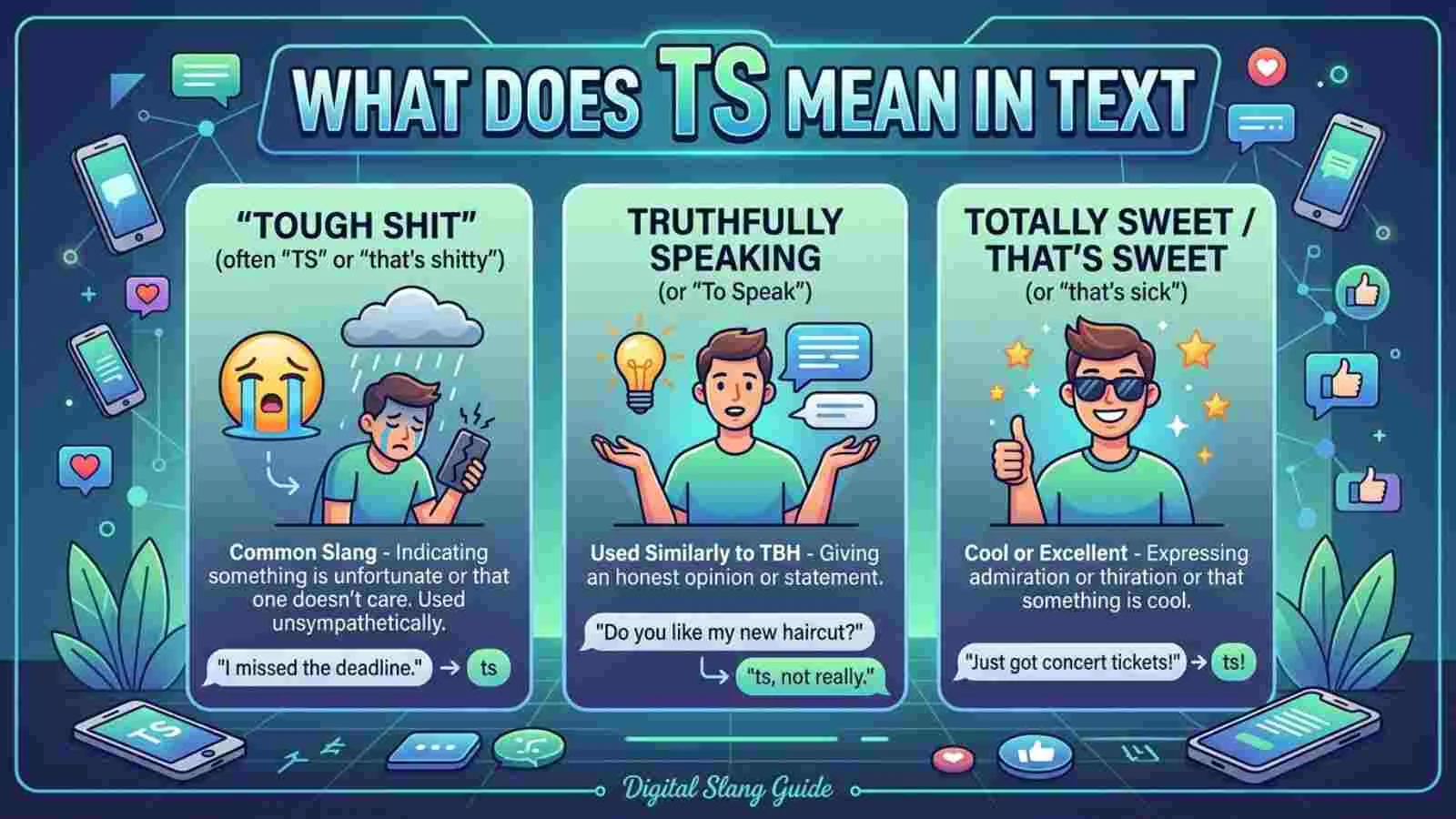
What Does TS Mean in Text?
TS most commonly means “That’s Serious” or “Talk Soon” in text messages.
But it can also mean:
- Tough Situation
- True Story
- TeamSpeak (in gaming)
- Transsexual / Transgender (in identity discussions, though this usage requires sensitivity)
The meaning depends completely on context — who’s texting, what you’re talking about, and the tone of the conversation.
Simple Meaning (Explained Like You’d Tell a Friend)
Think of “TS” as a shortcut.
Instead of typing:
- “That’s serious.”
- “Talk soon.”
- “True story.”
People just type TS to save time.
It’s fast.
It’s casual.
And it’s common in texting culture.
If you understand the conversation around it, the meaning becomes obvious.
Where Is TS Used?
You’ll mostly see “TS” in informal conversations.
Here’s where it shows up most:
1. Text Messages
Friends texting quickly.
Short replies.
Fast reactions.
Example:
“He got suspended.”
“TS.”
Here, it likely means That’s Serious.
2. Snapchat & Instagram DMs
Quick reactions to stories.
Example:
“I failed my driving test.”
“TS, you’ll pass next time.”
Again, it likely means That’s Serious or acknowledging something big happened.
3. Gaming Chats
In online gaming communities, TS can mean TeamSpeak — a voice chat software used by players.
Example:
“Join TS before the match.”
That clearly doesn’t mean “Talk Soon.” It means open the voice chat app.
4. Online Forums & Reddit
Sometimes used as:
- True Story
Example:
“I once slept through an exam. TS.”
Meaning: This actually happened.
Why Do People Use TS?
There are three main reasons:
1. Speed
Typing two letters is faster than typing a full sentence.
People text quickly.
They shorten everything.
TS fits that style.
2. Casual Tone
“TS” feels relaxed and informal.
It’s not something you’d write in an email to your boss.
But to your friend? Totally normal.
3. Inside Culture
Slang builds connection.
When you use terms like TS, it shows you’re comfortable with modern texting style.
It feels natural in digital conversations.
Real-Life Examples (With Clear Explanations)
Let’s look at how meaning changes depending on context.
Example 1: That’s Serious
Friend:
“My car broke down on the highway.”
You:
“TS. Are you okay?”
Here, TS means That’s Serious.
You’re reacting to something important.
Example 2: Talk Soon
You:
“I have to go to class now.”
Friend:
“Okay, TS.”
Here, TS means Talk Soon.
Example 3: Tough Situation
Friend:
“I have two exams and a presentation tomorrow.”
You:
“TS. Good luck.”
Meaning: That’s a tough situation.
Example 4: True Story
Someone posts:
“I once texted my teacher instead of my crush.”
Reply:
“TS.”
Meaning: True story. It actually happened.
TS vs Similar Text Slang
Here’s a quick comparison so you don’t mix things up.
| Slang | Meaning | When Used |
|---|---|---|
| TS | That’s Serious / Talk Soon / True Story | Casual texting |
| FR | For Real | Emphasizing truth |
| TBH | To Be Honest | Sharing opinion |
| TTYL | Talk To You Later | Ending conversation |
| IMO | In My Opinion | Giving personal view |
Notice something?
TTYL and TS can both mean goodbye, but TTYL is clearer. TS depends more on context.
When Should You Use TS?
Use TS when:
- You’re texting close friends
- The meaning is obvious from context
- The conversation is casual
- You want to keep things short
Avoid using TS when:
- You’re speaking professionally
- The meaning could confuse someone
- The topic is serious and needs clarity
- The other person may not know slang
Clarity always wins.
Common Misunderstandings About TS
Because TS has multiple meanings, confusion happens.
Here are common mistakes:
1. Thinking It Always Means “Talk Soon”
Not true.
It might mean “That’s Serious” instead. Always check the conversation tone.
2. Assuming It’s Negative
Sometimes people think TS is sarcastic.
It usually isn’t.
It’s neutral. Tone depends on how it’s used.
3. Misreading It in Identity Conversations
In some discussions, TS can refer to “transsexual” or “transgender.”
This usage requires respect and sensitivity.
Never assume meaning in serious discussions without clarity.
Pro Tips for Using TS Correctly
If you want to sound natural and avoid awkward replies, follow these tips:
1. Read the Full Conversation
Don’t isolate the word.
Look at the message before it.
Context tells you everything.
2. Match the Tone
If someone shares big news, TS probably means “That’s Serious.”
If someone is leaving the chat, TS likely means “Talk Soon.”
3. If You’re Unsure, Ask
It’s okay to say:
“What do you mean by TS?”
That’s better than misunderstanding.
4. Don’t Overuse It
Using too much slang can feel lazy or confusing.
Balance is key.
Is TS Popular in 2026?
Yes — but it’s not as trendy as newer slang like:
- “FR”
- “ONG”
- “BFFR”
TS is more subtle.
It’s been around for years and still appears in quick chats.
It’s not flashy.
It’s functional.
Final Thoughts
So, what does TS mean in text?
It usually means “That’s Serious” or “Talk Soon.”
But like most slang, the real answer depends on context.
When you see it, don’t panic.
Just look at the message around it.
And if you ever feel unsure — asking is always smarter than guessing.
Now the next time someone texts “TS,” you won’t freeze.
You’ll know exactly what they mean.
Frequently Asked Questions
1. Does TS always mean “Talk Soon”?
No. It can also mean “That’s Serious,” “True Story,” or other things depending on context.
2. Is TS rude?
No. It’s neutral. Tone depends on how it’s used in conversation.
3. Is TS used by teenagers only?
Mostly teens and young adults use it, but anyone familiar with texting slang might use it.
4. Can TS mean something inappropriate?
In some contexts, TS can refer to gender identity terms. Always consider the topic before assuming meaning.
Discover More Post
