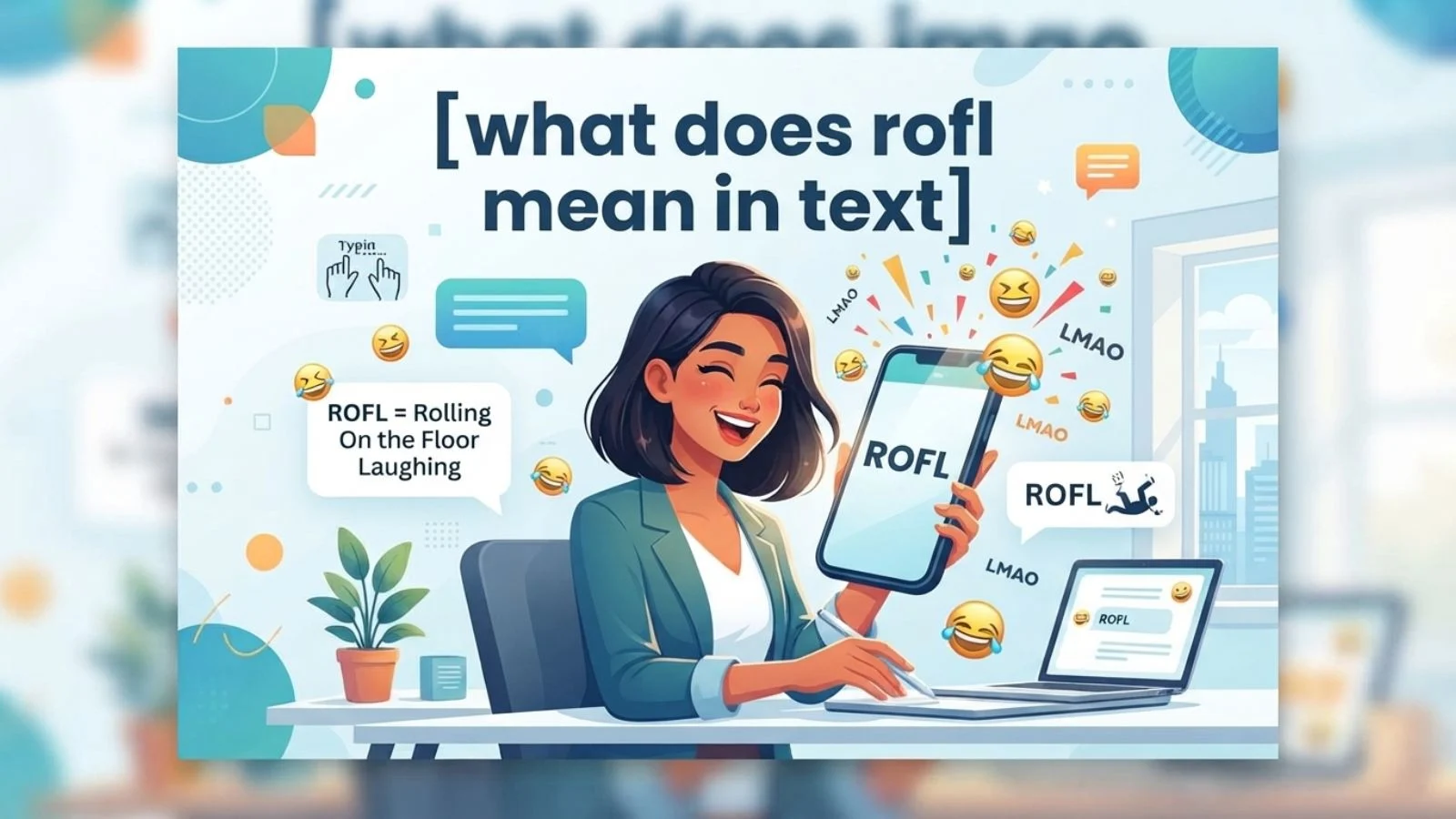
If you have seen someone type “ROFL” in a text, comment, or chat, they are usually saying that something is very funny. ROFL stands for “Rolling On the Floor Laughing.” It is an informal internet abbreviation used to show strong laughter or amusement.
Most people do not mean that they are literally rolling on the floor. Instead, ROFL is an exaggerated way to say, “That is so funny!” or “I am laughing really hard.”
You may see ROFL in text messages, group chats, social media comments, gaming conversations, memes, and casual online discussions. It is especially useful when a simple “LOL” does not feel strong enough.
What Does ROFL Mean in Text?
ROFL means “Rolling On the Floor Laughing.”
It is an internet slang expression that shows strong amusement. When someone replies with ROFL, they usually found the previous message, joke, story, picture, or video extremely funny.
For example:
Friend: “I tried to look cool and walked into the wrong classroom.”
You: “ROFL!”
Here, ROFL means “That is extremely funny!” The person is not saying that they are actually rolling on the floor.
The phrase is intentionally dramatic. It creates a funny mental picture of someone laughing so hard that they cannot stay upright.
Simple Definition of ROFL
In very simple English:
ROFL = I am laughing really hard because this is very funny.
You can think of it as a stronger reaction than ordinary laughter.
| Term | Meaning | General feeling |
|---|---|---|
| ROFL | Rolling On the Floor Laughing | Very strong laughter |
| LOL | Laughing Out Loud | General laughter |
| LMAO | Laughing My Ass Off | Very strong, informal laughter |
| HAHA | Laughter | Simple and flexible |
| ROFLMAO | Rolling On the Floor Laughing My Ass Off | Very exaggerated laughter |
The exact strength depends on the person and situation, but ROFL is generally used for something that the sender considers really funny.
What Does ROFL Stand For?
Each letter in ROFL comes from a word in the phrase:
- R = Rolling
- O = On
- F = Floor
- L = Laughing
So:
ROFL = Rolling On the Floor Laughing
You may also see ROTFL, which means “Rolling On the Floor Laughing.” The extra T represents “the.” Both forms communicate essentially the same idea. Dictionary sources list ROTFL as an alternative form of ROFL.
Is ROFL an Acronym or Abbreviation?
ROFL is commonly called an internet acronym, although linguistically it can also be described as an initialism because the letters represent the words in a phrase.
In everyday use, this difference is not important. If someone asks what ROFL means, the useful answer is simply:
ROFL means “Rolling On the Floor Laughing.”
Where Did ROFL Come From?
ROFL developed during the early period of internet communication when people used online chat rooms, forums, and messaging services to communicate quickly.
The Online Etymology Dictionary dates rofl to around 1993 as an online chat abbreviation for “rolling on the floor laughing.”
During the early internet years, people often needed short ways to show emotion because digital conversations were almost entirely text-based. Before modern reaction buttons, GIFs, and the huge variety of communication tools available today, abbreviations helped people make their tone clearer.
Expressions such as LOL, LMAO, and ROFL became part of this growing style of online communication.
The phrase itself is humorous because it describes laughter in an exaggerated physical way. Saying someone is “rolling on the floor laughing” does not usually mean that they are literally doing it.
ROFL and the Early Internet
ROFL belongs to the same general internet-language culture that produced many familiar abbreviations.
People wanted to communicate ideas quickly, so long phrases were shortened into a few letters.
For example:
“Be right back” → BRB
“Laughing out loud” → LOL
“Rolling on the floor laughing” → ROFL
This made fast online conversations easier.
ROFL became familiar through digital communication and later appeared in instant messaging, texting, social media, forums, and online communities.
How Is ROFL Used in a Text?
ROFL is usually used as a reaction.
Someone may send ROFL after reading a funny story, watching a funny video, seeing an unexpected mistake, or hearing a clever joke.
Here are some common examples.
Example 1: A Funny Story
Person A: “I waved at someone because I thought they were my friend. They were a complete stranger.”
Person B: “ROFL!”
Meaning: Person B thinks the situation is very funny.
Example 2: A Funny Video
Person A: “Did you watch that cat video?”
Person B: “Yes, ROFL. The ending was so unexpected.”
Meaning: Person B found the video extremely funny.
Example 3: A Friend’s Mistake
Person A: “I spent ten minutes looking for my phone while holding it.”
Person B: “ROFL, seriously?”
Meaning: Person B is laughing at the funny situation.
Example 4: A Funny Meme
Person A: “Sends a meme about waking up five minutes before work.”
Person B: “ROFL. This is literally me.”
Meaning: The meme feels funny and relatable to Person B.
Example 5: A Group Chat
Friend 1: “I accidentally sent my shopping list to my teacher.”
Friend 2: “ROFL!”
Friend 3: “No way!”
Meaning: ROFL shows that Friend 2 finds the embarrassing situation very funny.
Why Do People Use ROFL?
People use ROFL because text messages do not always show emotion clearly.
If someone writes:
“That was funny.”
the sentence can sound calm.
If they write:
“ROFL!”
the reaction feels much stronger and more playful.
ROFL helps communicate emotion and tone without requiring a long explanation.
People may use it to:
- Show strong laughter
- React to a joke
- Respond to a funny story
- Show that a meme is hilarious
- Make a conversation more playful
- Show that they understand the humor
- React to an unexpected situation
- Make their response feel more energetic
In many cases, ROFL is less about describing actual physical laughter and more about showing your emotional reaction.
What Kind of Personality Uses ROFL?
You cannot accurately determine someone’s personality just because they use ROFL.
However, the expression is usually associated with a casual, playful, or humorous communication style.
Someone who uses ROFL may be comfortable with internet slang and informal conversations. They may also use other expressions such as LOL, LMAO, or BRB.
But context matters.
A person who normally writes formally may still use ROFL when chatting with close friends. Likewise, someone who rarely uses slang may simply write “haha” instead.
So ROFL tells you more about the tone of that particular message than about the person’s overall personality.
Is ROFL Still Used in 2026?
Yes. ROFL remains recognizable in 2026, although its popularity can vary by age group, platform, and online community.
Internet language changes quickly. New expressions, reaction styles, GIFs, and visual responses can become popular while older abbreviations remain familiar.
ROFL is often understood by people who have used internet slang for many years. Some younger users may prefer newer expressions or visual reactions instead.
That does not make ROFL meaningless or incorrect. It simply means its style can feel older or more playful depending on the audience.
For example, someone might write:
“ROFL, I remember this meme!”
This can sound casual and even slightly nostalgic.
Modern 2026 Example
Person A: “I just watched my friend argue with an automatic door because it wouldn’t open.”
Person B: “ROFL, what happened next?”
Here, ROFL works as a strong reaction before asking for more details.
ROFL vs. LOL
One of the most common questions is the difference between ROFL and LOL.
LOL means “Laughing Out Loud.”
ROFL means “Rolling On the Floor Laughing.”
Both express amusement, but ROFL generally creates a stronger or more exaggerated image of laughter.
| Feature | LOL | ROFL |
|---|---|---|
| Full meaning | Laughing Out Loud | Rolling On the Floor Laughing |
| Tone | Casual | Very playful or exaggerated |
| Laughter level | General | Strong |
| Common use | Everyday reactions | Very funny situations |
| Formality | Informal | Informal |
Example
“That joke was LOL.”
This shows amusement.
“That joke was ROFL.”
This suggests a much stronger reaction.
Still, people do not always use these expressions according to a strict scale. Someone might type ROFL even when they are only mildly amused.
ROFL vs. LMAO
LMAO stands for “Laughing My Ass Off.”
It is another informal expression for strong laughter.
ROFL and LMAO are similar because both can show that something is extremely funny.
The main difference is the image and wording.
ROFL creates the image of someone rolling on the floor.
LMAO uses a more dramatic phrase about laughing very hard.
Both are informal, so they are usually better suited to casual conversations.
Example
“That video had me ROFL.”
This means the video made the person laugh very hard.
“That video had me LMAO.”
This also means the video made the person laugh very hard.
ROFL vs. ROFLMAO
You may also see ROFLMAO.
This combines:
ROFL + LMAO
It creates an even more exaggerated expression of laughter.
For example:
“ROFLMAO, I cannot believe you actually did that.”
The person is emphasizing that they find the situation extremely funny.
ROFLMAO is highly informal and can sound intentionally dramatic.
ROFL vs. ROTFL
ROFL and ROTFL have almost the same meaning.
- ROFL = Rolling On the Floor Laughing
- ROTFL = Rolling On The Floor Laughing
The only major difference is the inclusion of T for “the.”
Dictionary sources recognize ROTFL as an alternative form of ROFL.
If someone sends either one, they are generally expressing strong amusement.
Where Can You See ROFL?
ROFL can appear in many informal digital spaces.
Common places include:
- Text messages
- Group chats
- Social media comments
- Direct messages
- Gaming chats
- Online forums
- Meme discussions
- Casual conversations
- Community chats
- Informal posts
The exact popularity varies from one online community to another.
For example, a gaming group might use ROFL after a funny mistake during a game:
“You jumped off the map again. ROFL.”
The sender is laughing at the unexpected mistake.
Is ROFL Appropriate in Professional Communication?
Usually, no.
ROFL is informal internet slang, so it may not be suitable for formal emails, business reports, academic assignments, official documents, or serious workplace communication.
Instead of:
“ROFL, that was funny.”
a professional message could say:
“That was quite funny.”
or:
“That made me laugh.”
However, workplace culture varies. A casual team chat between close coworkers may have a different tone from a formal email to a client.
The safest approach is to match the communication style of the situation.
Where ROFL Works Well
ROFL is usually suitable for:
- Friends
- Family group chats
- Casual online conversations
- Gaming friends
- Informal social media conversations
- Meme discussions
Where to Avoid ROFL
Be careful with it in:
- Formal business emails
- Job applications
- Academic assignments
- Official reports
- Customer-service messages
- Serious discussions
- Professional documents
Common Mistakes About ROFL
Although ROFL is simple, people sometimes misunderstand how it works.
Mistake 1: Thinking ROFL Is Literal
Most people are not actually rolling on the floor.
ROFL is normally an exaggerated expression of laughter.
If someone writes:
“ROFL, your story is hilarious.”
they are probably not telling you that they physically fell onto the floor.
Mistake 2: Thinking ROFL Always Means Something Is Hilarious
ROFL usually shows strong amusement, but people sometimes use slang loosely or sarcastically.
For example:
“ROFL, what a great idea…”
Depending on the conversation, this could be genuine laughter or sarcasm.
Always look at the surrounding words and situation.
Mistake 3: Using ROFL in Every Conversation
ROFL is informal.
Using it in a formal school assignment or professional email may make your writing look too casual.
Choose language that matches your audience.
Mistake 4: Assuming ROFL Is Always Stronger Than LOL
ROFL is generally more exaggerated than LOL, but internet slang has no strict measurement system.
One person may use LOL for almost everything, while another may use ROFL for only very funny situations.
The person’s normal writing style matters.
Mistake 5: Thinking Capital Letters Change the Meaning
These forms normally communicate the same basic idea:
ROFL
rofl
Rofl
Capitalization usually changes the appearance, not the meaning.
How to Reply When Someone Says ROFL
If someone sends you ROFL, you can respond naturally based on the conversation.
Casual Replies
You could say:
- “Haha, I knew you’d laugh.”
- “I’m glad you found it funny.”
- “That reaction says everything.”
- “Right? It was hilarious.”
- “I couldn’t stop laughing either.”
Example Dialogue
Person A: “I accidentally wore two different shoes today.”
Person B: “ROFL!”
Person A: “I didn’t notice until lunchtime.”
Explanation: Person B is laughing at the funny situation. Person A continues the story in a friendly way.
How to Use ROFL Naturally
If you want to use ROFL yourself, keep a few simple rules in mind.
Use It After Something Funny
ROFL works best when there is a clear reason for laughter.
“ROFL, that ending was unexpected.”
This makes the meaning easy to understand.
Match the Tone
Use ROFL with people who are comfortable with casual internet language.
A formal conversation may require more traditional English.
Do Not Overuse It
If every message contains ROFL, the expression can lose its impact.
Use it when you genuinely want to show a strong humorous reaction.
Remember the Context
The same phrase can sound different depending on the conversation.
A friendly:
“ROFL!”
usually sounds positive.
A sarcastic:
“ROFL, sure.”
may have a completely different tone.
ROFL in Different Online Situations
ROFL in Text Messages
In texting, ROFL can be a quick reaction to a funny message.
“ROFL, your brother is hilarious.”
It means the sender strongly enjoyed what they read.
ROFL on Social Media
Someone may comment ROFL under a funny video, meme, or post.
“ROFL this is too accurate.”
The commenter is saying that the post is very funny or relatable.
ROFL in Gaming
Gamers may use ROFL after an unexpected mistake.
“You missed the easiest jump. ROFL.”
The sender is laughing at the funny gaming moment.
ROFL in Group Chats
Group chats often contain jokes and stories, so ROFL can work as a quick reaction.
“ROFL, I cannot believe you sent that to the wrong person.”
The sender is laughing at an embarrassing but humorous mistake.
Is ROFL Rude?
ROFL is not automatically rude.
In a friendly conversation, it usually shows amusement.
However, the context can change the tone.
If someone is sharing something painful or embarrassing and you respond with ROFL, it could seem insensitive.
For example, if a friend says:
“I had a really difficult day.”
replying:
“ROFL”
would obviously be inappropriate.
The important lesson is that internet slang does not replace emotional awareness.
Before using ROFL, consider what the other person is talking about and how they might feel.
Can ROFL Be Sarcastic?
Yes.
Like many expressions of laughter, ROFL can sometimes be used sarcastically.
For example:
“ROFL, because that plan worked so well.”
The sender may not actually be laughing. They could be making fun of the situation.
This is why you should not interpret ROFL only by its dictionary meaning. Look at the full message, relationship between the speakers, and conversation history.
Frequently Asked Questions About ROFL
1. What does ROFL mean in text?
ROFL means “Rolling On the Floor Laughing.” It is internet slang used to show that something is extremely funny or that the person is laughing very hard.
2. Is ROFL the same as LOL?
Not exactly. LOL means “Laughing Out Loud,” while ROFL means “Rolling On the Floor Laughing.” ROFL is generally more exaggerated, although people use both expressions differently.
3. What does ROFL mean from a girl?
If a girl sends you ROFL, it normally means she found something funny. The abbreviation itself does not have a special romantic meaning. The surrounding conversation determines the tone.
4. What does ROFL mean from a guy?
If a guy sends ROFL, it usually means he thinks something is very funny. The word itself does not automatically indicate flirting, attraction, or another hidden message.
5. Is ROFL still used in 2026?
Yes. ROFL is still recognized and used in informal digital communication in 2026, although different communities may prefer other laughter expressions, reactions, or newer slang.
6. Is ROFL formal English?
No. ROFL is informal internet slang. It is better suited to casual messages, social media, gaming chats, and conversations with friends than formal writing.
7. What is the difference between ROFL and ROFLMAO?
ROFL means “Rolling On the Floor Laughing.” ROFLMAO combines ROFL with LMAO and creates an even more exaggerated expression of laughter. Both are highly informal.
Final Thoughts
ROFL means “Rolling On the Floor Laughing.” It is a classic internet expression used to show strong amusement when something is very funny. You may see it in texts, group chats, social media comments, gaming conversations, memes, and other casual online spaces.
Most people who type ROFL are not literally rolling on the floor. The phrase is an exaggerated way to communicate laughter and make a message feel more energetic. It is generally stronger and more dramatic than LOL, although people use these expressions differently.
ROFL can also be playful or sarcastic, so always consider the surrounding conversation. It is best used with friends and in other informal settings rather than formal writing.
Now that you know what ROFL means, you can recognize it easily the next time it appears in a text or online conversation. If you enjoy learning modern slang and simple English expressions, keep exploring similar internet terms to make digital conversations easier to understand.
Discover More Post
