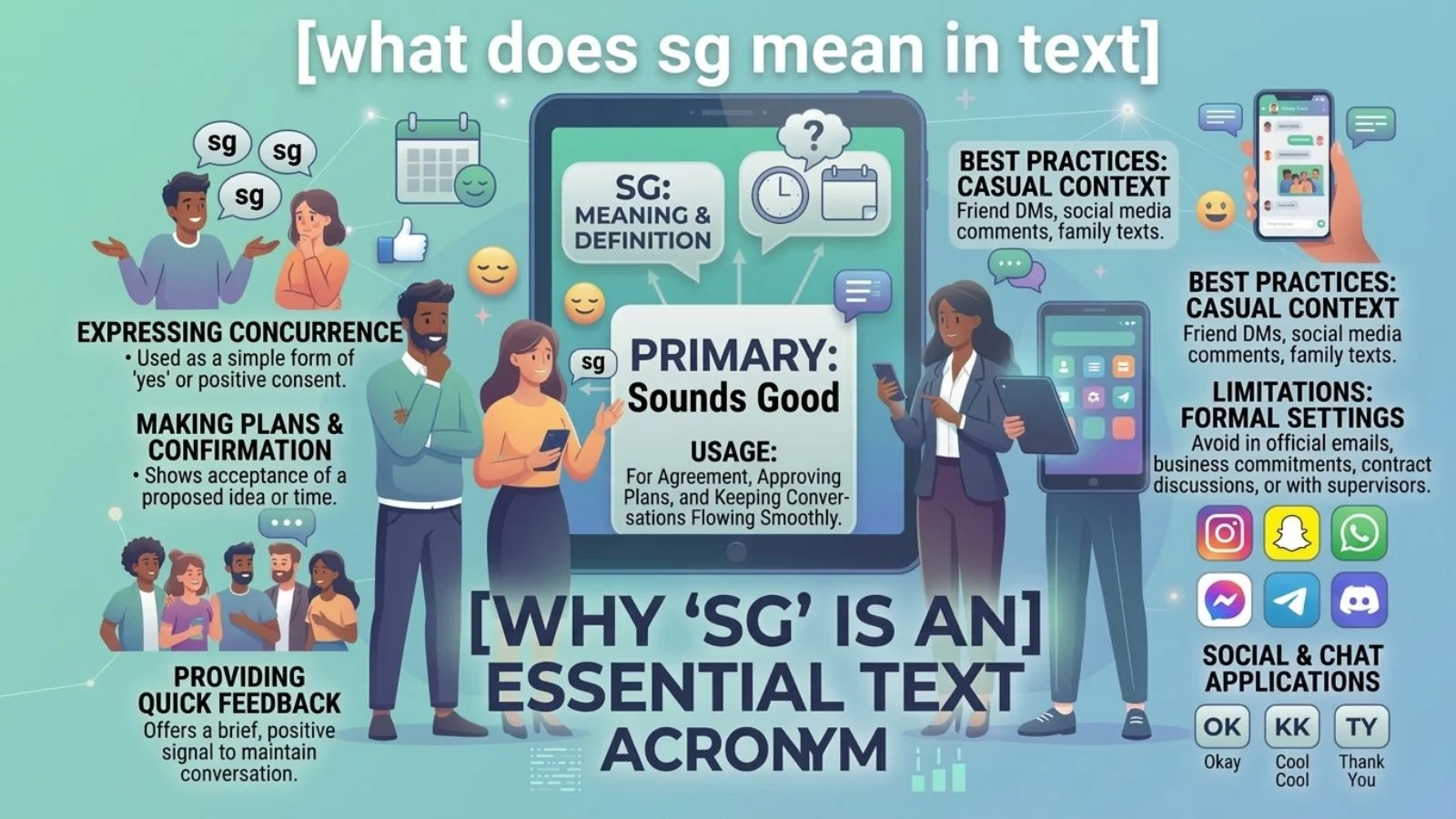
If someone texted you “sg” and you were not sure what they meant, you are not alone. Short forms can make a simple message confusing, especially when the same letters can have different meanings. In texting, SG can mean different things depending on the conversation and the person using it.
The most common meaning is often “sounds good,” especially when someone is agreeing with a plan or suggestion. However, SG can also stand for other phrases in different contexts. Understanding the surrounding message is the easiest way to figure out the intended meaning.
What Does SG Mean in Text?
In text messages and online conversations, SG most commonly means “sounds good.” People use it as a quick way to show that they agree with an idea, plan, suggestion, or arrangement.
For example:
“Want to meet at 7 tonight?”
“SG.”
Here, SG means “sounds good.” The person is saying that the proposed plan works for them.
However, SG does not always have one fixed meaning. Depending on the conversation, it can have other interpretations. That is why looking at the words around SG is important.
Simple Meaning of SG
In simple English, SG can mean “sounds good.”
It is similar to saying:
- “That works.”
- “Sure.”
- “Okay.”
- “I agree.”
- “That sounds good.”
- “I’m fine with that.”
It is usually a short and casual response.
For example:
Person 1: “I can send you the details later.”
Person 2: “SG.”
The second person is basically saying, “Sounds good.”
The abbreviation saves time and keeps the conversation relaxed.
Where Is SG Used in Texting?
You may see SG in many types of digital conversations. It is especially common when people are sending quick replies.
1. Text Messages
Friends may use SG when making plans or confirming something.
Example:
“I’ll pick you up around 6.”
“SG.”
The reply means the person agrees with the arrangement.
2. Social Media
SG can appear in comments, direct messages, or private conversations on social platforms.
Someone might suggest an idea and receive a short “sg” as a response.
3. Group Chats
In group conversations, people often use abbreviations because messages move quickly.
Example:
“Let’s order pizza tonight.”
“SG, I’m in.”
Here, SG means the suggestion sounds good.
4. Gaming Chats
Gamers often use short expressions because they need to communicate quickly.
Example:
“Meet at the next checkpoint?”
“SG.”
In this context, it can mean the player agrees with the plan.
5. Casual Online Conversations
SG can also appear in informal chats when someone wants to respond quickly without typing a full sentence.
Why Do People Use SG?
The main reason people use SG is convenience.
Typing “sounds good” takes more time than typing two letters. When the meaning is already clear from the conversation, an abbreviation can make the exchange faster.
People may use SG because:
- It is quick to type.
- It keeps conversations casual.
- It shows agreement.
- It avoids unnecessary words.
- It works well in fast-moving chats.
Think of it as a shortcut. Instead of writing a complete response, the person uses two letters to communicate the same basic idea.
Examples of SG in Text
The best way to understand SG is to see it in real conversations.
Example 1: Making Plans
Alex: “Want to grab coffee tomorrow?”
Sam: “SG. What time?”
Here, SG means “sounds good.” Sam agrees with the idea and then asks for more details.
Example 2: Confirming a Meeting
Mia: “Let’s meet outside the library at 4.”
Sara: “SG.”
The response means “Sounds good.”
Example 3: Agreeing With a Suggestion
Tom: “We could watch a movie after dinner.”
Jake: “SG.”
Jake is agreeing with the suggestion.
Example 4: A Casual Reply
Friend: “I’ll message you when I get home.”
You: “SG.”
This simply means that you are okay with the plan.
Example 5: Group Chat
Friend 1: “Should we start at 8?”
Friend 2: “SG.”
Friend 3: “Works for me too.”
Here, SG is being used as a quick agreement.
Example 6: Work-Related Chat
Coworker: “I’ll send the updated file this afternoon.”
You: “SG, thanks.”
In this case, SG means the arrangement is acceptable.
However, in professional communication, writing “Sounds good” may be clearer and more polished than using SG.
SG vs Similar Texting Terms
SG is close in meaning to several other casual expressions, but they are not always interchangeable.
| Term | Meaning | Common Use |
|---|---|---|
| SG | Sounds good | Agreeing with a suggestion |
| OK | Okay | General acknowledgment |
| Sure | Yes / Of course | Accepting a request |
| K | Okay | Very short acknowledgment |
| TY | Thank you | Showing thanks |
| NP | No problem | Responding to thanks or an issue |
| Lmk | Let me know | Asking someone to provide information |
For example, “SG” specifically suggests that you like or accept the idea being discussed.
If someone says:
“Let’s meet at 5.”
A response of “SG” directly communicates that the plan sounds acceptable.
When Should You Use SG?
You can use SG when you are having an informal conversation and want to quickly agree with something.
It works well when:
- A friend makes a plan.
- Someone suggests an activity.
- You are confirming an arrangement.
- You are chatting casually.
- You are responding quickly in a group chat.
For example:
“I’ll call you after dinner.”
“SG.”
That feels natural in a casual conversation.
When You Should Avoid SG
Although SG is useful in casual texting, it may not be the best choice everywhere.
Avoid abbreviations like SG when:
- You are writing a formal email.
- You are communicating with a client.
- You are submitting a professional document.
- The other person may not understand texting abbreviations.
- The conversation requires a very clear response.
Instead of:
“SG.”
You could write:
“Sounds good.”
This removes any possible confusion.
Common Misunderstandings About SG
One of the biggest problems with short forms is that the same abbreviation can have multiple meanings.
SG can refer to different words or phrases depending on the context, so you should not automatically assume it means “sounds good.”
For example, if someone sends:
“SG is my favorite place.”
The meaning may be completely different because the abbreviation could refer to a name, location, organization, or another phrase.
Context Matters
Look at the rest of the conversation before deciding what SG means.
Ask yourself:
- Is the person responding to a suggestion?
- Are you discussing plans?
- Are they agreeing with something?
- Does “sounds good” make sense in the sentence?
- Is SG being used as a name or abbreviation for something else?
If the person is responding to a suggestion, “sounds good” is often the most natural interpretation.
Can SG Mean Something Other Than “Sounds Good”?
Yes. This is important.
Text abbreviations do not always have one universal definition. SG can have different meanings in different communities, industries, games, countries, or conversations.
For example, SG may be used as an abbreviation for a proper name, organization, location, title, or another phrase.
That means you should not interpret SG based only on the two letters.
The surrounding conversation gives you the strongest clue.
If someone says:
“Do you want to meet at 6?”
“SG.”
“Sounds good” makes obvious sense.
But if someone says:
“I moved to SG last year.”
The intended meaning may be something completely different, depending on the conversation.
How to Reply When Someone Says SG
If someone sends you SG and means “sounds good,” you usually do not need a complicated response.
You can reply with:
- “Great.”
- “Perfect.”
- “Awesome.”
- “Okay.”
- “See you then.”
- “Sounds good.”
- “Thanks.”
Your response depends on what the conversation is about.
For example:
Friend: “SG, see you at 7.”
You: “Perfect, see you then.”
The conversation can move forward naturally without explaining the abbreviation.
SG in Lowercase vs Uppercase
You may see the abbreviation written as SG, sg, or sometimes Sg.
In casual texting, capitalization usually does not change the intended meaning.
For example:
“sg”
and
“SG”
can both mean “sounds good” when used as a quick agreement.
The context matters much more than capitalization.
Is SG Rude?
Usually, SG is not considered rude when it is clearly being used to mean “sounds good.”
However, very short replies can sometimes feel cold depending on the conversation.
Compare:
“SG.”
with:
“Sounds good! Thanks.”
The first response is much shorter and more neutral. The second feels warmer.
If you are talking to someone who expects a friendly or detailed response, adding a few words can make your message feel more natural.
Pro Tips for Understanding SG
If you see SG in a message and are unsure what it means, do not panic. Use the conversation as your guide.
1. Read the Previous Message
The message immediately before SG often gives you the answer.
If someone made a suggestion, “sounds good” is a strong possibility.
2. Look at the Tone
Casual conversations often use abbreviations. Formal conversations usually use complete words.
3. Do Not Assume One Meaning
SG can have multiple meanings. Context should always come first.
4. Ask If You Are Unsure
There is nothing wrong with asking:
“What do you mean by SG?”
A quick clarification is better than misunderstanding the conversation.
5. Match the Other Person’s Style
If your friend frequently uses abbreviations, SG may fit naturally into your conversation.
For professional communication, using the complete phrase is usually clearer.
FAQ: What Does SG Mean in Text?
What does SG mean in a text message?
SG most commonly means “sounds good” in casual texting. It is used to agree with a suggestion, plan, or idea. However, the exact meaning can change depending on the conversation.
Is SG short for “sounds good”?
Yes. In many casual text conversations, SG is used as a shortened form of “sounds good.”
For example:
“Want to meet at 6?”
“SG.”
The response means “Sounds good.”
Is SG the same as OK?
They can be similar, but they are not exactly the same. OK is a general acknowledgment, while SG usually expresses agreement with a suggestion or plan.
Should I use SG in professional messages?
It depends on the situation. In a casual work chat, SG may be understood, but in formal emails or client communication, writing “Sounds good” is usually clearer and more professional.
Final Thoughts
So, what does SG mean in text? In many casual conversations, SG means “sounds good.” It is a quick way to agree with a plan, suggestion, or idea without typing the full phrase.
Still, context matters because SG can have other meanings in different situations. Before interpreting it, look at the message around it and consider what the conversation is about.
When the context is a casual plan or suggestion, SG usually means that the person agrees and is happy with the idea.
Discover More Post
