Have you ever received a text that says “NBD” and wondered what the person actually meant? This short abbreviation is common in casual online conversations, but its meaning can feel unclear if you have never seen it before.
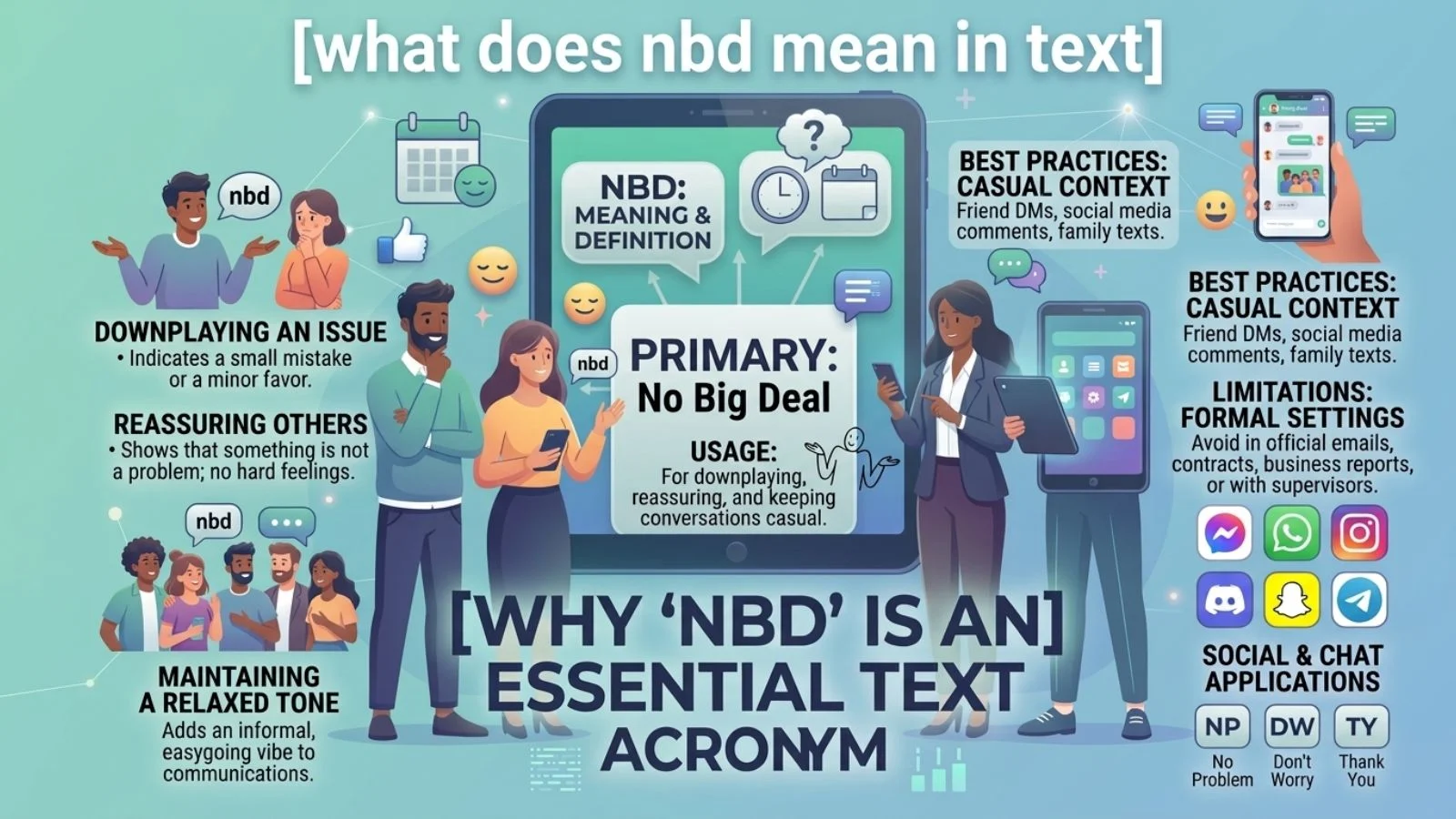
In most texts, NBD means “no big deal.” People use it to say that something is not important, serious, or worth worrying about. Depending on the conversation, it can sound relaxed, reassuring, or even slightly dismissive.
What Does NBD Mean in Text?
NBD means “no big deal” in text messages, chats, and social media conversations.
People usually use it when they want to say that something is not a problem, not important, or nothing to worry about.
For example:
“Sorry I forgot to reply earlier.”
“NBD, I was busy too.”
Here, NBD means “No big deal.” The person is saying they are not upset about the late reply.
This abbreviation is mostly used in informal communication, so it is more common in texts, DMs, comments, and casual chats than in formal writing.
Simple Meaning of NBD
The easiest way to understand NBD is:
NBD = No Big Deal = It is okay / It is not a problem / It is not important.
The exact feeling can change depending on the situation.
Someone might use NBD to:
- Reassure you
- Accept an apology
- Minimize a small problem
- Say something is not important
- Show that they are relaxed about a situation
- Avoid making a small issue seem serious
For example:
“I accidentally sent you the wrong file.”
“NBD. Just send the right one.”
In this case, NBD means the mistake is not a serious problem.
Where Is NBD Used?
You can see NBD in many forms of casual digital communication.
Text Messages
Friends and family often use NBD when talking about small mistakes, delays, or inconveniences.
Example:
“Sorry, I’m 10 minutes late.”
“NBD. Take your time.”
Social Media
NBD can also appear in comments, captions, replies, and direct messages.
Someone might jokingly write:
“Just met my favorite singer. NBD.”
Here, the phrase can be humorous because the person is pretending that meeting a famous singer is not a big deal.
Online Chats
Gaming communities, group chats, and other online conversations may also use NBD.
Example:
“I lost the match, but NBD. We can play again.”
Casual Conversations
Although NBD is an abbreviation, people sometimes say “no big deal” in spoken conversation. The shortened form is especially common when typing.
Why Do People Use NBD?
There are several reasons people use NBD instead of writing “no big deal.”
It Saves Time
Texting often involves short words and abbreviations. Writing NBD is quicker than typing the complete phrase.
It Keeps the Conversation Casual
NBD has a relaxed tone. It can make a response sound friendly and informal.
It Reassures Someone
If someone feels bad about a small mistake, saying NBD can let them know that everything is okay.
For example:
“Sorry I forgot to bring your book.”
“NBD. You can bring it tomorrow.”
It Downplays a Situation
Sometimes people use NBD to show that something does not deserve much attention.
“I missed one question on the quiz. NBD.”
The speaker is saying that the mistake is not worth worrying about.
NBD Meaning in Different Situations
The meaning is generally the same, but the tone can change depending on context.
NBD as Reassurance
Someone may use it to make you feel less worried.
“Sorry I broke your pen.”
“NBD. I have another one.”
Here, NBD sounds forgiving and reassuring.
NBD as a Casual Response
It can simply mean that something does not bother the person.
“I can’t come tonight.”
“NBD. Maybe next time.”
NBD as Humor
NBD can also be used sarcastically or humorously.
“I just won a huge award. NBD.”
The person obviously knows that winning the award is a big deal. They are using NBD as a joke.
NBD as Dismissal
Sometimes NBD can sound like the person is brushing something aside.
“You didn’t answer my question.”
“NBD.”
Depending on the relationship and previous conversation, this might sound less friendly than intended.
That is why context matters.
Real-Life Examples of NBD in Text
Here are some natural examples of how people may use NBD in everyday messages.
Example 1: Late Reply
Person A: Sorry for replying so late.
Person B: NBD. I was busy too.
Meaning: The late reply is not a problem.
Example 2: Small Mistake
Person A: I accidentally deleted the message.
Person B: NBD. Just send it again.
Meaning: The mistake is not serious.
Example 3: Cancelled Plans
Person A: I can’t make it today.
Person B: NBD. We can meet tomorrow.
Meaning: The cancellation is okay.
Example 4: Asking for Help
Person A: Can you send me those notes again?
Person B: NBD. I’ll send them now.
Meaning: The person does not mind helping.
Example 5: Humorous Use
Person A: I got front-row seats!
Person B: NBD.
Meaning: Depending on the tone, this may be playful sarcasm rather than a serious statement that the seats are unimportant.
NBD vs Similar Terms
Several texting expressions can have meanings close to NBD, but they are not always interchangeable.
| Texting Term | Meaning | Typical Use |
|---|---|---|
| NBD | No big deal | Something is not a problem or not important |
| NP | No problem | Responding to a request, favor, or apology |
| DW | Don’t worry | Reassuring someone |
| IDC | I don’t care | Showing a lack of concern or interest |
| IK | I know | Showing that you already know something |
| It’s okay | Everything is fine | Reassuring someone |
| All good | Everything is fine | Casual reassurance |
NBD vs NP
NBD means “no big deal.”
NP usually means “no problem.”
They can be similar, but NP is often used as a direct response to a request or apology.
“Can you help me with this?”
“NP.”
Meanwhile:
“Sorry I forgot to call.”
“NBD.”
Both responses are casual, but their emphasis is slightly different.
NBD vs DW
DW means “don’t worry.”
It focuses more directly on someone’s concern.
“Sorry I made a mistake.”
“DW, NBD.”
These two abbreviations can even appear together.
When Should You Use NBD?
NBD works best in casual conversations with people who understand texting abbreviations.
You can use it when:
- A friend apologizes for something minor
- Someone is worried about a small mistake
- You want to say something is not important
- Plans change and you are okay with it
- Someone thinks they have inconvenienced you
- You want a short, relaxed response
For example:
“Sorry I couldn’t call earlier.”
“NBD. Call whenever you’re free.”
This sounds natural in a casual conversation.
When Should You Avoid NBD?
Although NBD is common online, it is not appropriate for every situation.
Avoid using it in formal emails, professional documents, academic assignments, or serious conversations unless the context is very casual.
For example, instead of writing:
“NBD, I’ll fix the report.”
in a professional email, you could write:
“No problem. I’ll correct the report.”
The full phrase is clearer and more professional.
You should also be careful when discussing something that is genuinely important to another person. Saying NBD may accidentally make their concern feel unimportant.
Common Misunderstandings About NBD
NBD Does Not Always Mean the Person Is Completely Unbothered
Usually, NBD means the person considers something minor. However, tone and context matter.
Someone could say:
“Yeah, NBD.”
while actually sounding annoyed, especially if the conversation has already become tense.
Text messages do not include facial expressions or voice tone, so short abbreviations can sometimes be misunderstood.
NBD Does Not Mean “I Don’t Care” in Every Situation
Some people may interpret NBD as “I don’t care,” but that is not always accurate.
NBD usually means:
“This isn’t a big problem.”
IDC means:
“I don’t care.”
Those expressions can communicate very different attitudes.
NBD Can Be Sarcastic
If someone says:
“I just bought a new house. NBD.”
they may be joking.
The literal meaning says it is not a big deal, while the context suggests the opposite.
How to Understand NBD From Context
If someone sends you NBD, look at the message before it.
Ask yourself:
- Were you apologizing?
They probably mean that everything is okay. - Did you make a small mistake?
They may be saying it is not important. - Were you talking about an achievement?
They might be using NBD humorously. - Was the conversation already tense?
The abbreviation could sound dismissive. - Did they use extra punctuation or emojis?
These can sometimes provide clues about their intended tone.
The words alone do not always tell you the full meaning.
Pro Tips for Using NBD
If you want your texting to sound natural, keep these tips in mind.
1. Use It With the Right Audience
NBD is best for friends, family, classmates, and casual online conversations.
2. Consider the Situation
If someone is discussing a serious personal problem, NBD may sound insensitive.
3. Pay Attention to Tone
Short replies can sometimes sound colder than you intended. If you want to sound warmer, use a longer response.
Instead of:
“NBD.”
you could write:
“No big deal at all. Don’t worry about it.”
4. Do Not Overuse It
Using the same abbreviation in every conversation can make your messages feel repetitive.
5. Remember That Context Changes Meaning
NBD can be sincere, casual, reassuring, or humorous. Always consider the complete conversation.
Is NBD Positive or Negative?
NBD is usually neutral to positive, especially when someone uses it to reassure another person.
For example:
“Sorry I forgot your birthday.”
“NBD. I know you’ve been busy.”
This is clearly reassuring.
However, the same abbreviation can feel negative if someone uses it to dismiss an issue that matters to you.
That is why tone and context are more important than the abbreviation itself.
NBD in Social Media and Internet Culture
Short abbreviations like NBD became popular as online communication developed. People often shorten common phrases because quick messages are easier to type and understand.
NBD fits naturally into the same casual style as abbreviations such as LOL, BTW, IDK, TBH, and NP.
On social media, it can also be used for humor. Someone might describe an impressive achievement and then add “NBD” to make the statement sound deliberately casual.
For example:
“Finished my first marathon today. NBD.”
The phrase can make the post feel playful because the achievement is clearly significant to the person.
What Should You Reply to NBD?
Your response depends on the original conversation.
If someone says:
“NBD.”
you can simply continue the conversation.
For example:
“Thanks, I appreciate it.”
Or:
“Okay, thanks!”
If they are reassuring you after an apology, you might say:
“Glad we’re good.”
There is no special response required. NBD is usually a casual phrase, not a question.
Final Thoughts
So, what does NBD mean in text? In most cases, it means “no big deal.” People use it to say that something is not a serious problem, does not matter much, or is nothing to worry about.
You will usually see NBD in texts, DMs, social media comments, group chats, and other casual conversations. It can be reassuring, relaxed, or humorous depending on the context.
The most important thing is to pay attention to the conversation around it. A simple “NBD” can mean “you’re fine,” “don’t worry about it,” or even be a playful joke.
FAQ About NBD
What does NBD stand for in texting?
NBD stands for “no big deal.” It is a casual abbreviation used to say that something is not important, serious, or worth worrying about.
Is NBD rude?
Usually, NBD is not rude. It is often used in a friendly and reassuring way. However, it can sound dismissive if someone uses it to minimize an issue that another person considers important.
What is the difference between NBD and NP?
NBD means “no big deal,” while NP usually means “no problem.” Both can be reassuring, but NBD focuses on how unimportant or minor something is, while NP often responds to a request, favor, or apology.
Can NBD be used sarcastically?
Yes. Someone can use NBD sarcastically or humorously, especially after mentioning an impressive achievement. The surrounding context helps determine whether the person is being serious or joking.
Discover More Post
