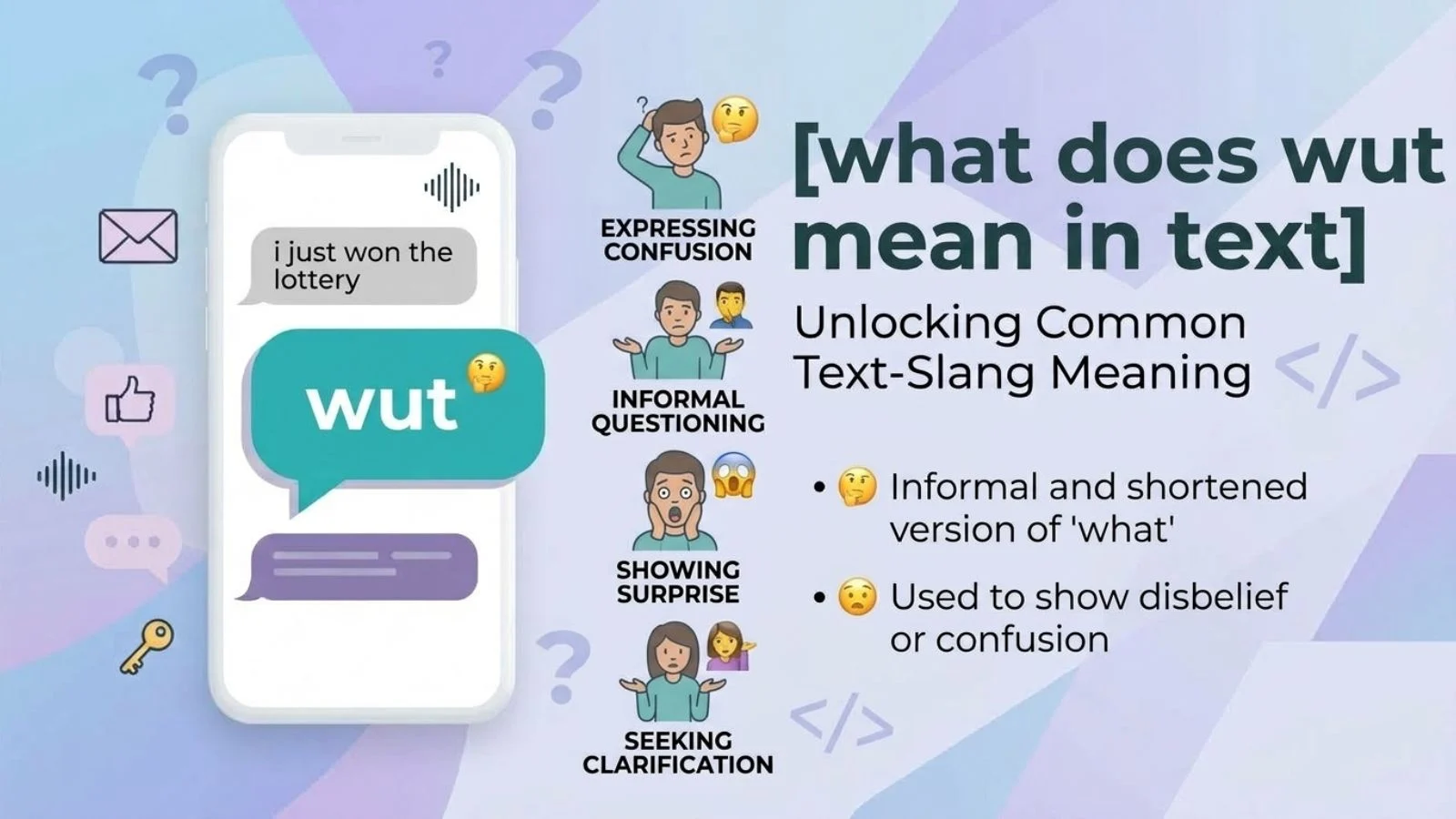
If you see “wut” in a text, chat, comment, or gaming message, it usually means “what.” It is an informal and playful spelling of the standard English word “what.” People use it to show confusion, surprise, disbelief, curiosity, or humor.
For example, if a friend says, “I just bought a car for $10,” you might reply, “Wut?” You are basically saying, “What?” or “Are you serious?”
The spelling is different, but the basic meaning stays the same. The main difference is tone. “What?” can sound normal or neutral, while “wut?” often feels more casual, funny, dramatic, or surprised.
You may see wut in text messages, social media comments, online games, forums, memes, and other casual digital spaces. It is generally not considered standard English, so it is better to use “what” in school, business, academic writing, and professional emails.
What Does Wut Mean in Text?
Wut means “what” in texting and online communication. It is a nonstandard spelling that people use to make a message sound more relaxed, playful, confused, surprised, or dramatic.
The exact feeling depends on the conversation.
For example:
Friend: I finished the whole project in one hour.
You: Wut?
Here, “wut?” shows surprise or disbelief. You may really mean, “What? How did you do that so fast?”
In another conversation:
Friend: Wut are you doing tonight?
Here, “wut” simply replaces “what.” The sentence means, “What are you doing tonight?”
So, the meaning is usually simple. The unusual spelling mainly adds personality and tone.
Quick Meaning of Wut
| Term | Meaning | Common Tone |
|---|---|---|
| wut | what | Casual |
| wut? | what? | Confused or curious |
| WUT?! | what?! | Shocked or surprised |
| wut lol | what, seriously? | Funny or playful |
| wuttt | what?! | Dramatic or exaggerated |
The spelling can change the feeling without changing the basic meaning.
Is Wut Slang or an Acronym?
Wut is generally internet slang or an informal spelling, not an acronym.
An acronym is usually made from the first letters of several words. For example, LOL means “laugh out loud,” and BRB means “be right back.”
“Wut” does not normally work that way. It is simply a stylized version of “what.”
So, if someone asks, “What is the full form of wut?” the simplest answer is:
Wut = What
There is usually no hidden phrase behind the three letters.
This is important because people sometimes assume that every short internet term is an abbreviation. In this case, it is better to think of wut as an intentionally altered spelling.
Where Did Wut Come From?
The exact origin of “wut” is difficult to trace to one person, website, or exact year. Like many internet expressions, it developed gradually through informal online communication.
Sources on internet language connect the spelling with older online forums, gaming communities, chat rooms, and meme culture. The term became especially common in online spaces where users wanted quick and humorous ways to react to strange or unexpected statements.
Early internet users often changed the spelling of common words. Sometimes they wanted to type faster. Other times, the unusual spelling itself was part of the joke.
For example, instead of:
What?!
someone might write:
Wut?!
The second version looks more informal and exaggerated.
There is no strong evidence that one specific person officially “invented” wut. It is safer to describe it as an evolution of internet writing rather than give it one exact origin date.
Why Did People Start Using Wut?
Online conversations do not have facial expressions, voice tone, or body language. Because of this, people often change spelling and punctuation to show emotion.
Compare these:
What?
This can sound neutral.
Wut?
This feels more casual or playful.
WUT?!
This looks much more shocked or dramatic.
That small spelling change can help the reader understand the writer’s reaction.
What Feelings Can Wut Express?
The word wut can express different feelings. Context is very important.
1. Confusion
Someone may type “wut” when they do not understand what another person said.
Example:
A: The meeting is tomorrow, but yesterday was tomorrow.
B: Wut?
The reply shows that B is confused by the statement.
2. Surprise
“Wut” can also show that something is unexpected.
Example:
A: I won a free trip to Japan.
B: Wut?! Seriously?
Here, the word expresses strong surprise.
3. Disbelief
Sometimes “wut” means that someone finds a statement hard to believe.
Example:
A: I finished the entire book in 20 minutes.
B: Wut?
B probably thinks the claim sounds unbelievable.
4. Curiosity
A person may use “wut” simply because they want more information.
Example:
A: Something happened at work today.
B: Wut happened?
The person is asking for an explanation.
5. Humor
Friends can use “wut” as a funny reaction.
Example:
A: My cat opened the kitchen door by itself.
B: Wut lol.
The response is playful rather than seriously confused.
6. Mild Sarcasm
“Wut” can sometimes sound sarcastic when someone says something obvious or strange.
Example:
A: I forgot my umbrella, so I got wet in the rain.
B: Wut?
The person may be joking because the result was obvious.
Wut vs. What: What Is the Difference?
The basic meaning of wut and what is usually the same, but the tone can be different.
| Word | Meaning | Tone | Best Use |
|---|---|---|---|
| What | Standard question word | Neutral | Almost anywhere |
| Wut | Informal form of what | Casual/playful | Texts and casual chats |
| Huh? | Asking for clarification | Informal | Casual conversation |
| Wat | Informal spelling of what | Casual/funny | Internet conversations |
| WTF | Strong reaction to something shocking | Very informal | Casual contexts only |
For example:
What?
This is the normal English form.
Wut?
This sounds more like internet slang.
Huh?
This can sound like you did not understand or hear something.
WTF?
This is much stronger and contains profanity, so it should not be treated as a simple replacement for “what.”
Wut vs. Wat
You may also see “wat” online.
Both wut and wat can be informal spellings of “what.” They are often used for confusion, surprise, humor, or disbelief.
For example:
Wat is happening?
and
Wut is happening?
Both are understandable as informal versions of:
What is happening?
The exact spelling can depend on the online community and the writer’s personal style.
How Is Wut Used in Text Messages?
There are several common ways people type wut.
“Wut?”
This is probably the simplest form.
It usually means:
- What?
- What do you mean?
- Can you explain?
- I do not understand.
Example:
A: I quit my job yesterday.
B: Wut?
B is surprised and wants more information.
“Wut?!”
The question mark and exclamation mark make the reaction stronger.
Example:
A: I met my favorite singer today.
B: WUT?!
This shows excitement and surprise.
“Wut lol”
This version usually sounds lighter.
Example:
A: My brother tried to cook and burned the toast.
B: Wut lol.
The person is amused by the situation.
“Wut are you doing?”
Here, “wut” simply replaces “what.”
Example:
**Wut are you doing tonight?
The standard version is:
What are you doing tonight?
The meaning does not really change.
“Wut happened?”
This means:
What happened?
It can show curiosity or concern, depending on the conversation.
Wut in Social Media Comments
You may see wut in comments when someone reacts to something strange, funny, unexpected, or confusing.
For example:
Video caption: My dog learned how to open the refrigerator.
Comment: Wut?
The commenter is expressing surprise.
Another example:
Post: I found $100 in an old jacket.
Comment: WUT?!
The capital letters and punctuation make the reaction stronger.
On social media, spelling can become part of a person’s online voice. A deliberately unusual spelling may make a comment feel more expressive than a standard sentence.
Wut in Gaming Chats
Gaming is another place where short reactions are common.
Players often have to communicate quickly, so short words and slang can be useful.
Example:
Player 1: The boss just disappeared.
Player 2: Wut?
Player 2 is confused about what happened.
Another example:
Player 1: I won with one health point.
Player 2: WUT?!
Here, the response shows strong surprise.
The meaning is still basically “what?”, but the context makes the emotion clear.
Wut in Memes and Internet Humor
Internet memes often use strange or intentionally incorrect spelling for humor.
Because wut looks different from normal English, it can make a reaction seem exaggerated.
For example:
Someone: I ate an entire pizza by myself.
Reply: Wut.
The short response can make the situation sound funny or unbelievable.
In meme culture, spelling does not always follow formal grammar rules. The unusual spelling may actually be the point.
What Does Wut Say About the Person’s Tone?
A person’s use of wut can give clues about their communication style, but it should not be used to judge their personality by itself.
Someone who writes “wut” may simply prefer casual internet language.
The word can suggest that the writer wants the conversation to feel:
- Relaxed
- Playful
- Funny
- Informal
- Surprised
- Dramatic
- Confused
- Lighthearted
However, context matters more than the spelling.
For example, “wut lol” between friends may be playful. The same word during a serious argument could sound dismissive or sarcastic.
Is Wut Rude?
Wut is not automatically rude.
Its tone depends on the situation, relationship, punctuation, and message around it.
Compare these examples:
Friend: I just got accepted into college!
You: Wut?! That’s amazing!
This sounds excited and supportive.
Now consider:
Person: I worked on this project all night.
Reply: Wut?
This could sound confused, but in some situations it might also seem dismissive.
If someone is upset, using playful slang may not always be the best choice.
The safest approach is to read the whole conversation before deciding what “wut” means emotionally.
Common Mistakes and Misunderstandings
Mistake 1: Thinking Wut Is a Formal English Word
“Wut” is not the standard spelling of “what.”
Use what in formal writing.
Mistake 2: Thinking Wut Is an Acronym
It usually is not an acronym.
It is an informal spelling of what.
Mistake 3: Assuming Wut Always Means Shock
Not every “wut” means someone is shocked.
It can simply mean “what?” or “what do you mean?”
Mistake 4: Assuming It Is Always Rude
The word itself is not automatically rude.
The surrounding conversation determines the tone.
Mistake 5: Using Wut in Formal Messages
Avoid it in:
- Job applications
- Professional emails
- School assignments
- Academic papers
- Business reports
- Official documents
Instead of:
Wut do you mean?
write:
What do you mean?
When Should You Use Wut?
Use wut when the conversation is casual and the other person is comfortable with internet slang.
It can work well with:
- Close friends
- Casual text messages
- Gaming chats
- Social media comments
- Meme conversations
- Informal group chats
For example:
Friend: Guess what?
You: Wut?
This sounds natural in a casual conversation.
However, if you are speaking to a teacher, manager, client, interviewer, or professional contact, standard English is usually better.
When Should You Avoid Wut?
Avoid wut when you need to sound clear, respectful, or professional.
For example, do not write:
Wut time is the interview?
A better professional version is:
What time is the interview?
Similarly, instead of:
Wut do you need from me?
use:
What do you need from me?
The standard version is clearer and more appropriate.
Modern Examples of Wut in 2026
In 2026, casual digital communication continues to use altered spellings and short reaction words. Current explanations of wut still describe it mainly as an informal form of “what,” especially when expressing confusion, surprise, disbelief, or humor.
Here are some relatable examples.
Example 1: Unexpected News
A: I got tickets for the concert.
B: WUT?!
Meaning: B is extremely surprised and excited.
Example 2: Confusing Message
A: I will meet you after the thing.
B: Wut thing?
Meaning: B wants the other person to explain what they mean.
Example 3: Funny Situation
A: My little brother put cereal in the fridge.
B: Wut lol.
Meaning: B thinks the situation is strange and funny.
Example 4: Surprise Purchase
A: I bought a new laptop today.
B: Wut? Already?
Meaning: B is surprised that the purchase happened so quickly.
Example 5: Social Media Reaction
Post: I woke up at 4 a.m. and decided to clean the whole house.
Comment: Wut?
Meaning: The commenter finds the situation unusual.
Example 6: Gaming
Player A: I defeated the final boss with my weakest character.
Player B: WUT?!
Meaning: Player B is shocked by the unexpected result.
How Should You Reply to “Wut?”
Your response depends on what the person is asking.
If they are confused, explain:
“I mean that the meeting was moved to Friday.”
If they are surprised, give more information:
“Yes, I really got the tickets yesterday.”
If they are joking, you can joke back:
“Yep. You heard me.”
If you are not sure what they mean, ask:
“What part confused you?”
You do not need to copy their slang. A normal reply is perfectly fine.
Wut and Punctuation: Why It Matters
Punctuation can change the emotional strength of the message.
| Version | Possible Tone |
|---|---|
| wut | Casual reaction |
| wut? | Confusion or curiosity |
| wut?! | Shock or disbelief |
| WUT?! | Very strong surprise |
| wut lol | Amusement |
| wuttt | Dramatic or playful |
These meanings are not fixed rules. They are common interpretations based on online writing style.
The conversation always matters.
Is Wut Still Used in 2026?
Yes. Wut continues to appear in casual internet communication, including text messages, comments, gaming conversations, memes, and online chats. Current 2026 references describe it as an informal spelling of “what.”
However, internet slang changes quickly. Some expressions become popular for a short time and then disappear, while others remain useful because they are easy to understand.
“Wut” has stayed recognizable because it is very close to the standard word “what.”
Even someone who has never used the slang may understand what the writer means from the context.
Wut vs. Similar Internet Expressions
Here is a simple comparison:
| Expression | Basic Meaning | Common Feeling |
|---|---|---|
| Wut | What? | Casual confusion or surprise |
| Huh? | What? / I don’t understand | Confusion |
| What? | What? | Neutral |
| Wat | What? | Informal or humorous |
| WTF? | What the heck? | Strong shock or disbelief |
| IDK | I don’t know | Uncertainty |
| FR? | For real? | Surprise or disbelief |
These terms are not perfect replacements for one another. The strength and tone can be different.
Frequently Asked Questions
1. What does wut mean in text?
Wut usually means “what.” It is an informal spelling commonly used in texts, online chats, social media, gaming, and memes. Depending on context, it can show confusion, surprise, disbelief, curiosity, or humor.
2. Is wut a real word?
“Wut” is used as an internet slang form of “what,” but it is not the standard spelling used in formal English. It is best treated as an informal digital expression.
3. Is wut an acronym?
No. Wut is generally not an acronym. It is a stylized spelling of the word “what.” Unlike LOL or BRB, its letters do not normally represent several separate words.
4. What does “wut?” mean?
“Wut?” usually means “What?” Depending on the conversation, it may also mean “What do you mean?”, “I don’t understand,” or “Are you serious?”
5. What does “WUT?!” mean?
“WUT?!” usually shows a stronger reaction. It can express shock, disbelief, excitement, or extreme surprise. The capital letters and punctuation make the reaction look more dramatic.
6. Is wut rude?
Not necessarily. Wut can be friendly, funny, confused, or surprised. However, its tone can feel rude or dismissive in some serious conversations. Always consider the context and relationship between the people.
7. Can I use wut in a professional email?
It is better to use “what” in professional emails, job applications, schoolwork, academic writing, and business communication. “Wut” is mainly suitable for casual digital conversations.
Final Thoughts
Wut usually means “what” in text. It is an informal spelling that can make a message feel more casual, playful, confused, surprised, or dramatic. You may see it in texts, social media comments, gaming chats, memes, and other online conversations. The punctuation and surrounding words can help you understand the exact tone. While “wut” works well with friends and in casual chats, “what” is better for school, work, and professional writing. Once you understand the context, this simple internet expression is easy to recognize and use.
If you enjoy learning the meaning of modern texting words and internet slang, keep exploring our language guides to understand more of the expressions people use online in 2026.
Discover More post
